Loading...
Done
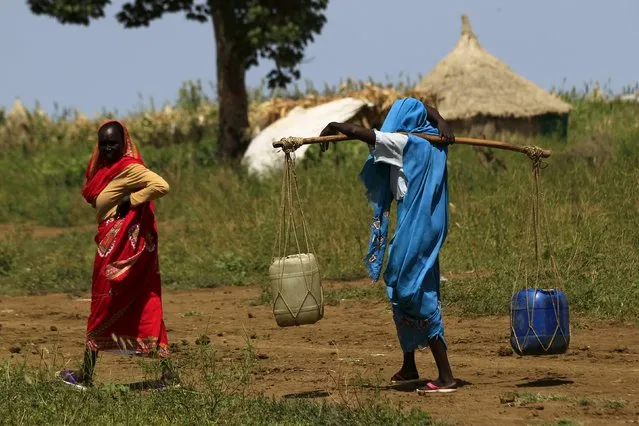
A woman carries water during during a visit by a European Union delegation, at an IDP camp in Azaza, east of Ad Damazin, capital of Blue Nile state, October 21, 2015. (Photo by Mohamed Nureldin Abdallah/Reuters)

A woman carries water during during a visit by a European Union delegation, at an IDP camp in Azaza, east of Ad Damazin, capital of Blue Nile state, October 21, 2015. The camp houses people displaced by war between the Sudan People's Liberation Movement-North (SPLM-N) rebels and the Sudanese government. (Photo by Mohamed Nureldin Abdallah/Reuters)
Details
24 Oct 2015 08:04:00
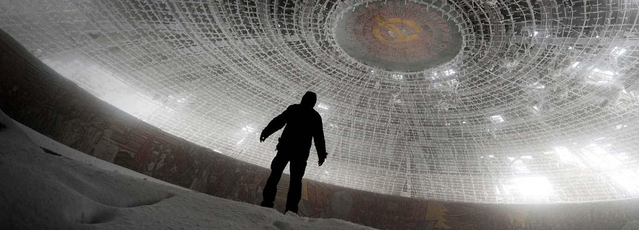
Monument of Buzludja

Buzludzha is a historical peak in the Central Stara Planina, Bulgaria and is 1441 metres high. In 1868 it was the place of the final battle between Bulgarian rebels led by Hadji Dimitar and Stefan Karadzha and the Ottoman Empire. The Buzludzha Monument on the peak was built by the Bulgarian communist regime to commemorate the events in 1891 when the socialists led by Dimitar Blagoev assembled secretly in the area to form an organised socialist movement with the founding of the Bulgarian Social Democratic Party, a fore-runner of the Bulgarian Communist Party. The Monument was opened in 1981. No longer maintained by the Bulgarian government, it has fallen into disuse. Buzludzha is reached by a 12 km side road from the Shipka Pass.
Details
12 Nov 2013 08:16:00

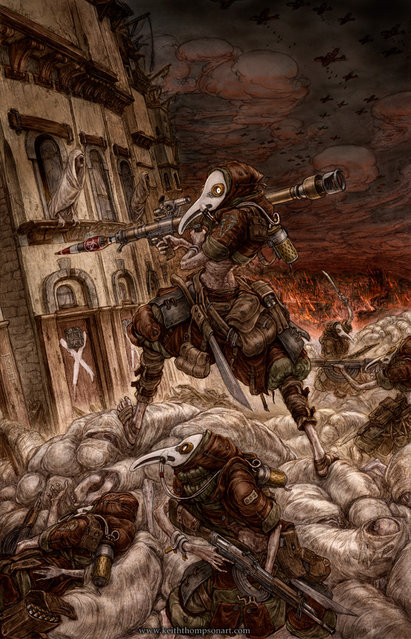
VIRAEMIA

The civilised world lies on its knees, a sickness wracking its body. The affliction causes a necrotising of tissues so perfectly uniform in distribution that victims take on the appearance of corpses long before death occurs due to organ failure or secondary infections. ...
Details
03 May 2012 22:54:00
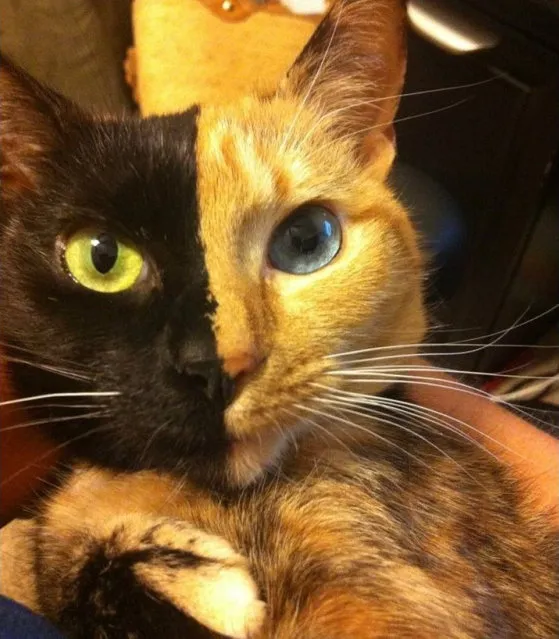
Venus the Chimera Cat

Venus is not necessarily a chimera, or an animal whose cells contain two sets of DNA caused when two embryos fuse together during development. But to find out for sure whether or not Venus is a chimera, she’d need to perform genetic testing.
Details
24 Oct 2012 08:58:00
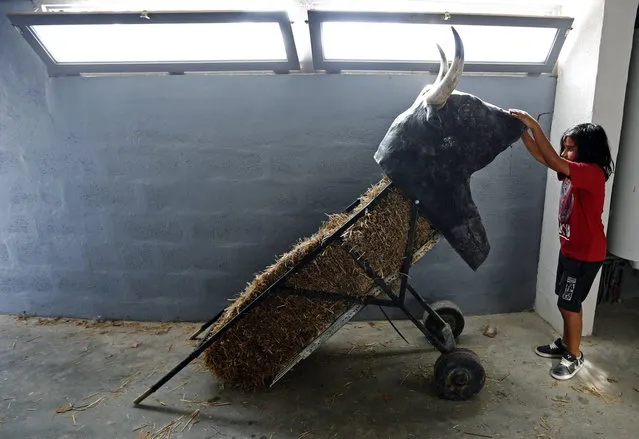
Nino, a ten-year-old toreador apprentice of the French Tauromachy Centre, nicknamed El Nino, touches a practice bull at the bullring of Garons, near Nimes, September 25, 2013. (Photo by Jean-Paul Pelissier/Reuters)

Nino, a ten-year-old toreador apprentice of the French Tauromachy Centre, nicknamed El Nino, touches a practice bull at the bullring of Garons, near Nimes, September 25, 2013. Since 1983, the French Tauromachy Centre in Nimes has trained some 1,000 youths in the art of bullfighting. Twenty of them have gone on to become professional matadors, facing fighting bulls in the arena. Twice a week, students take courses with a matador to learn the movements and gestures of the bullfighter in the ring, but without an animal present. Students train with calves in the surrounding fields during spring, and regularly participate in beginner's bullfights (becerradas) without killing calves. Solal has been taking courses for three years and Nino, for just a year now. Both are normally enrolled in French public schools, but have one thought in mind – bullfighting. They share a passion linked to the city of Nimes, famous for its ferias and bullring. (Photo by Jean-Paul Pelissier/Reuters)

Details
06 Nov 2013 10:12:00
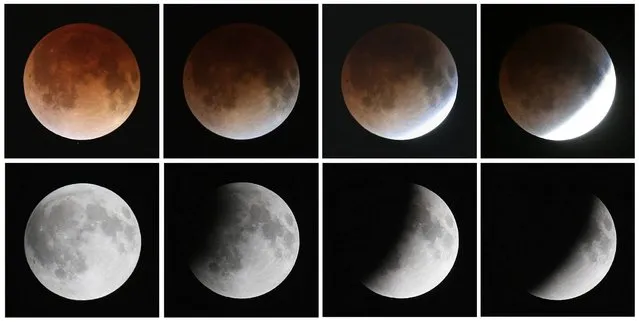
This composite image shows a sequence, from bottom left to top left, of the moon's transition during a total lunar eclipse on April 15, 2014 in Miami, Florida. People in most of north and south America should be able to witness this year's first total lunar eclipse, which will cause a “blood moon” and is the first of four in a rare Tetrad of eclipses over the next two years. (Photo by Joe Raedle/Getty Images)

This composite image shows a sequence, from bottom left to top left, of the moon's transition during a total lunar eclipse on April 15, 2014 in Miami, Florida. People in most of north and south America should be able to witness this year's first total lunar eclipse, which will cause a “blood moon” and is the first of four in a rare Tetrad of eclipses over the next two years. (Photo by Joe Raedle/Getty Images)
Details
15 Apr 2014 14:28:00
On August 31, 2012, a long filament of solar material that had been hovering in the sun's atmosphere, the corona, erupted out into space at 4:36 p.m. EDT. The coronal mass ejection, or CME, traveled at over 900 miles per second. The CME did not travel directly toward Earth, but did connect with Earth's magnetic environment, or magnetosphere, causing aurora to appear on the night of Monday, September 3. (Photo by NASA/GSFC/SDO)

On August 31, 2012, a long filament of solar material that had been hovering in the sun's atmosphere, the corona, erupted out into space at 4:36 p.m. EDT. The coronal mass ejection, or CME, traveled at over 900 miles per second. The CME did not travel directly toward Earth, but did connect with Earth's magnetic environment, or magnetosphere, causing aurora to appear on the night of Monday, September 3. (Photo by NASA/GSFC/SDO via The Atlantic)
Details
14 Sep 2012 09:01:00
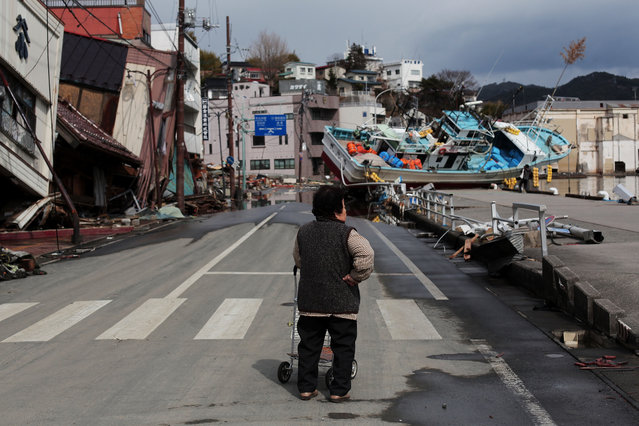
A woman surveys the damage after the earthquake on March 17, 2011 in Kensennuma, Japan. Residents were allowed back to their homes today and began the massive cleanup operation caused by a 9.0 magnitude strong earthquake that struck on March 11 off the coast of north-eastern Japan. The quake triggered a tsunami wave of up to 10 metres which engulfed large parts of north-eastern Japan. The death toll has risen past 5000 with at least 8600 people still missing. (Photo by Chris McGrath/Getty Images)

A woman surveys the damage after the earthquake on March 17, 2011 in Kensennuma, Japan. Residents were allowed back to their homes today and began the massive cleanup operation caused by a 9.0 magnitude strong earthquake that struck on March 11 off the coast of north-eastern Japan. The quake triggered a tsunami wave of up to 10 metres which engulfed large parts of north-eastern Japan. The death toll has risen past 5000 with at least 8600 people still missing. (Photo by Chris McGrath/Getty Images)
Details
13 Mar 2017 00:05:00