Loading...
Done
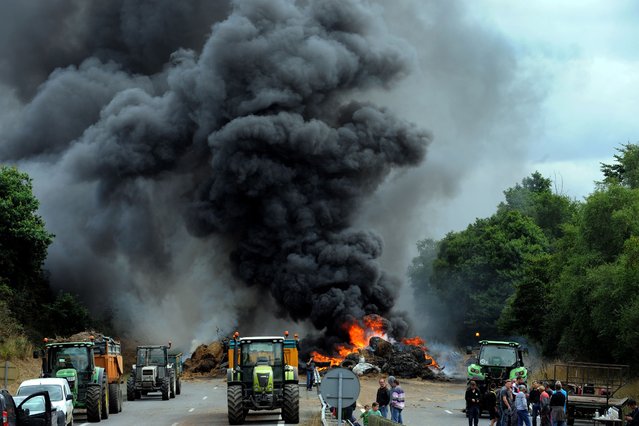
Farmers use tractors and burn tires, hay and manure as they block the highway between Morlaix and Brest during a demonstration against the market prices of their product, on July 22, 2015 in Morlaix, western of France. French farmers protesting over falling food prices threatened to step up blockades of cities, roads and tourist sites, as the government prepared to unveil emergency aid for them. (Photo by Fred Tanneau/AFP Photo)

Farmers use tractors and burn tires, hay and manure as they block the highway between Morlaix and Brest during a demonstration against the market prices of their product, on July 22, 2015 in Morlaix, western of France. French farmers protesting over falling food prices threatened to step up blockades of cities, roads and tourist sites, as the government prepared to unveil emergency aid for them. Farmers have dumped manure in cities, blocked access roads and motorways and hindered tourists from reaching Mont St-Michel in northern France, one of France's most visited sites. (Photo by Fred Tanneau/AFP Photo)
Details
23 Jul 2015 10:39:00
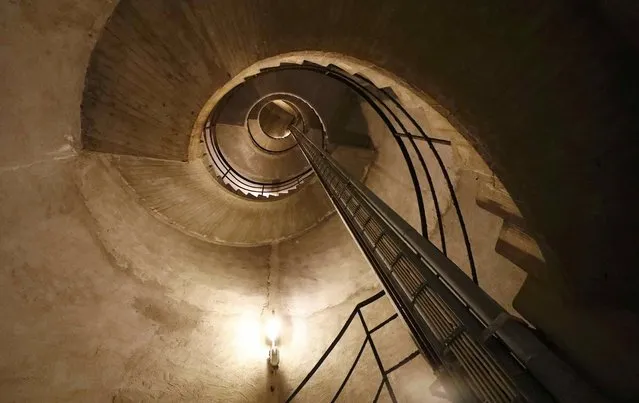
A 20 metre high spiral staircase in a tower used as an emergency exit, is seen inside a Federal Reserve bank (Bundesbank) bunker, prior to the bunker's official opening to the public in Cochem, Germany, March 18, 2016. (Photo by Kai Pfaffenbach/Reuters)

A 20 metre high spiral staircase in a tower used as an emergency exit, is seen inside a Federal Reserve bank (Bundesbank) bunker, prior to the bunker's official opening to the public in Cochem, Germany, March 18, 2016. West Germany's Central Bank (Deutsche Bundesbank) stored some 20 billion German marks of emergency notes in two underground bunkers, one in Frankfurt the other in Cochem, between 1964-1988 during the cold war. (Photo by Kai Pfaffenbach/Reuters)
Details
19 Mar 2016 12:36:00
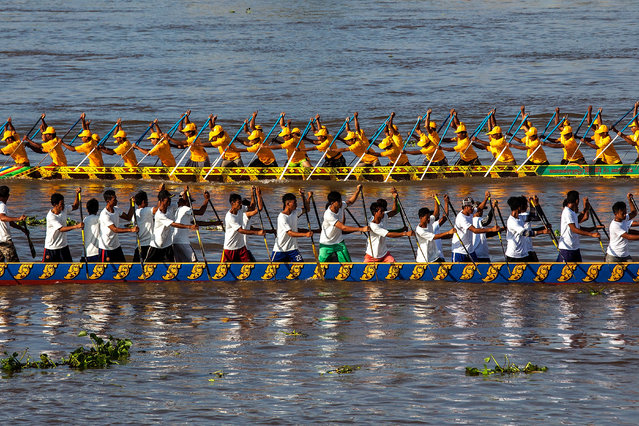
Boat crew members train on the waters of the Tonle Sap River on the morning of the first day of the Water Festival on November 13, 2016 in Phnom Penh, Cambodia. The yearly three-day Water Festival is one of the most important holidays in Cambodia and celebrates the end of the rainy season and the start of the rice harvesting. The Festival also coincides with the Tonle Sap river reversing course, which it does twice a year. Approximately 2 million people are expected to attend this year's festival, during which 259 boats and nearly 20,000 oarsmen will participate in the races. After a fatal stampede resulting in the death of some 353 people during the Water Festival in 2010, it has been cancelled four times over the past five years, with weather used as an official excuse. (Photo by Omar Havana/Getty Images)

Boat crew members train on the waters of the Tonle Sap River on the morning of the first day of the Water Festival on November 13, 2016 in Phnom Penh, Cambodia. The yearly three-day Water Festival is one of the most important holidays in Cambodia and celebrates the end of the rainy season and the start of the rice harvesting. The Festival also coincides with the Tonle Sap river reversing course, which it does twice a year. Approximately 2 million people are expected to attend this year's festival, during which 259 boats and nearly 20,000 oarsmen will participate in the races. After a fatal stampede resulting in the death of some 353 people during the Water Festival in 2010, it has been cancelled four times over the past five years, with weather used as an official excuse. (Photo by Omar Havana/Getty Images)
Details
15 Nov 2016 11:26:00
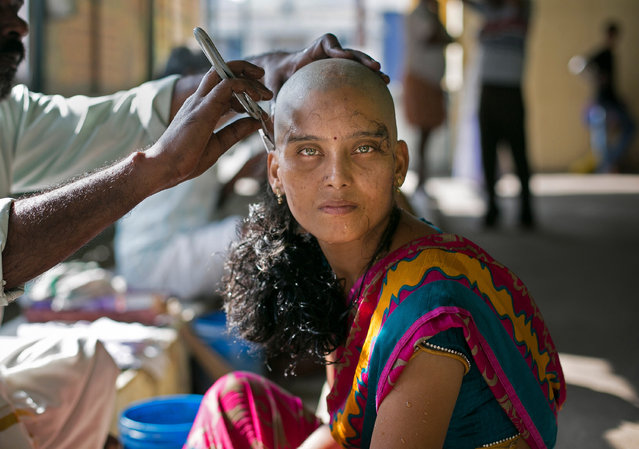
28 year old Rupa has her hair shaven to donate to the Gods at the Thiruthani Murugan Temple November 10, 2016 in Thiruttani, India. Rupa donated her hair with the wish that her daughter's illness is cured. The process of shaving ones hair and donating it to the Gods is known as tonsuring. It is common for Hindu believers to tonsure their hair at a temple as a young child, and also to celebrate a wish coming true, such as the birth of a baby or the curing of an illness. The “temple hair”, as it's known, is then auctioned off to a processing plant and then sold as pricey wigs and weaves in the US, Europe and Africa. (Photo by Allison Joyce/Getty Images)

28 year old Rupa has her hair shaven to donate to the Gods at the Thiruthani Murugan Temple November 10, 2016 in Thiruttani, India. Rupa donated her hair with the wish that her daughter's illness is cured. The process of shaving ones hair and donating it to the Gods is known as tonsuring. It is common for Hindu believers to tonsure their hair at a temple as a young child, and also to celebrate a wish coming true, such as the birth of a baby or the curing of an illness. The “temple hair”, as it's known, is then auctioned off to a processing plant and then sold as pricey wigs and weaves in the US, Europe and Africa. (Photo by Allison Joyce/Getty Images)
Details
21 Nov 2016 10:30:00
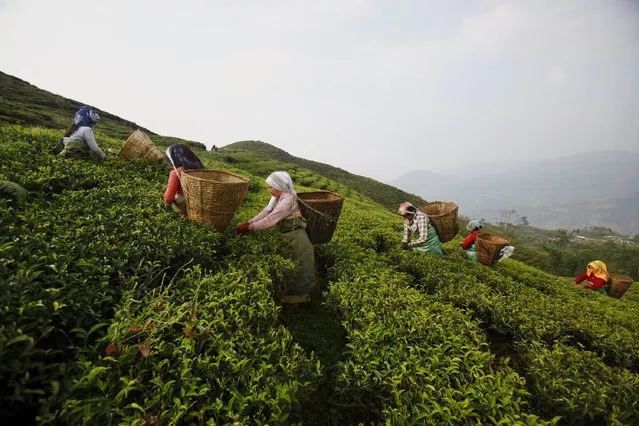
In this Sunday, November 16, 2014 photo, Nepalese women pick tea at a tea garden of Kanyam in Illam district, around 500 kilometers (310 miles) from Katmandu, Nepal. Illam is a hilly district of tea gardens and estates in eastern Nepal's Himalayan region with one of its largest and most productive tea estate being Kanyam estates. (Photo by Niranjan Shrestha/AP Photo)

In this Sunday, November 16, 2014 photo, Nepalese women pick tea at a tea garden of Kanyam in Illam district, around 500 kilometers (310 miles) from Katmandu, Nepal. Illam is a hilly district of tea gardens and estates in eastern Nepal's Himalayan region with one of its largest and most productive tea estate being Kanyam estates. The district produces orthodox tea, hand-processed or machine rolled, which is generally exported to international markets, specially Europe and the United States. Most of the tea pickers here are paid 186 Nepalese Rupees (US $ 2) for 8 hours of work everyday. (Photo by Niranjan Shrestha/AP Photo)
Details
19 Nov 2014 14:28:00
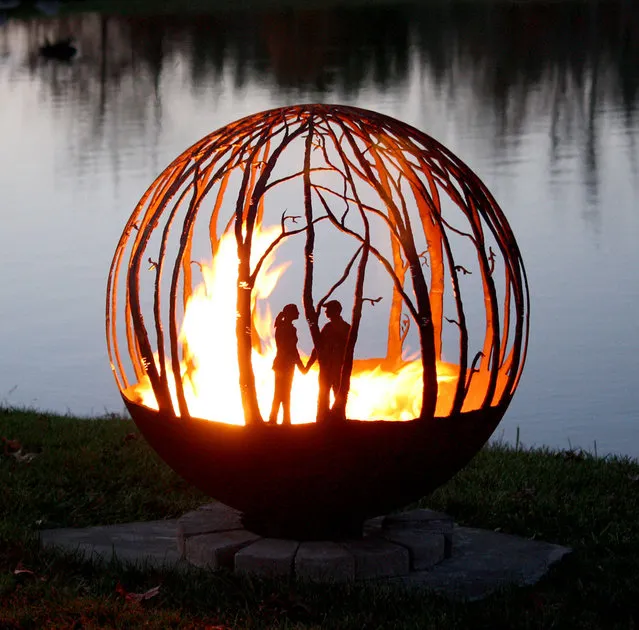
Fire Pit By Melissa Crisp

A burning flame and a broad expanse of water are among the few things which do not tire us with their beauty. However, while we have many sources of water around us, it is quite hard to marvel at a burning flame on a daily basis. Melissa Crisp is one of the few people who were able to subdue the element of fire. She is the person who is behind the design of the uniquely-shaped fire pits, which feature mystifying themes, including a pair of lovers, a fire on the rodeo arena, a forest fire, a fiery flower, and a number of others. Each of the fire pits entrances you, and it almost seems like the characters are alive, as the hot fire burns deep within the spheres, casting dancing shadows all around. (Photo by Melissa Crisp)
Details
15 Jan 2015 13:35:00
“Whether that means getting up way before the sun, like I do most days, going out somewhere that I’m not comfortable or just trying to get different angles or styles of photos, I am trying to display the crazy beauty of the ocean, and usually moments that literally last less than a split second”. (Photo by Ryan Pernoski/Caters News Agency)

These kaleidoscopic images are the work of one persistent photographer’s efforts to capture vibrant hues at the exact moment a wave breaks. Ryan Pernofski‘s stunning shots feature brilliant yellows, reds, blues and purples as an array of sunlight hits the water at the perfect time. What’s even more impressive: Ryan, a 27-year-old Australian, began shooting his popular masterpieces without using a professional camera, taking his iPhone out into the water instead. Ryan began experimenting with this method in 2012, using an underwater housing to protect his phone, as he could not afford a professional camera. (Photo by Ryan Pernoski/Caters News Agency)
Details
09 Jun 2018 00:05:00
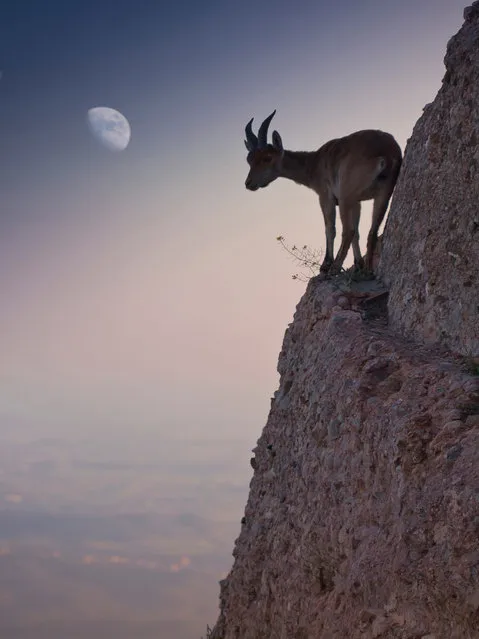
“For a bouquet of flowers”. Photographs made ​​in the last hours of the day. A goat is directed by a dangerous way to eat a small bouquet of flowers. Location: España, Barcelona, Montserrat. (Photo and caption by Renato Lopez Baldo/National Geographic Traveler Photo Contest)

“For a bouquet of flowers”. Photographs made ​​in the last hours of the day. A goat is directed by a dangerous way to eat a small bouquet of flowers. Location: España, Barcelona, Montserrat. (Photo and caption by Renato Lopez Baldo/National Geographic Traveler Photo Contest)

ATTENTION! All pictures are presented in high resolution. To see Hi-Res images – just TWICE click on any picture. In other words, click small picture – opens the BIG picture. Click BIG picture – opens VERY BIG picture.
Details
25 Jun 2013 12:51:00