Loading...
Done
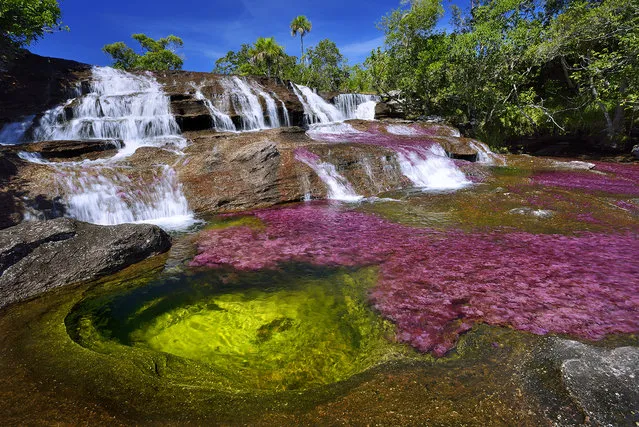
A waterfall is seen at the end of the rainy season, in August, when the water level finally decreases, in the Cano Cristales RIver in the Sierra de la Macarena in Colombia. It has become covered with a bright pink endemic aquatic plant, Macarenia Clavigera. (Photo by Olivier Grunewald)

“El rio mas bonito del Mundo”, the most beautiful river of the world, the “River of five colors”, the “Rainbow River”, or even the “Escaped from Paradise”, are the shimmering appellations that Colombians give to Cano Cristales, a small stream located in the heart of the Macarena National Park, 150 km (93 miles) south of Bogota. Photo: A waterfall is seen at the end of the rainy season, in August, when the water level finally decreases, in the Cano Cristales RIver in the Sierra de la Macarena in Colombia. It has become covered with a bright pink endemic aquatic plant, Macarenia Clavigera. (Photo by Olivier Grunewald)
Details
25 Mar 2014 15:15:00
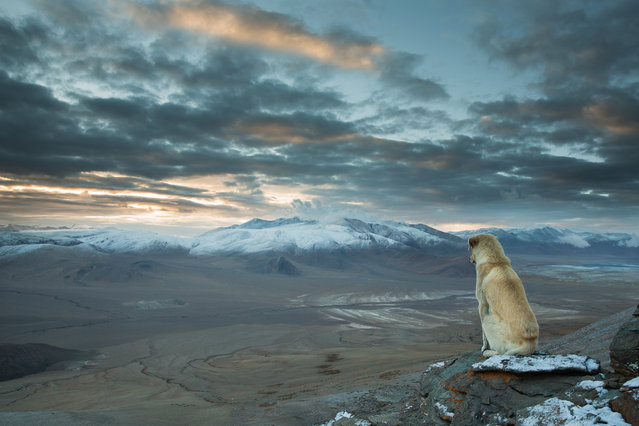
“Himalayan Dog”. This dog just appeared out of nowhere and followed us for an entire week during our trekking trip in the Himalayan outback. He always used to sleep in front of our tent and guarded us in the nights. When I decided to get up at 4 a.m. to climb the next 5000 m peak for sunrise he accompanied me as well. On the top he was sitting for the entire 30 minutes on this place looking straight into the countryside. Photo location: Ladakh, India. (Photo and caption by Sebastian Wahlhuetter/National Geographic Photo Contest)

“Himalayan Dog”. This dog just appeared out of nowhere and followed us for an entire week during our trekking trip in the Himalayan outback. He always used to sleep in front of our tent and guarded us in the nights. When I decided to get up at 4 a.m. to climb the next 5000 m peak for sunrise he accompanied me as well. On the top he was sitting for the entire 30 minutes on this place looking straight into the countryside. Photo location: Ladakh, India. (Photo and caption by Sebastian Wahlhuetter/National Geographic Photo Contest)
Details
01 Apr 2014 10:47:00
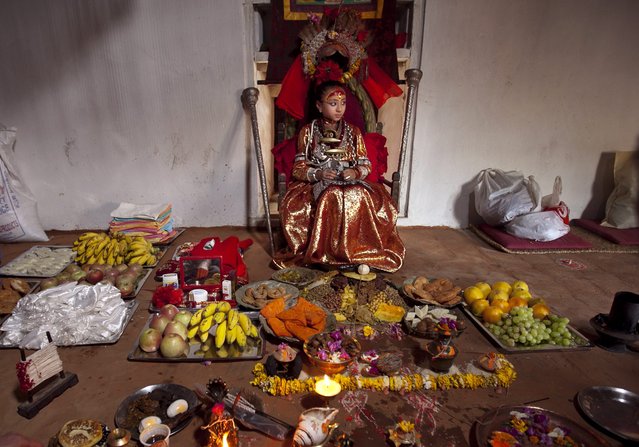
Kumari Samita Bajracharya sits in front of devotees offers during a special puja at Kumari Ghar in Patan, Nepal, 09 April 2011. It is believed that worshipping Kumari and receiving tika from her reduces illness and avoid problems. Kumari, or Kumari Devi, is a “living goddess”. The word literally means virgin in Nepali. The Living Goddesses are young pre-pubescent girls that are considered to be incarnations of the Hindu Goddess of Power, Kali. The Kumari retires when she reaches puberty. (Photo by Narendra Shrestha/EPA)

Kumari Samita Bajracharya sits in front of devotees offers during a special puja at Kumari Ghar in Patan, Nepal, 09 April 2011. It is believed that worshipping Kumari and receiving tika from her reduces illness and avoid problems. Kumari, or Kumari Devi, is a “living goddess”. The word literally means virgin in Nepali. The Living Goddesses are young pre-pubescent girls that are considered to be incarnations of the Hindu Goddess of Power, Kali. The Kumari retires when she reaches puberty. (Photo by Narendra Shrestha/EPA)
Details
18 Jun 2014 12:31:00
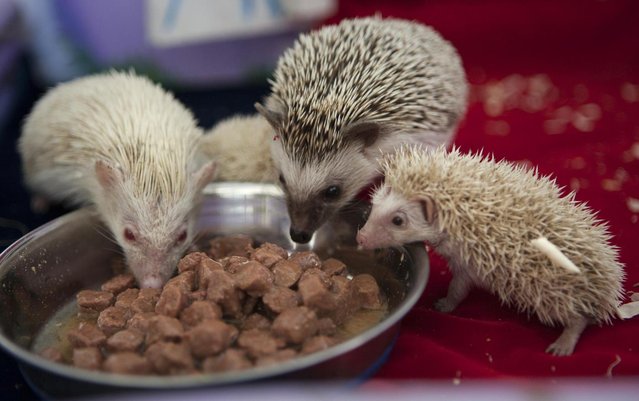
Parent hedgehogs Maria, left, and Gosha, 2nd right, eat with their albino babies in a private Zoo in Moscow, Russia, Thursday, August 22, 2013. Three rare albino hedgehog babies, born on the same day as Britain's new prince, have moved into a miniature castle at a Moscow petting zoo. The three are named after the Prince of Cambridge – George, Alexander and Louis. On Thursday, when they turned one month old, they were shown their new home at the All-Russia Exhibition Center. (Photo by Alexander Zemlianichenko Jr./AP Photo)

Parent hedgehogs Maria, left, and Gosha, 2nd right, eat with their albino babies in a private Zoo in Moscow, Russia, Thursday, August 22, 2013. Three rare albino hedgehog babies, born on the same day as Britain's new prince, have moved into a miniature castle at a Moscow petting zoo. The three are named after the Prince of Cambridge – George, Alexander and Louis. On Thursday, when they turned one month old, they were shown their new home at the All-Russia Exhibition Center. (Photo by Alexander Zemlianichenko Jr./AP Photo)
Details
26 Aug 2013 09:23:00
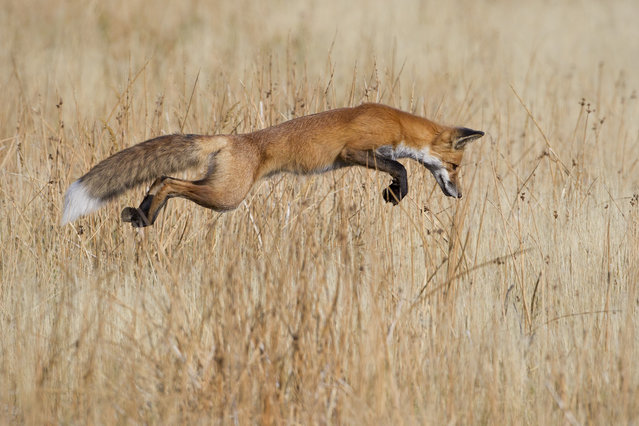
Canada: “Lucky pounce”. (Photo by Connor Stefanison/Wildlife Photographer of the Year 2013)

The winners of The London’s Natural History Museum's prestigious Wildlife Photographer of the Year for 2013 have finally been unveiled. Selected from almost 43,000 entries from 96 countries, the winners offer a glimpse of the stunning array of natural beauty on our planet. Photo: Canada: “Lucky pounce”. “Anticipating the pounce – that was the hardest part”, says Connor, who had come to Yellowstone National Park, Wyoming, USA, in search of wildlife as much as the spectacular landscape. He had found this fox, his first ever, on his last day in the park. It was so absorbed in hunting that Connor had plenty of time to get out of the car and settle behind a rock. It quartered the grassland, back and forth, and then started staring intently at a patch of ground, giving Connor just enough warning of the action to come. When it sprung up, Connor got his shot. And when it landed, the fox got his mouse. (Photo by Connor Stefanison/Wildlife Photographer of the Year 2013)
Details
17 Oct 2013 08:12:00
Giant's Causeway

Legend has it that the Irish warrior Fionn mac Cumhaill (Finn McCool) built the causeway to walk to Scotland to fight his Scottish counterpart Benandonner. One version of the legend tells that Fionn fell asleep before he got to Scotland. When he did not arrive, the much larger Benandonner crossed the bridge looking for him. To protect Fionn, his wife Oonagh laid a blanket over him so he could pretend that he was actually their baby son. In a variation, Fionn fled after seeing Benandonner's great bulk, and asked his wife to disguise him as the baby. In both versions, when Benandonner saw the size of the 'infant', he assumed the alleged father, Fionn, must be gigantic indeed. Therefore, Benandonner fled home in terror, ripping up the Causeway in case he was followed by Fionn.
Details
11 May 2015 10:45:00
Lv Mengmeng, who was born in 1995, poses for a photograph in Shanghai August 22, 2014. When asked if she would like siblings, Mengmeng said: “Maybe brothers, because I think they could protect me”. (Photo by Carlos Barria/Reuters)

Reuters Photographer Carlos Barria photographed a person born in each year China's one child policy has been in existence; from a man born in 1979, to a baby born in 2014, and asked them if they would have like to have siblings. Here: Lv Mengmeng, who was born in 1995, poses for a photograph in Shanghai August 22, 2014. When asked if she would like siblings, Mengmeng said: “Maybe brothers, because I think they could protect me”. (Photo by Carlos Barria/Reuters)
Details
06 Oct 2014 08:20:00
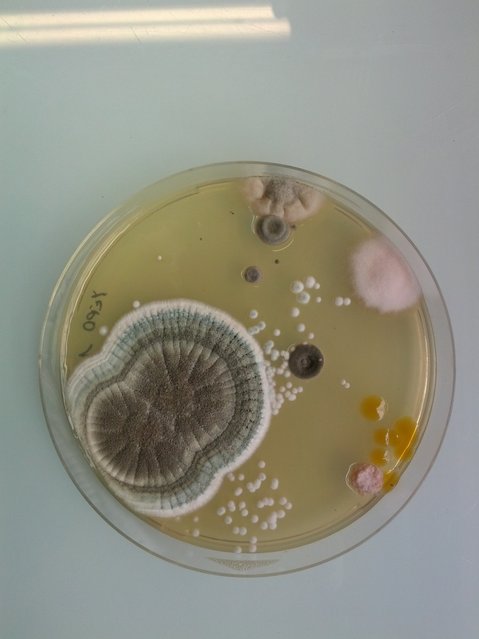
Magical Contamination By Antoine Bridier-Nahmias

Modern art is truly fascinating. Not in a way that it produces some novel things that will fascinate future generations for decades and even centuries to come. No, that is very far from the truth. On the contrary, modern art is essentially anything (yes, any little thing) that is a bit unusual and was created by a famous person. Let’s take the creation of Antoine Bridier-Nahmias for example. His brainchild is a set of pictures of petri dishes that were contaminated by various cultures of fungi. If this is art, I missed my chance of becoming famous when I accidentally left a piece of bread in a bag in a cupboard for about six months, and didn’t take a picture of the rather shocking results that awaited me when I finally discovered it. (Photo by Antoine Bridier-Nahmias)
Details
12 Dec 2014 13:03:00