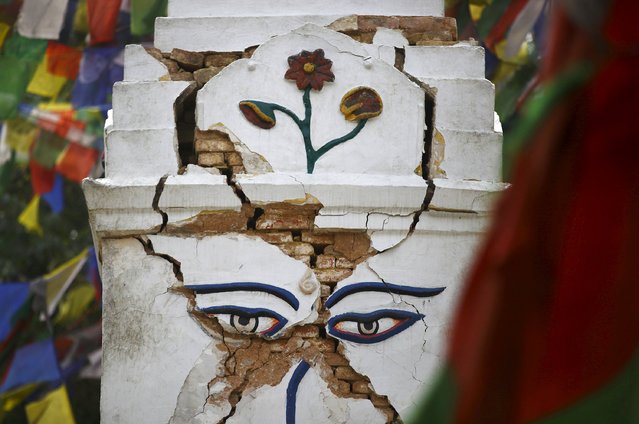
Cracks are seen on one of the shrines at Swoyambhunath Stupa, a UNESCO world heritage site, after Saturday's earthquake in Kathmandu, Nepal April 28, 2015. (Photo by Navesh Chitrakar/Reuters)
Zulmira Jesus poses for a portrait at a street in Povoa de Agracoes, near Chaves, Portugal April 19, 2016. In the villages of Agracoes and Povoa de Agracoe, the steady drip-drip of emigration has brought down population numbers from more than 50 residents to fewer than a dozen each. These remaining villagers share the same glum acceptance that, after they have gone, their villages will die out too. It is the same desolate picture in scores of other backwater settlements in Portugal's interior, north to south. (Photo by Rafael Marchante/Reuters)
A police cadet casts her vote in the presidential election in Moscow, Russia, Sunday, March 18, 2018. Vladimir Putin headed to an overwhelming win in Russia' s presidential election Sunday, adding six years in the Kremlin for the man who has led the world' s largest country for all of the 21 st century. (Photo by Pavel Golovkin/AP Photo)
Women look at a collapsed building caused by earthquakes, in Bhaktapur, Nepal, May 18, 2015. Nepal is facing billions in reconstruction costs with almost 745,600 buildings and homes damaged or destroyed, including at least 87,700 in the capital, according to Nepal's emergency authority. (Photo by Ahmad Masood/Reuters)
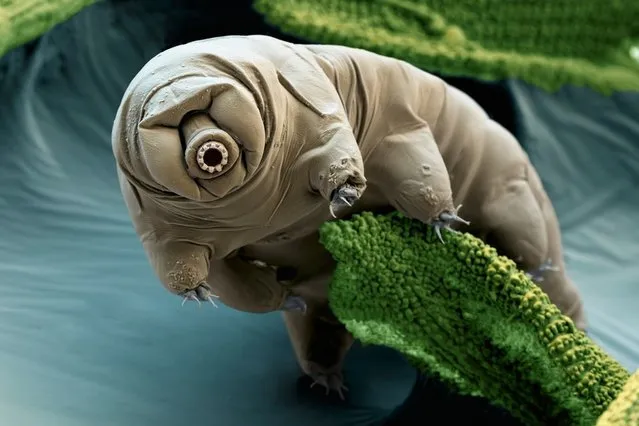
“Tardigrades (commonly known as waterbears or moss piglets) are small, water-dwelling, segmented animals with eight legs. Tardigrades were first discovered in 1773 by Johann August Ephraim Goeze, who called them kleiner Wasserbär, meaning “little water bear” in German. The name Tardigrada means “slow walker” and was given by Lazzaro Spallanzani in 1777. The name water bear comes from the way they walk, reminiscent of a bear's gait. The biggest adults may reach a body length of 1.5 millimetres (0.059 in), the smallest below 0.1 mm. Freshly hatched tardigrades may be smaller than 0.05 mm”. – Wikipedia. Photo: Tardigrades. (Photo by SPL/East News)
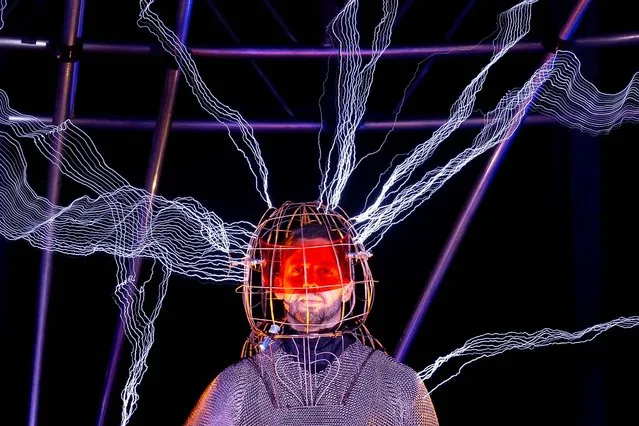
“Magician David Blaine's latest stunt boasts lots of high-voltage snap, crackle and pop – but experts say he'll be safe from electrocution as long as he wears his chain-mail suit and metal headgear”. – NBC News. Photo: Blaine stands inside the apparatus, surrounded by a million volts of electric currents streamed by tesla coils. The stunt, sponsored by Intel, is the latest of daredevil endeavors by the magician whose previous stunts included being encased in ice for over 60 hours in Times Square, on October 5, 2012. (Photo by John Minchillo/Associated Press)
Victorian and Australian women's cricket team representative Meg Lanning dives for a catch during a photo shoot at Quarry Park on October 27, 2011 in Melbourne, Australia. (Photo by Mark Dadswell/Getty Images)