Loading...
Done
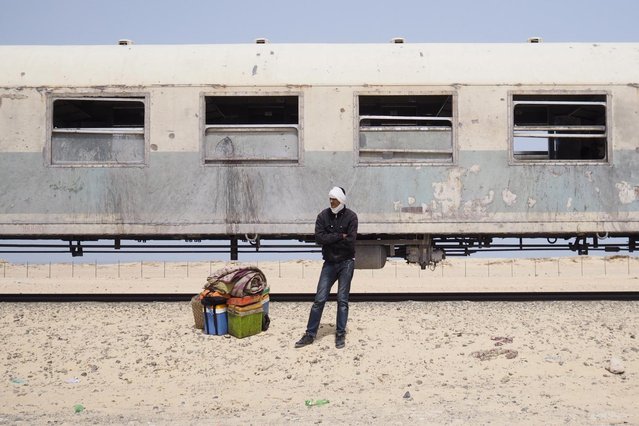
A passenger on a SNIM train carrying iron ore and mine workers waits for transport after arriving in Nouadhibou June 25, 2014. (Photo by Joe Penney/Reuters)

A passenger waits after his train arrived in Nouadhibou, Mauritania’s second largest city and the main export port for the country’s iron ore industry, on June 25, 2014. The mining company’s employees proudly call their firm the lung of their nation's economy and the train that ferries the ore to the coast stretches some two kilometres, making it one of the world's longest. SNIM mines black iron ore in the northern town of Zouerate, a remote desert location which nevertheless attracts people from all over the country looking for work. (Photo by Joe Penney/Reuters)
Details
27 Oct 2014 11:51:00
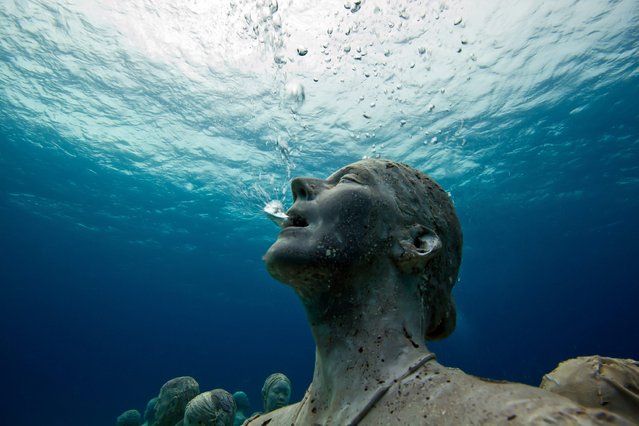
Monumental Underwater Museum MUSA; Jason deCaires Taylor; Silent Evolution

“In 2009 a monumental underwater museum called “MUSA” (Museo Subacuático de Arte) was formed in the waters surrounding Cancun, Isla Mujeres and Punta Nizuc. The project founded by Jaime Gonzalez Cano of The National Marine Park, Roberto Diaz of The Cancun Nautical Association and Jason deCaires Taylor consists of over 450 permanent life-size sculptures and is one of the largest and most ambitious underwater artificial art attractions in the world”. – UnderwaterSculpture (Photos by Jason deCaires Taylor/Intrepidacious/Kozy and Dan Kitchens)

Details
05 Oct 2012 07:26:00
Larissa Neto, a muse of the Unidos da Tijuca Samba School, poses as she wears a carnival dress in Sao Goncalo near Rio de Janeiro, Brazil, February 3, 2016. (Photo by Ricardo Moraes/Reuters)

Larissa Neto, a muse of the Unidos da Tijuca Samba School, poses as she wears a carnival dress in Sao Goncalo near Rio de Janeiro, Brazil, February 3, 2016. Rio de Janeiro's carnival parades are known the world over for the glitz and glamour, high-tech allegorical floats and shimmering bodies, which battle it out each year for the championship title. Each school is fronted by the Queen of the Drums, who dances alongside the raging percussion, and her court of sparkling, sculpted dancers known as “muses”. (Photo by Ricardo Moraes/Reuters)
Details
05 Feb 2016 10:52:00
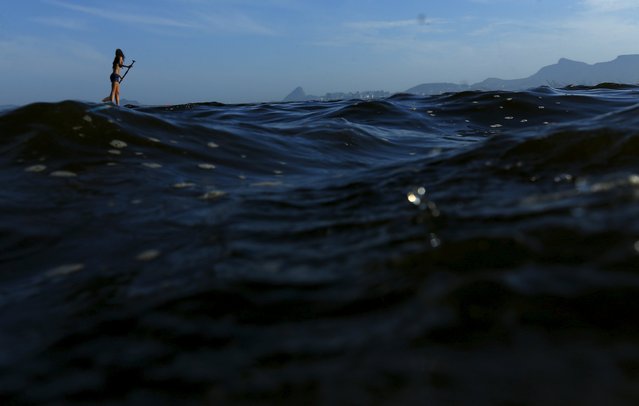
A girl paddles on her stand-up board on the waters of Guanabara bay at Bica beach in Rio de Janeiro Brazil, January 10, 2016. (Photo by Ricardo Moraes/Reuters)

A girl paddles on her stand-up board on the waters of Guanabara bay at Bica beach in Rio de Janeiro Brazil, January 10, 2016. Few features capture the beauty, or the problems, of one of the world's most dramatic urban landscapes like Guanabara Bay - the finger-like inlet that forms the shoreline and harbor for Rio de Janeiro. The bay, which carves into southeast Brazil from the Atlantic Ocean, literally gave Rio its name when Portuguese mariners mistook it for a “rio”, or “river”. Four centuries later, the bay is preparing to welcome another sort of seafarer – Olympic sailors, who will navigate the bay when the 2016 Rio Olympics kick off in August. (Photo by Ricardo Moraes/Reuters)
Details
28 Apr 2016 12:13:00
In this photograph taken on December 14, 2016, an Indian craftsman works on unfinished cricket bats in a factory in Meerut, some 70 kms north- east of New Delhi. As Indian factory worker Jitender Singh carves out another big- hitting slab of thick willow he insists MCC proposals to limit the size of cricket bats won' t tame Twenty20 marauders. “I don' t think the thickness matters. It' s more about the balance of the bat and the talent of the batsman”, says Singh, who has made bats for many stars, including South Africa's AB de Villiers. The World Cricket committee of the MCC, the guardians of the game, recommended in December 2016 that limitations be placed on the width and depth of bats because it had become too easy to smash fours and sixes. (Photo by Dominique Faget/AFP Photo)

In this photograph taken on December 14, 2016, an Indian craftsman works on unfinished cricket bats in a factory in Meerut, some 70 kms north- east of New Delhi. (Photo by Dominique Faget/AFP Photo)
Details
11 Jan 2017 14:32:00
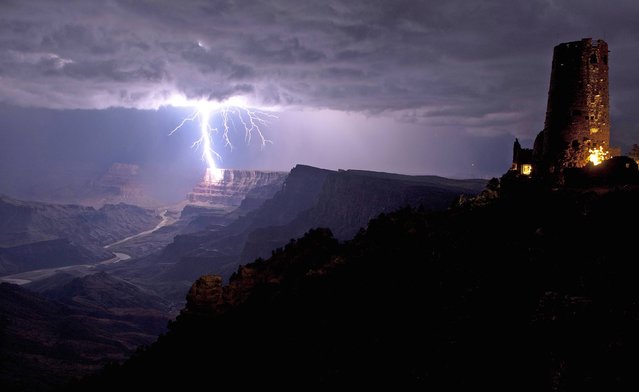
This is the incredible moment a fierce lightning bolt crashed against the Grand Canyon illuminating the steep canyon walls. Shrouded in darkness, the breath-taking landscape was shocked into life as mother nature sent the bolt storming down to Earth. (Photo by Travis Roe/U.S. Dept. of the Interior/Caters News)

This is the incredible moment a fierce lightning bolt crashed against the Grand Canyon illuminating the steep canyon walls. Shrouded in darkness, the breath-taking landscape was shocked into life as mother nature sent the bolt storming down to Earth. As it cracked against the rocks the bright blue bolt illuminated the South Rim of the canyon, considered one of the Seven Natural Wonders of the World. With just the Desert View Watchtower in the foreground, the lightning was perfectly framed by the canyon which is located in Arizona, USA. (Photo by Travis Roe/U.S. Dept. of the Interior/Caters News)
Details
14 May 2013 11:00:00
Albertus in the church of St George in Burgrain, Germany. Incredibly, some of the skeletons, which took up to five years to decorate, were even found hidden away in lock-ups and containers. (Photo by Paul Koudounaris/BNPS)

A relic hunter dubbed “Indiana Bones” has lifted the lid on a macabre collection of 400-year-old jewel-encrusted skeletons unearthed in churches across Europe. Art historian Paul Koudounaris has hunted down and photographed dozens of gruesome skeletons in some of the world's most secretive religious establishments. Photo: Albertus in the church of St George in Burgrain, Germany. Incredibly, some of the skeletons, which took up to five years to decorate, were even found hidden away in lock-ups and containers. (Photo by Paul Koudounaris/BNPS)
Details
08 Sep 2013 07:20:00
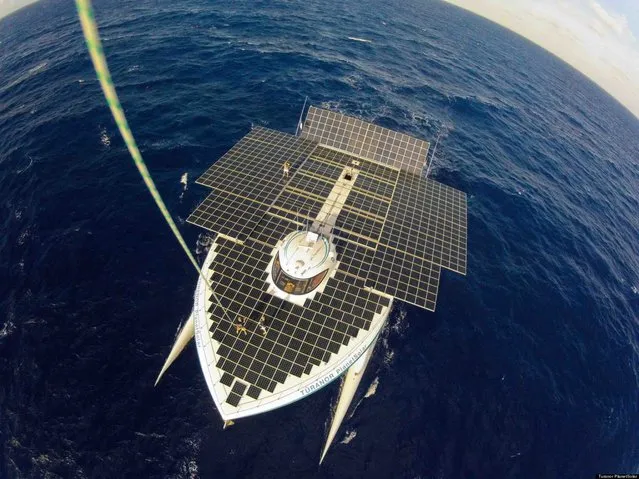
Turanor PlanetSolar

MS Tûranor PlanetSolar, known under the project name PlanetSolar, is the largest solar-powered boat in the world The vessel was designed by LOMOcean Design, built by Knierim Yachtbau in Kiel, Germany, and launched on 31 March 2010. In May 2012, it became the first ever solar electric vehicle to circumnavigate the globe. The 31-meter boat is covered in over 500 square meters of solar panels rated 93 kW, which in turn connect to one of the two electric motors in each hull. There are 8.5 tons of lithium-ion batteries in the ship's two hulls. The boat's shape allows it to reach speeds of up to 14 knots. The hull was model tested in wind tunnels and was tank tested to determine its hydrodynamics and aerodynamics. The boat has been designed to be used as a luxury yacht after the record attempt is finished.
Details
30 Oct 2013 09:06:00