Loading...
Done
Paramedics care for a woman who is ill after the Geelong Cup on Geelong Cup day at Geelong Racecourse in Melbourne, Australia, 19 October 2016. The Geelong Racing Club was founded in March 1865 at a public meeting at the British Hotel. The first Geelong Cup was held in 1872 over a distance of two miles. (Photo by Tracey Nearmy/EPA)

Paramedics care for a woman who is ill after the Geelong Cup on Geelong Cup day at Geelong Racecourse in Melbourne, Australia, 19 October 2016. The Geelong Racing Club was founded in March 1865 at a public meeting at the British Hotel. The first Geelong Cup was held in 1872 over a distance of two miles. (Photo by Tracey Nearmy/EPA)
Details
20 Oct 2016 10:49:00
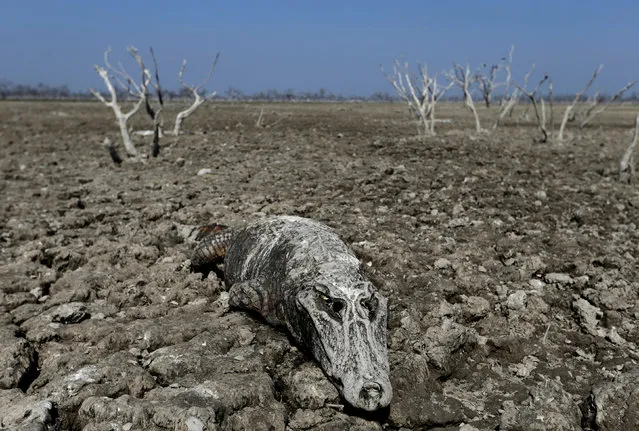
The carcass of a yacare caiman lies in the dried-up river bed of the Pilcomayo river in Boqueron, Paraguay, August 14, 2016. In Paraguay, alongside the Pilcomayo River, black vultures flew over a shrinking pond where a group of crocodilian reptiles known as yacare caimans sought refuge. Water from the river, which divides Paraguay and Argentina in the area of the Gran Chaco, was scarce. This is not an uncommon sight in the region of General Diaz, about 700 kilometres (435 miles) northwest of the country's capital Asuncion, where the Pilcomayo's waters form lakes and streams that give life to capybaras, birds and caimans. “The river's situation is critical. No water is forecast to enter the basin until December, as happens every year”, said Alcides Gonzalez, a resident of the area. (Photo by Jorge Adorno/Reuters)

The carcass of a yacare caiman lies in the dried-up river bed of the Pilcomayo river in Boqueron, Paraguay, August 14, 2016. In Paraguay, alongside the Pilcomayo River, black vultures flew over a shrinking pond where a group of crocodilian reptiles known as yacare caimans sought refuge. Water from the river, which divides Paraguay and Argentina in the area of the Gran Chaco, was scarce. This is not an uncommon sight in the region of General Diaz, about 700 kilometres (435 miles) northwest of the country's capital Asuncion, where the Pilcomayo's waters form lakes and streams that give life to capybaras, birds and caimans. (Photo by Jorge Adorno/Reuters)
Details
03 Nov 2016 12:40:00
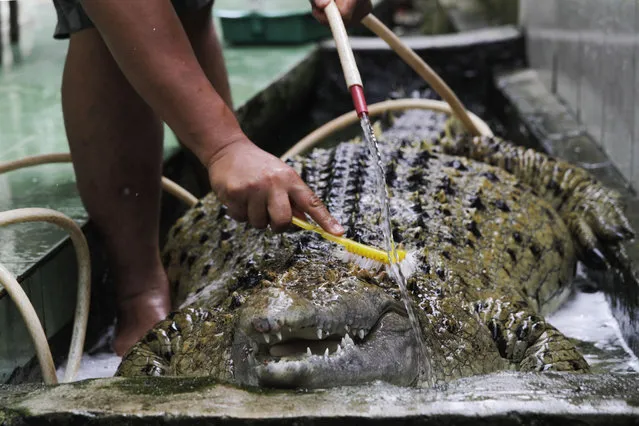
Irwan bathes a domesticated crocodile at his house in Bogor, Indonesia on January 22, 2018. Irwan found it as a baby and now it has been living with Irwans family for 20 years. Indonesia is known as a hotbed of exotic pet domestication and trade. People have been known to keep endangered animals such as slow lorises, eagles and pangolins, angering conservationists and animal rights activists. (Photo by Eko Siswono Toyudho/Anadolu Agency/Getty Images)

Irwan bathes a domesticated crocodile at his house in Bogor, Indonesia on January 22, 2018. Irwan found it as a baby and now it has been living with Irwans family for 20 years. Indonesia is known as a hotbed of exotic pet domestication and trade. People have been known to keep endangered animals such as slow lorises, eagles and pangolins, angering conservationists and animal rights activists. (Photo by Eko Siswono Toyudho/Anadolu Agency/Getty Images)
Details
28 Jan 2018 07:57:00
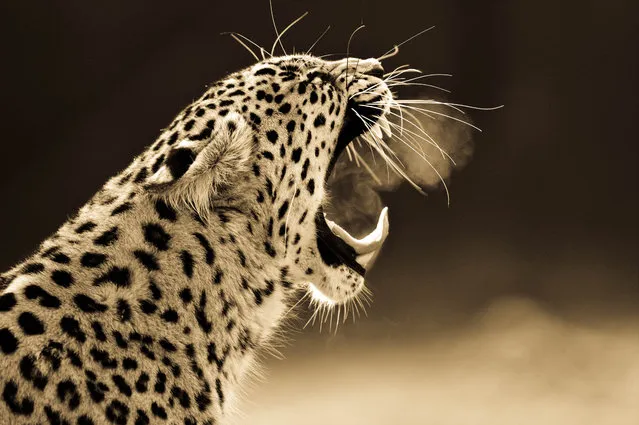
These romantic sepia shots show lovers enjoying quiet, unguarded moments together – but the subjects are not besotted couples; they are fearsome big cats. Freelance snapper Goran Anastasovski has devoted more than 10 years of his life to photographing big cats and other animals. The 46-year-old from Macedonia aims to emphasize their human qualities in his photographs. (Photo by Goran Anastasovski/Caters News)

These romantic sepia shots show lovers enjoying quiet, unguarded moments together – but the subjects are not besotted couples; they are fearsome big cats. Freelance snapper Goran Anastasovski has devoted more than 10 years of his life to photographing big cats and other animals. The 46-year-old from Macedonia aims to emphasize their human qualities in his photographs. (Photo by Goran Anastasovski/Caters News)
Details
11 Jan 2016 08:01:00
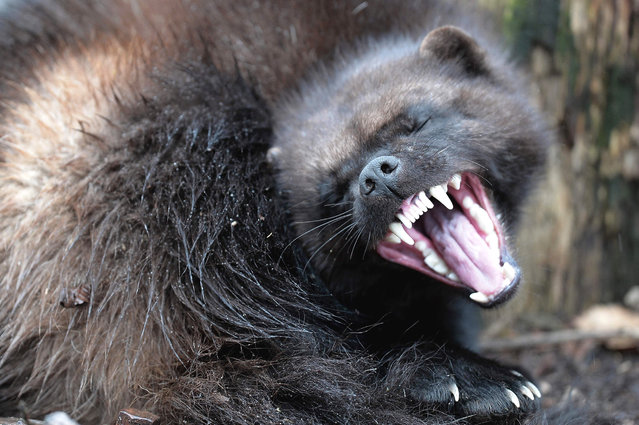
A wolverine is pictured during its first public appearance at the Animal Park of Sainte-Croix in Rhodes, eastern France on January 28, 2016. (Photo by Frederick Florin/AFP Photo)

A wolverine is pictured during its first public appearance at the Animal Park of Sainte-Croix in Rhodes, eastern France on January 28, 2016. (Photo by Frederick Florin/AFP Photo)
Details
31 Jan 2016 08:43:00
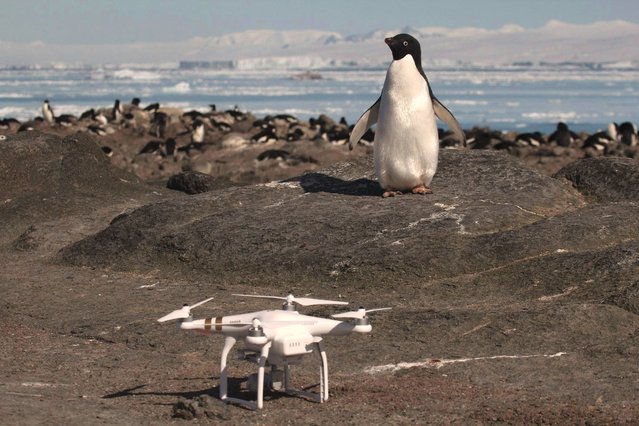
This undated handout photograph released by Stony Brook University/ Louisiana State University on March 2, 2018, shows an Adélie penguin (R) looking at a drone at breeding colony on Heroina Island, Danger Islands, Antarctica. A thriving “hotspot” of some 1.5 million Adelie penguins has been discovered on the remote Danger Islands in the east Antarctic, surprised scientists announced on March 2, 2018. (Photo by Rachael Herman/AFP Photo/Louisiana State University AND Stony Brook University)

This undated handout photograph released by Stony Brook University/ Louisiana State University on March 2, 2018, shows an Adélie penguin looking at a drone at breeding colony on Heroina Island, Danger Islands, Antarctica. A thriving “hotspot” of some 1.5 million Adelie penguins has been discovered on the remote Danger Islands in the east Antarctic, surprised scientists announced on March 2, 2018. (Photo by Rachael Herman/AFP Photo/Louisiana State University AND Stony Brook University)
Details
04 Mar 2018 00:03:00
A bloody zombie baby head, brain and a hand made of gummy candy and red jelly are pictured as a woman works (rear) at the Zombie Gourmet homemade candy manufacturer on the outskirts of Mexico City October 30, 2015. (Photo by Carlos Jasso/Reuters)

A bloody zombie baby head, brain and a hand made of gummy candy and red jelly are pictured as a woman works (rear) at the Zombie Gourmet homemade candy manufacturer on the outskirts of Mexico City October 30, 2015. (Photo by Carlos Jasso/Reuters)
Details
03 Nov 2015 08:04:00
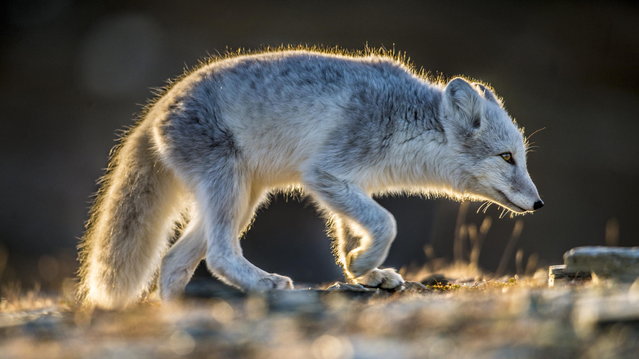
Arctic Fox. (Photo by Trond Eriksen)

“The arctic fox (Vulpes lagopus), also known as the white fox, polar fox, or snow fox, is a small fox native to the Arctic regions of the Northern Hemisphere and is common throughout the Arctic tundra biome. It is well adapted to living in cold environments. It has a deep thick fur which is brown in summer and white in winter. It averages in size at about 85.3 cm (33.6 in) in body length, with a generally rounded body shape to minimize the escape of body heat. – Wikipedia. (Photo by Trond Eriksen)
Details
26 May 2014 14:09:00