Loading...
Done
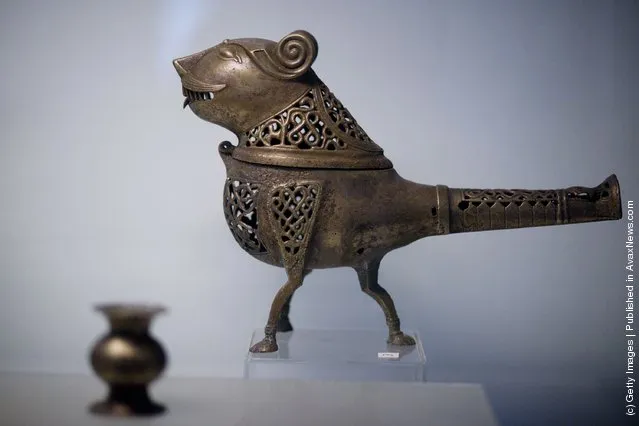
An ancient sculptures, pottery and bowls is displayed in the Kabul Museum August 4, 2011 in Kabul, Afghanistan

An ancient sculpture is displayed in the Kabul Museum August 4, 2011 in Kabul, Afghanistan. The sculptures, which had been destroyed by Islamists during the Taliban regime, were repaired after the collapse of the hardliners in 2001. Portions of the collection have been exhibited in seven countries. (Photo by Majid Saeedi/Getty Images)
Details
05 Aug 2011 09:27:00
A girl has her helmet adjusted on the top of a tank during the Children's Day celebration at a military facility in Bangkok, Thailand January 9, 2016. (Photo by Jorge Silva/Reuters)

A girl has her helmet adjusted on the top of a tank during the Children's Day celebration at a military facility in Bangkok, Thailand January 9, 2016. Army barracks opened their doors to children to interact with their weapons and vehicles as part of the celebration. (Photo by Jorge Silva/Reuters)
Details
11 Jan 2016 08:06:00
A reveller dances during “Lou Queernaval” parade, the first lesbian, gay, bisexual and transgender (LGBT) carnival in France, as part of the Carnival of Nice February 19, 2016. (Photo by Eric Gaillard/Reuters)

A reveller dances during “Lou Queernaval” parade, the first lesbian, gay, bisexual and transgender (LGBT) carnival in France, as part of the Carnival of Nice February 19, 2016. (Photo by Eric Gaillard/Reuters)
Details
21 Feb 2016 11:26:00
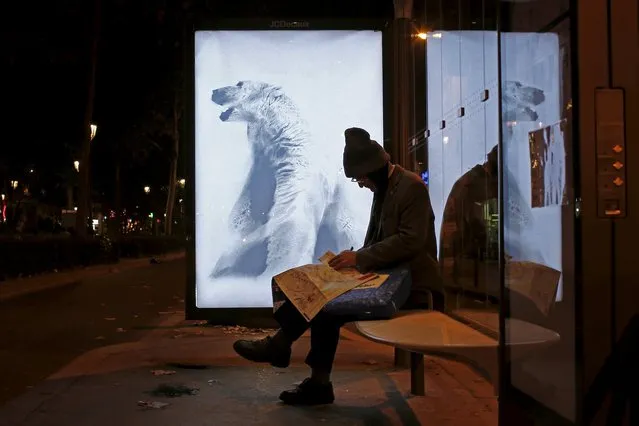
A poster by street artist Aaron Li-Hill as part of the "Brandalism" project is displayed at a bus stop in Paris, France, November 28, 2015, ahead of the United Nations COP21 Climate Change conference in Paris. (Photo by Benoit Tessier/Reuters)

A poster by street artist Aaron Li-Hill as part of the "Brandalism" project is displayed at a bus stop in Paris, France, November 28, 2015, ahead of the United Nations COP21 Climate Change conference in Paris. Brandalism is a revolt against corporate control of the visual realm. Following on in the guerilla art traditions of the 20th Century and taking inspiration from Agitprop, Situationist and Street Art movements, the Brandalism project sees artists from around the world collaborate to challenge the authority and legitimacy of commercial images within public space and within our culture. (Photo by Benoit Tessier/Reuters)
Details
30 Nov 2015 08:03:00
Fireworks light the sky over Copacabana beach during New Year's Eve celebrations in Rio de Janeiro, Brazil, Thursday, January 1, 2016. (Photo by Mauro Pimentel/AP Photo)

Fireworks light the sky over Copacabana beach during New Year's Eve celebrations in Rio de Janeiro, Brazil, Thursday, January 1, 2016. (Photo by Mauro Pimentel/AP Photo)
Details
02 Jan 2016 08:02:00
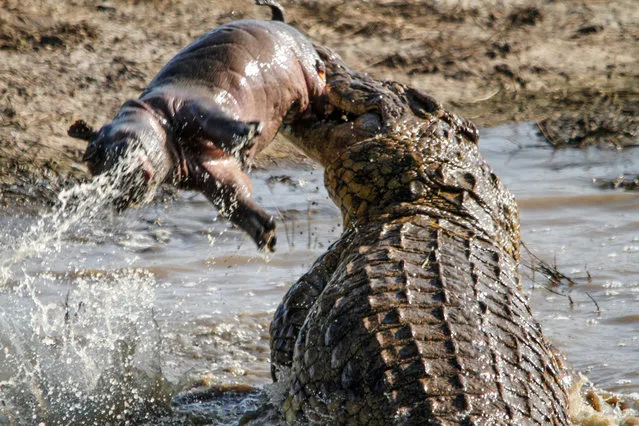
An enormous crocodile mauls a young hippo calf carcass near Lower Sabie on May 11, 2014, in Kruger National Park, South Africa. (Photo by Roland Ross/Barcroft Media)

An enormous crocodile mauls a young hippo calf carcass near Lower Sabie on May 11, 2014, in Kruger National Park, South Africa. An enormous crocodile tosses around a young hippo calf caught in its lethal jaws. The giant reared out of the water revealing a young hippo calf between its teeth. The huge beast then span, jumped and splashed in the water with the small carcass. Amateur photographer Roland Ross captured these incredible photographs near Lower Sabie in Kruger Park, South Africa. (Photo by Roland Ross/Barcroft Media)
Details
06 Aug 2014 10:52:00
Deadly Insects Hornet

Hornets are insects that are the largest eusocial wasps. Some species can reach up to 5.5 cm (2.2 in) in length. The true hornets make up the genus Vespa and are distinguished from other vespines by the width of the vertex (part of the head behind the eyes), which is proportionally larger in Vespa and by the anteriorly rounded gasters (the section of the abdomen behind the wasp waist). The best known species is the European hornet (Vespa crabro), about 2–3.5 cm in length, widely distributed throughout Europe, Russia, North America and Northeast Asia.
Details
13 Oct 2014 10:17:00
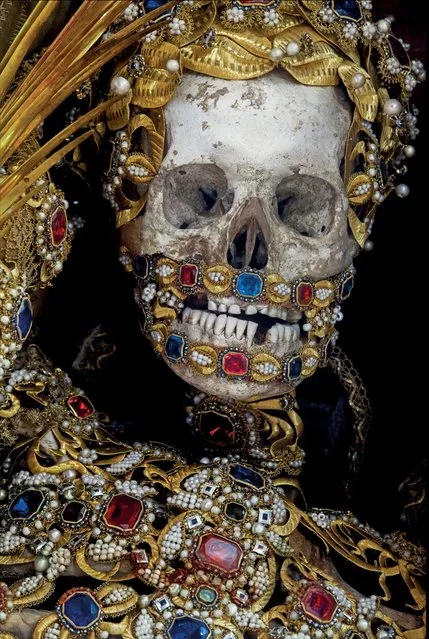
Albertus in the church of St George in Burgrain, Germany. Incredibly, some of the skeletons, which took up to five years to decorate, were even found hidden away in lock-ups and containers. (Photo by Paul Koudounaris/BNPS)

A relic hunter dubbed “Indiana Bones” has lifted the lid on a macabre collection of 400-year-old jewel-encrusted skeletons unearthed in churches across Europe. Art historian Paul Koudounaris has hunted down and photographed dozens of gruesome skeletons in some of the world's most secretive religious establishments. Photo: Albertus in the church of St George in Burgrain, Germany. Incredibly, some of the skeletons, which took up to five years to decorate, were even found hidden away in lock-ups and containers. (Photo by Paul Koudounaris/BNPS)
Details
08 Sep 2013 07:20:00