Loading...
Done
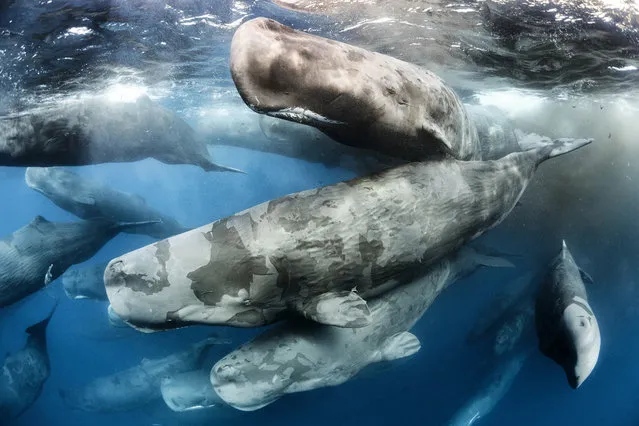
Giant gathering by Tony Wu. “The first indication that something extraordinary was going on were the blows, huge numbers of them – the exhalations of huge numbers of whales. Entering the water, the photographer witnessed an extraordinary scene. Hundreds, possibly thousands, of sperm whales were twirling and twisting through the water, bumping and rubbing against each other, and there was a cacophony of sound – the pulsation, buzz, creak and crackle of whale communication. The picture shows just a fraction of the scene, with the whales stacked up below. Undoubtedly, this was a clan gathering”. (Photo by Tony Wu/Unforgettable Underwater Photography/NHM)

A new book published by the UK Natural History Museum showcases some of the most memorable underwater photographs taken over the last few decades in its annual wildlife photographer of the year competition. Here: Giant gathering by Tony Wu. “The first indication that something extraordinary was going on were the blows, huge numbers of them – the exhalations of huge numbers of whales. Entering the water, the photographer witnessed an extraordinary scene”. (Photo by Tony Wu/Unforgettable Underwater Photography/NHM)
Details
17 Apr 2018 00:03:00
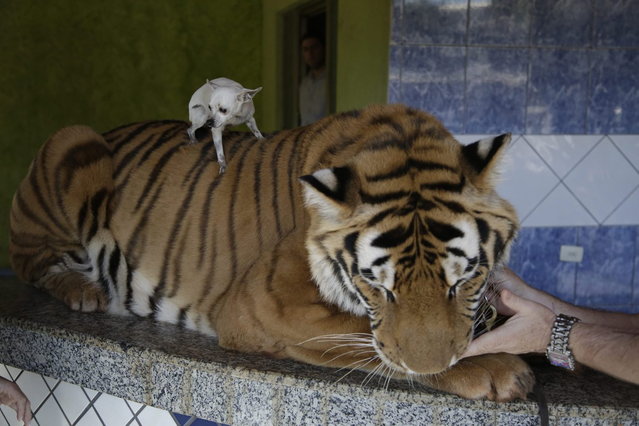
The Borges' family pet dog, Little, is placed on the back of Tom, their tiger, for a photo to be taken, in Maringa, Brazil, Friday, September 27, 2013. The Brazilian family is now locked in a legal dispute for the big cats, they have eight tigers and two lions, with federal wildlife officials working to take them away. While Borges does have a license to raise the animals, Brazilian wildlife officials say he illegally bred the cats, creating a public danger. (Photo by Renata Brito/AP Photo)

“Ary Borges and his family live in southern Brazil like most families the Borges' love animals and have an array of cats living in their home. The only difference between the cats owned by the Borges family and the cat that is cuddled up on your lap as you read this is the Borges' cats weigh over 700 pounds and could kill you just as soon as look at you. The Borges family shares their home with nine tigers, two lionesses, a chimp and a Chihuahua”. – Amanda Schiavo via Latin Times. Photo: The Borges' family pet dog, Little, is placed on the back of Tom, their tiger, for a photo to be taken, in Maringa, Brazil, Friday, September 27, 2013. (Photo by Renata Brito/AP Photo)
Details
04 Oct 2013 11:51:00
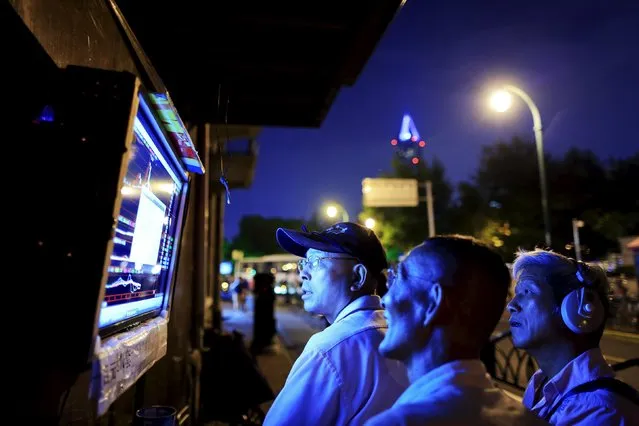
Shen Yuxi (L), introduces analysis software to investors at a “street stock salon” in central Shanghai, China, September 5, 2015. Shen carries a TV screen on his electronic bike to the "salon" every weekends where he sets it up on the wall outside a brokerage house. Shen's been selling analysis software at "the salon" for more than 10 years. (Photo by Aly Song/Reuters)

Some are in it just for the money, others to help buy a meal. Then there are those who trade for fun or to spend time among friends. Millions of investors – pensioners, security guards, high-school students – dominate China's stock markets, conducting about 80 percent of all trades. Retirees gather in brokerage houses dotted around China also to enjoy some company and savour the air conditioning on hot days. Some start as young as 13, trading from home with an eye on future careers in finance. Winning isn't guaranteed. This year, among the most turbulent in China's financial history, its stock markets more than doubled in the six months to May, only to crash amid concerns that growth in the country, which makes everything from cars to steel, is slowing faster than previously thought. (Photo by Aly Song/Reuters)
Details
13 Oct 2015 08:00:00
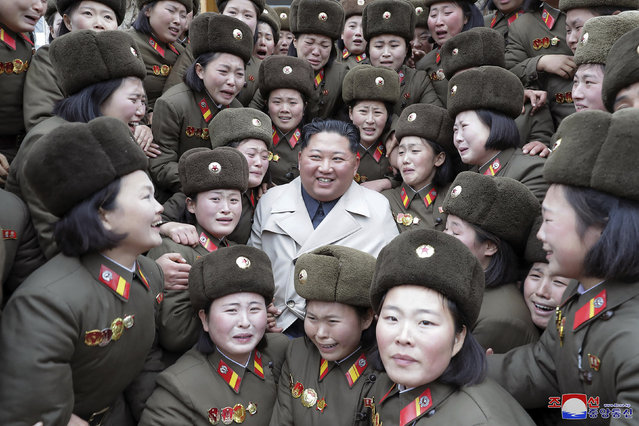
In this undated photo provided on Monday, November 25, 2019, by the North Korean government, North Korean leader Kim Jong Un, center, poses as he inspects a women's company under Unit 5492 of the Korean People's Army in North Korea. Independent journalists were not given access to cover the event depicted in this image distributed by the North Korean government. The content of this image is as provided and cannot be independently verified. Korean language watermark on image as provided by source reads: “KCNA” which is the abbreviation for Korean Central News Agency. (Photo by Korean Central News Agency/Korea News Service via AP Photo)

In this undated photo provided on Monday, November 25, 2019, by the North Korean government, North Korean leader Kim Jong Un, center, poses as he inspects a women's company under Unit 5492 of the Korean People's Army in North Korea. Independent journalists were not given access to cover the event depicted in this image distributed by the North Korean government. The content of this image is as provided and cannot be independently verified. (Photo by Korean Central News Agency/Korea News Service via AP Photo)
Details
26 Nov 2019 00:05:00
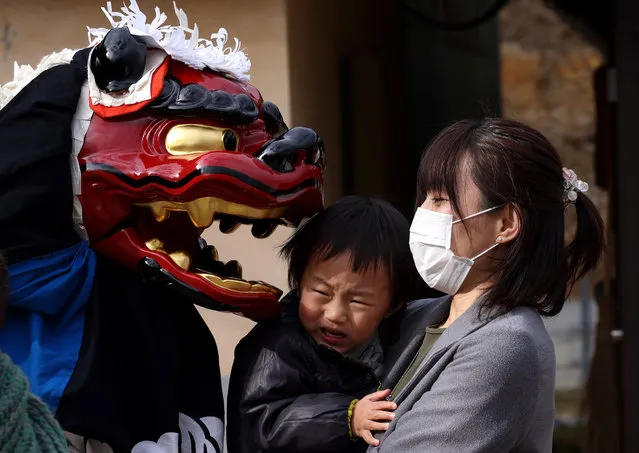
A performer wearing a lion mask performs the Ise Daikagura lion dance at the remote village of Yamanawa on February 08, 2021 in Ryuo, Japan. Ise Daikagura is a group of traditional Lion Dance performers who pray in front of farmers houses and businesses for good grain harvests and disease-free lives. Performers play sacred music using drums and flutes with two lion mask dancers. A lion mask is considered a symbol of God, who enters the house and performs in front of the Shinto God, a statue placed inside the house, mostly in the kitchen. These prayers are called “Kamodo Barai”. After the prayers, they are gifted with money, rice, sake and Japanese sweets from the householders. A group can travel for more than one hundred days to thousands of households and businesses throughout rural-villages in western Japan, and pray to those who are unable to visit the country’s most sacred shrine, the Grand Ise Shrine in Mie Prefecture. The group started its performance in the Edo era between 1603 to 1868 according to Japanese history. The Japanese government designated it as an important folk cultural national property in 1981. (Photo by Buddhika Weerasinghe/Getty Images)

A performer wearing a lion mask performs the Ise Daikagura lion dance at the remote village of Yamanawa on February 08, 2021 in Ryuo, Japan. Ise Daikagura is a group of traditional Lion Dance performers who pray in front of farmers houses and businesses for good grain harvests and disease-free lives. (Photo by Buddhika Weerasinghe/Getty Images)
Details
18 Feb 2021 09:27:00
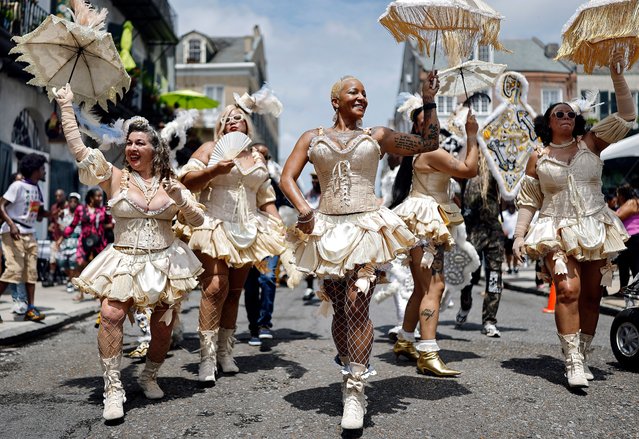
Members of the Mahogany Blue Baby Dolls including Victoria “Lady Lotus” Spotts (C) march in the 25th Anniversary Satchmo Salute second line parade, honoring New Orleans jazz legend Louis Armstrong, on August 3, 2025 in New Orleans, Louisiana. Revelers marched from historic St. Augustine Catholic Church in the Tremé neighborhood to the New Orleans Jazz Museum where Satchmo Summerfest is being held. New Orleans and the Gulf Coast region are preparing to mark the 20 year anniversary of Hurricane Katrina, which occurred on August 29, 2005. The failure of levees during the catastrophic storm in New Orleans flooded about 80 percent of the city including historic communities such as the Lower Ninth Ward. Katrina resulted in nearly 1,400 deaths, according to revised statistics from the National Hurricane Center, and remains the costliest storm in U.S. history at around $200 billion in today’s dollars. (Photo by Mario Tama/Getty Images)

Members of the Mahogany Blue Baby Dolls including Victoria “Lady Lotus” Spotts (C) march in the 25th Anniversary Satchmo Salute second line parade, honoring New Orleans jazz legend Louis Armstrong, on August 3, 2025 in New Orleans, Louisiana. Revelers marched from historic St. Augustine Catholic Church in the Tremé neighborhood to the New Orleans Jazz Museum where Satchmo Summerfest is being held. (Photo by Mario Tama/Getty Images)
Details
12 Aug 2025 03:19:00
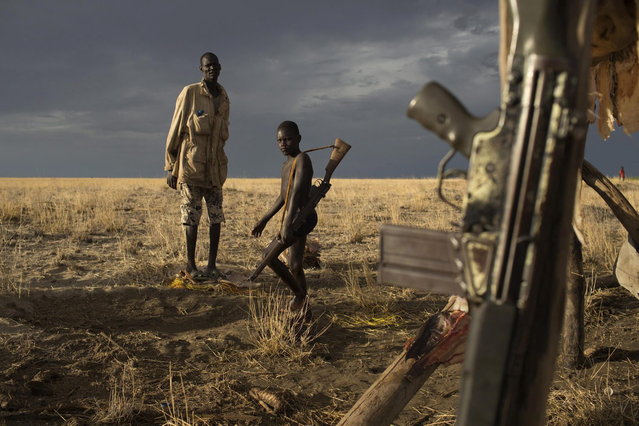
A Turkana man and a boy carrying a gun look on as a G3 battle rifle hangs from a structure used to dry fish at a fishing camp on the shores of Lake Turkana, some kilometres from Todonyang near the Kenya-Ethiopia border in northwestern Kenya October 12, 2013. (Photo by Siegfried Modola/Reuters)

A Turkana man and a boy carrying a gun look on as a G3 battle rifle hangs from a structure used to dry fish at a fishing camp on the shores of Lake Turkana, some kilometres from Todonyang near the Kenya-Ethiopia border in northwestern Kenya October 12, 2013The Turkana are traditionally nomadic pastoralists, but they have seen the pasture that they need to feed their herds suffer from recurring droughts and many have turned to fishing. However, Lake Turkana is overfished, and scarcity of food and pastureland is fuelling long-standing conflict with Ethiopian indigenous Dhaasanac, who have seen grazing grounds squeezed by large-scale government agricultural schemes in southern Ethiopia. The Dhaasanac now venture ever deeper into Kenyan territory in search of fish and grass, clashing with neighbours. Fighting between the communities has a long history, but the conflict has become ever more fatal as automatic weapons from other regional conflicts seep into the area. While the Turkana region is short of basics like grass and ground-water, it contains other resources including oil reserves and massive, newly discovered underground aquifers. (Photo by Siegfried Modola/Reuters)
Details
05 Dec 2013 12:08:00

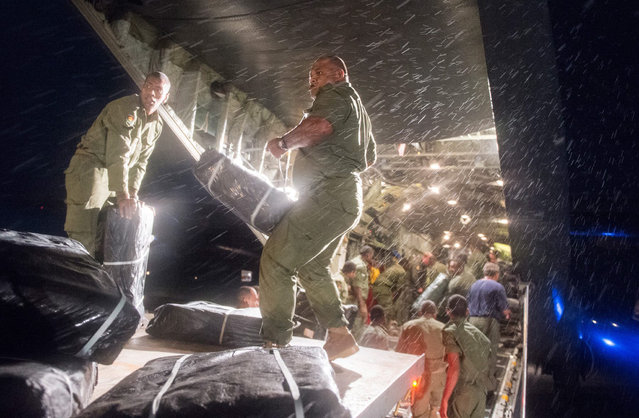
A handout image provided by the New Zealand Defence Force shows aid supplies being unloaded by Fijian soldiers from an Royal New Zealand Airforce C-130 Hercules plane in Suva, Fiji, 23 February 2016. Tool kits, generators, ration packs, water containers and chainsaws make up part of the New Zealand relief following Tropical Cyclone Winston. The death toll from the cyclone that hit Fiji over the weekend climbed to 29, local media reported ON 23 February. (Photo by Sam Shepherd/EPA/NZ Defence Force)

A handout image provided by the New Zealand Defence Force shows aid supplies being unloaded by Fijian soldiers from an Royal New Zealand Airforce C-130 Hercules plane in Suva, Fiji, 23 February 2016. Tool kits, generators, ration packs, water containers and chainsaws make up part of the New Zealand relief following Tropical Cyclone Winston. The death toll from the cyclone that hit Fiji over the weekend climbed to 29, local media reported ON 23 February. Cyclone Winston, the most powerful storm in Fiji's history, battered the country's main island of Viti Levu and other smaller surrounding islands on Saturday, the Fiji Broadcasting Corporation reported. (Photo by Sam Shepherd/EPA/NZ Defence Force)
Details
24 Feb 2016 12:56:00