Loading...
Done


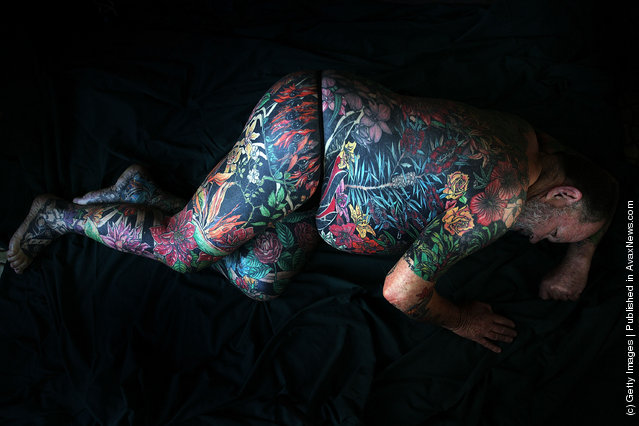
Retired teacher Geoff Ostling displays his tattooed skin at a portrait session at his home in Petersham on May 11, 2009 in Sydney, Australia. The 62-year old has pledged to donate his skin to the National Gallery in Canberra after his death. Ostling, who did not get his first tattoo until he was in his forties, is now covered in the artwork by artist eX de Merci from neck to ankle with the theme 'all the flowers of a Sydney garden'. (Photo by Lisa Maree Williams/Getty Images)
Details
15 Jun 2011 10:22:00
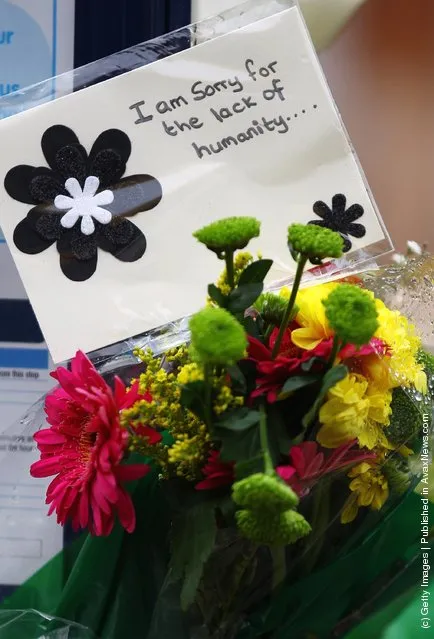
Respects Are Paid To Three Killed In Hit And Run During Birmingham Riot

Flowers are left at the scene of a hit and run following civil disturbances in the Winson Green area on August 11, 2011 in Birmingham, England. Police are continuing investigations after three people – reportedly trying to protect shops from rioting and looting in Dudley Road – were struck by a car. Police have so far arrested over 1,000 people following rioting which erupted over a four-day period across the UK. (Photo by Jeff J Mitchell/Getty Images)
Details
11 Aug 2011 14:14:00
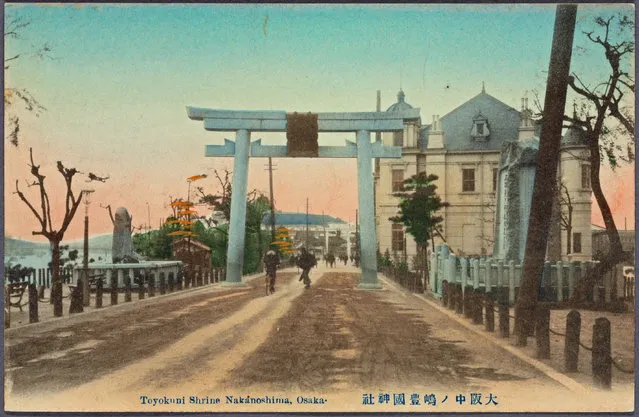
Toyokuni Shrine Nakanoshima, Osaka, Japan. (Photo by New York Public Library/Caters News)

These timeless postcards offer an eye-opening glimpse into life in Japan in the early 20th century. Taken from hand-colored photographs, the postcards showcase the still beauty of the country, depicting a nation on the cusp of modernization. The images feature solemn fishermen, bustling streets, temples and shrines: a country yet to be influenced by Western culture. The tinting effect brings out the rich colors of the natural surroundings, with trees, flowers and cherry blossoms jumping from the original black-and-white images. Here: Toyokuni Shrine Nakanoshima, Osaka, Japan. (Photo by New York Public Library/Caters News)
Details
02 Apr 2016 09:33:00
A woman wearing a four-leaf clover-like hairpin takes a selfie nearby Nanluoguxiang street in Beijing, China, September 16, 2015. (Photo by Kim Kyung-Hoon/Reuters)

A woman wearing a four-leaf clover-like hairpin takes a selfie nearby Nanluoguxiang street in Beijing, China, September 16, 2015. Wearing antenna styled hairpins in the shape of various flowers and plants at scenic spots has become a new trend in Beijing. (Photo by Kim Kyung-Hoon/Reuters)
Details
18 Sep 2015 15:08:00
An Indian artist gives the finishing touches to a figure of the elephant-headed Hindu god Ganesha at a workshop ahead of the Ganesh Chaturthi festival in New Delhi on September 15, 2015. (Photo by Sajjad Hussain/AFP Photo)

An Indian artist gives the finishing touches to a figure of the elephant-headed Hindu god Ganesha at a workshop ahead of the Ganesh Chaturthi festival in New Delhi on September 15, 2015. The idol is meant for the forthcoming festival Ganesha Chaturthi, a ten-day long event which is celebrated all over India. During the Ganpati festival, that is celebrated as the birthday of Lord Ganesha, idols of the Hindu deity are worshipped at hundreds of pandals or makeshift tents before they are immersed into water bodies. This year, the festival starts on 17 September 2015. (Photo by Sajjad Hussain/AFP Photo)
Details
17 Sep 2015 10:38:00
A bullied student with vitiligo is celebrating learning to love her skin by turning it into art  making a world map, flowers and even a Van Gogh painting. Ashley Soto, 21, from Orlando in Florida, USA, has found turning her white patches of skin into art has empowered her and helped her to embrace her vitiligo. Here are some of the art pieces Ashleys made to celebrate and embrace her vitiligo from a world map to simply tracing her vitiligo and also Van Goghs Starry Night. (Photo by Ashley Soto/Caters News Agency)

A bullied student with vitiligo is celebrating learning to love her skin by turning it into art making a world map, flowers and even a Van Gogh painting. Ashley Soto, 21, from Orlando in Florida, USA, has found turning her white patches of skin into art has empowered her and helped her to embrace her vitiligo. Here are some of the art pieces Ashleys made to celebrate and embrace her vitiligo from a world map to simply tracing her vitiligo and also Van Goghs Starry Night. (Photo by Ashley Soto/Caters News Agency)
Details
16 Mar 2017 00:02:00
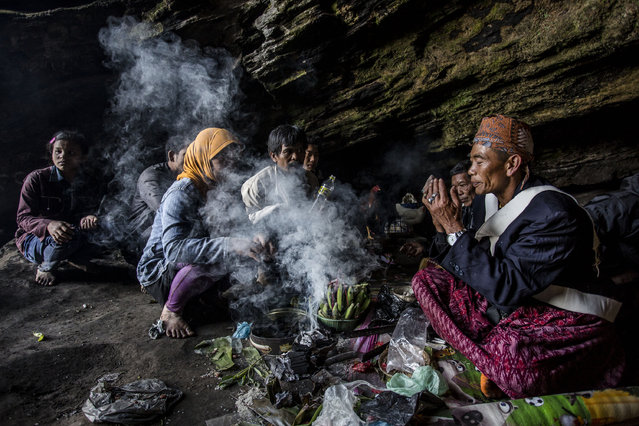
A Tenggerese shaman praying for worshippers at Widodaren cave during the Tenggerese Hindu Yadnya Kasada festival on July 31, 2015 in Probolinggo, East Java, Indonesia. The festival is the main festival of the Tenggerese people and lasts about a month. On the fourteenth day, the Tenggerese make the journey to Mount Bromo to make offerings of rice, fruits, vegetables, flowers and livestock to the mountain gods by throwing them into the volcano's caldera. (Photo by Ulet Ifansasti/Getty Images)

A Tenggerese shaman praying for worshippers at Widodaren cave during the Tenggerese Hindu Yadnya Kasada festival on July 31, 2015 in Probolinggo, East Java, Indonesia. The festival is the main festival of the Tenggerese people and lasts about a month. On the fourteenth day, the Tenggerese make the journey to Mount Bromo to make offerings of rice, fruits, vegetables, flowers and livestock to the mountain gods by throwing them into the volcano's caldera. The origin of the festival lies in the 15th century when a princess named Roro Anteng started the principality of Tengger with her husband Joko Seger, and the childless couple asked the mountain Gods for help in bearing children. The legend says the Gods granted them 24 children but on the provision that the 25th must be tossed into the volcano in sacrifice. The 25th child, Kesuma, was finally sacrificed in this way after initial refusal, and the tradition of throwing sacrifices into the caldera to appease the mountain Gods continues today. (Photo by Ulet Ifansasti/Getty Images)
Details
01 Aug 2015 12:07:00
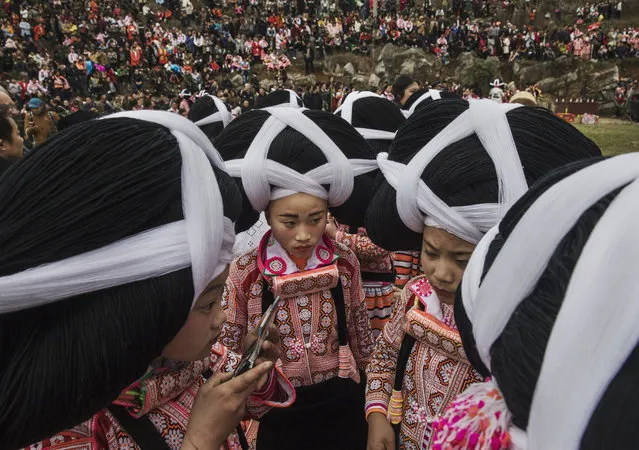
Girls of the Long Horn Miao ethnic minority group wear headdresses as they prepare gather for Tiaohua or Flower Festival as part of the Lunar New Year on February 6, 2017 in Longga village, Guizhou province, southern China. The Long Horn Miao are recognized for their declining practice of wrapping a blend of linen, wool, and the hair of their ancestors around animal horns or a wooden clip to make headdresses. Many young women say they now wear the headdresses only for special occasions and festivals, as the ornaments, which are attached by the horns to their real hair, have proved impractical for modern daily life in a fast changing world. China officially recognizes 56 different ethnic minorities, and statistics show over 7 million Chinese identifying themselves as Miao. But the small Long Horn Miao community counts only around 5000 people living in 12 villages, whose age-old traditions, language, and culture are fading. It is increasingly difficult in a modernizing China, as young people are drawn from remote rural villages to opportunities in bigger cities amongst wide-scale urbanization. Farming and labour remain the mainstays of life for the Long Horn Miao, leaving the area relatively poor in comparison with many parts of China. The government has invested significant amounts into local infrastructure and the tourism industry to try to bolster the local economy. (Photo by Kevin Frayer/Getty Images)

Girls of the Long Horn Miao ethnic minority group wear headdresses as they prepare gather for Tiaohua or Flower Festival as part of the Lunar New Year on February 6, 2017 in Longga village, Guizhou province, southern China. (Photo by Kevin Frayer/Getty Images)
Details
13 Feb 2017 00:01:00