Loading...
Done
A young boy scoops water from a hand-dug well in the dry riverbed near Matinyani, in the semi-arid Kitui County in southeastern Kenya, 22 March 2015, the World Water Day. Residents of Kitui County and other arid and semi-arid areas of the country have been hard-hit by extremely poor rainfall this year while the government said in previous month that some 1.6 million people countrywide are facing acute starvation due to the drought and will need relief food over the next six months. (Photo by Dai Kurokawa/EPA)

A young boy scoops water from a hand-dug well in the dry riverbed near Matinyani, in the semi-arid Kitui County in southeastern Kenya, 22 March 2015, the World Water Day. Residents of Kitui County and other arid and semi-arid areas of the country have been hard-hit by extremely poor rainfall this year while the government said in previous month that some 1.6 million people countrywide are facing acute starvation due to the drought and will need relief food over the next six months. Residents of Matinyani say they haven't seen a drop of rain in nearly four months. Thousands of Kenyans in rural areas walk tens of kilometers just to fetch water to drink and to be used in their homes. According to an estimate by UNESCO (United Nations Educational, Scientific and Cultural Organization), 17 million people lack access to safe water in Kenya, where the drought is a perennial problem. (Photo by Dai Kurokawa/EPA)
Details
23 Mar 2015 11:01:00
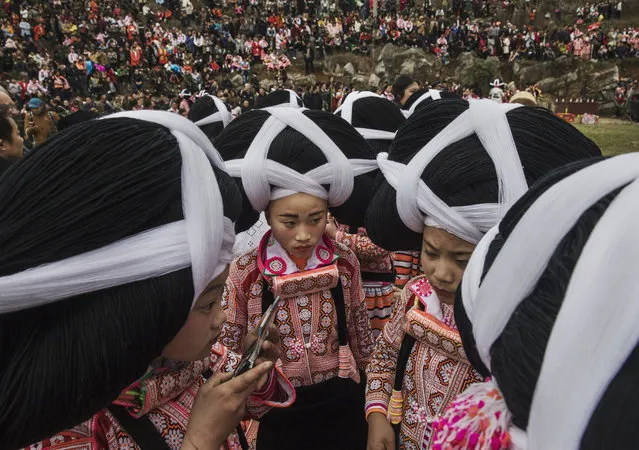
Girls of the Long Horn Miao ethnic minority group wear headdresses as they prepare gather for Tiaohua or Flower Festival as part of the Lunar New Year on February 6, 2017 in Longga village, Guizhou province, southern China. The Long Horn Miao are recognized for their declining practice of wrapping a blend of linen, wool, and the hair of their ancestors around animal horns or a wooden clip to make headdresses. Many young women say they now wear the headdresses only for special occasions and festivals, as the ornaments, which are attached by the horns to their real hair, have proved impractical for modern daily life in a fast changing world. China officially recognizes 56 different ethnic minorities, and statistics show over 7 million Chinese identifying themselves as Miao. But the small Long Horn Miao community counts only around 5000 people living in 12 villages, whose age-old traditions, language, and culture are fading. It is increasingly difficult in a modernizing China, as young people are drawn from remote rural villages to opportunities in bigger cities amongst wide-scale urbanization. Farming and labour remain the mainstays of life for the Long Horn Miao, leaving the area relatively poor in comparison with many parts of China. The government has invested significant amounts into local infrastructure and the tourism industry to try to bolster the local economy. (Photo by Kevin Frayer/Getty Images)

Girls of the Long Horn Miao ethnic minority group wear headdresses as they prepare gather for Tiaohua or Flower Festival as part of the Lunar New Year on February 6, 2017 in Longga village, Guizhou province, southern China. (Photo by Kevin Frayer/Getty Images)
Details
13 Feb 2017 00:01:00
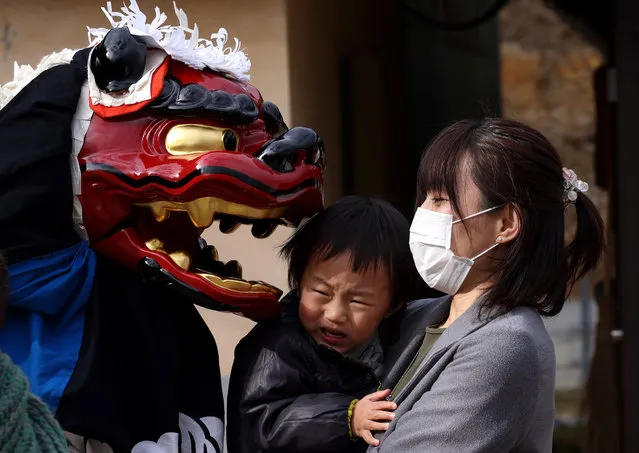
A performer wearing a lion mask performs the Ise Daikagura lion dance at the remote village of Yamanawa on February 08, 2021 in Ryuo, Japan. Ise Daikagura is a group of traditional Lion Dance performers who pray in front of farmers houses and businesses for good grain harvests and disease-free lives. Performers play sacred music using drums and flutes with two lion mask dancers. A lion mask is considered a symbol of God, who enters the house and performs in front of the Shinto God, a statue placed inside the house, mostly in the kitchen. These prayers are called “Kamodo Barai”. After the prayers, they are gifted with money, rice, sake and Japanese sweets from the householders. A group can travel for more than one hundred days to thousands of households and businesses throughout rural-villages in western Japan, and pray to those who are unable to visit the country’s most sacred shrine, the Grand Ise Shrine in Mie Prefecture. The group started its performance in the Edo era between 1603 to 1868 according to Japanese history. The Japanese government designated it as an important folk cultural national property in 1981. (Photo by Buddhika Weerasinghe/Getty Images)

A performer wearing a lion mask performs the Ise Daikagura lion dance at the remote village of Yamanawa on February 08, 2021 in Ryuo, Japan. Ise Daikagura is a group of traditional Lion Dance performers who pray in front of farmers houses and businesses for good grain harvests and disease-free lives. (Photo by Buddhika Weerasinghe/Getty Images)
Details
18 Feb 2021 09:27:00
A Pakistani vendor prepares peanuts for sale on a roadside in Peshawar, Pakistan, 01 January 2018. After a good raining season the sales of dry fruits flourish in the country. Tourists from all over Pakistan come to Peshawar to purchase dry fruits along with other items because of price differences between different parts of the country. (Photo by Bilawal Arbab/EPA/EFE)

A Pakistani vendor prepares peanuts for sale on a roadside in Peshawar, Pakistan, 01 January 2018. After a good raining season the sales of dry fruits flourish in the country. Tourists from all over Pakistan come to Peshawar to purchase dry fruits along with other items because of price differences between different parts of the country. (Photo by Bilawal Arbab/EPA/EFE)
Details
09 Feb 2018 07:06:00
Festival goers having fun at the Balaton Sound music festival in Zamardi next to the Lake of Balaton, 110 km (68 miles) west of Budapest, July 6, 2017. (Photo by Zsolt Furesz)

Festival goers having fun at the Balaton Sound music festival in Zamardi next to the Lake of Balaton, 110 km (68 miles) west of Budapest, July 6, 2017. (Photo by Zsolt Furesz)
Details
07 Jul 2017 07:39:00
A reveller takes part in the Gay Pride Parade in San Salvador, on June 24, 2017. (Photo by Marvin Recinos/AFP Photo)

A reveller takes part in the Gay Pride Parade in San Salvador, on June 24, 2017. (Photo by Marvin Recinos/AFP Photo)
Details
26 Jun 2017 09:20:00
An abandoned protection masks in the deserted building near bypass channel for cooling at the Chernobyl nuclear power plant in the Exclusion Zone, Ukraine, April 5, 2017. (Photo by Vitaliy Holovin/Corbis via Getty images)

An abandoned protection masks in the deserted building near bypass channel for cooling at the Chernobyl nuclear power plant in the Exclusion Zone, Ukraine, April 5, 20177. The Chernobyl nuclear accident occurred on 26 April 1986 in the No.4 light water graphite moderated reactor at the Chernobyl Nuclear Power Plant near Pripyat. An estimated 47,000 people of the city of Pripyat were evacuated after the explosion in 1986. (Photo by Vitaliy Holovin/Corbis via Getty images)
Details
24 May 2019 00:03:00
Roxy, Bono and Blue in costumes inspired by Tim Burton's films in Sonoma County, California, 2014. As Halloween draws closer even pugs are dressing up in costumes. But these outfits are unlikely to give anyone nightmares and are more cute than creepy. (Photo by Phillip Lauer/Barcroft Media)

Roxy, Bono and Blue in costumes inspired by Tim Burton's films in Sonoma County, California, 2014. As Halloween draws closer even pugs are dressing up in costumes. But these outfits are unlikely to give anyone nightmares and are more cute than creepy. Philip Lauer, from California, has dressed his three pets Bono, Blue and Roxy, in adorable costumes – with witch hats and black capes. His home in Sonoma County, California, has its own studio to take professional pictures of the posing pups. Every year he and wife wife Sue dress their pets in creepy costumes and send pictures of them to their friends and family as a spooky treat. (Photo by Phillip Lauer/Barcroft Media)
Details
02 Nov 2014 11:46:00