Loading...
Done
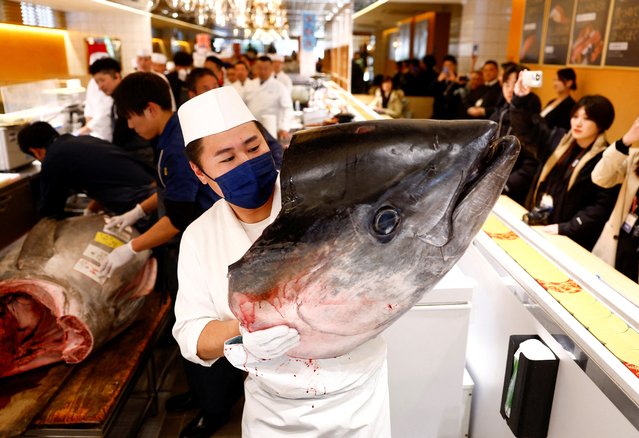
The head of a 276-kilogram bluefin tuna that was auctioned for 207 million Japanese yen (about 1.3 million U.S. dollars), which was bought jointly by sushi restaurant operator Onodera Group and wholesaler Yamayuki, is carried by a sushi chef at an Onodera sushi restaurant after the first tuna auction of the New Year in Tokyo, Japan on January 5, 2025. (Photo by Issei Kato/Reuters)

The head of a 276-kilogram bluefin tuna that was auctioned for 207 million Japanese yen (about 1.3 million U.S. dollars), which was bought jointly by sushi restaurant operator Onodera Group and wholesaler Yamayuki, is carried by a sushi chef at an Onodera sushi restaurant after the first tuna auction of the New Year in Tokyo, Japan on January 5, 2025. (Photo by Issei Kato/Reuters)
Details
08 Jan 2025 03:59:00
Japanese actress and singer Anna Sawai, left, winner of the award for outstanding lead actress in a drama series for “Shogun”, and Hiroyuki Sanada, winner of the awards for outstanding lead actor in a drama series, and outstanding drama series for “Shogun” pose in the press room during the 76th Primetime Emmy Awards on Sunday, Sept. 15, 2024, at the Peacock Theater in Los Angeles. (Photo by Jae C. Hong/AP Photo)

Japanese actress and singer Anna Sawai, left, winner of the award for outstanding lead actress in a drama series for “Shogun”, and Hiroyuki Sanada, winner of the awards for outstanding lead actor in a drama series, and outstanding drama series for “Shogun” pose in the press room during the 76th Primetime Emmy Awards on Sunday, Sept. 15, 2024, at the Peacock Theater in Los Angeles. (Photo by Jae C. Hong/AP Photo)
Details
16 Jan 2026 11:20:00
A performer wearing a lion mask performs the Ise Daikagura lion dance at the remote village of Yamanawa on February 08, 2021 in Ryuo, Japan. Ise Daikagura is a group of traditional Lion Dance performers who pray in front of farmers houses and businesses for good grain harvests and disease-free lives. Performers play sacred music using drums and flutes with two lion mask dancers. A lion mask is considered a symbol of God, who enters the house and performs in front of the Shinto God, a statue placed inside the house, mostly in the kitchen. These prayers are called “Kamodo Barai”. After the prayers, they are gifted with money, rice, sake and Japanese sweets from the householders. A group can travel for more than one hundred days to thousands of households and businesses throughout rural-villages in western Japan, and pray to those who are unable to visit the country’s most sacred shrine, the Grand Ise Shrine in Mie Prefecture. The group started its performance in the Edo era between 1603 to 1868 according to Japanese history. The Japanese government designated it as an important folk cultural national property in 1981. (Photo by Buddhika Weerasinghe/Getty Images)

A performer wearing a lion mask performs the Ise Daikagura lion dance at the remote village of Yamanawa on February 08, 2021 in Ryuo, Japan. Ise Daikagura is a group of traditional Lion Dance performers who pray in front of farmers houses and businesses for good grain harvests and disease-free lives. (Photo by Buddhika Weerasinghe/Getty Images)
Details
18 Feb 2021 09:27:00
Senji Nakajima sleeps with his Love Doll “Saori” at Love Hotel on June 4, 2016 in Nagano, Japan. Senji Nakajima, 61 years old, lives with his life-size 'love doll' named “Saori” in his apartment in Tokyo, Japan. Nakajima, married with two children, who lives away from home for work, first started his life with Saori six years ago. At first, he used to imagine as if the doll was his first girl friend, and used it only for sexual purposes to fill the loneliness, but months later, he started to find Saori actually has an original personality. “She never betrays, not after only money. I'm tired of modern rational humans. They are heartless”, Nakajima says, “for me, she is more than a doll. Not just a silicon rubber. She needs much help, but still is my perfect partner who shares precious moments with me and enriches my life”. (Photo by Taro Karibe/Getty Images)

Senji Nakajima sleeps with his Love Doll “Saori” at Love Hotel on June 4, 2016 in Nagano, Japan. Senji Nakajima, 61 years old, lives with his life-size “love doll” named “Saori” in his apartment in Tokyo, Japan. Nakajima, married with two children, who lives away from home for work, first started his life with Saori six years ago. (Photo by Taro Karibe/Getty Images)
Details
07 Aug 2016 09:21:00


“Takeru Kobayashi (born March 15, 1978) is a Japanese competitive eater. He held the world record for hot dog eating for nearly six years, and holds several other eating records, including four Guinness Records for hot dogs, meatballs, hamburgers, and pasta”. – Wikipedia

Photo: Takeru Kobayashi challeges 2011 Nathan's Famous Hot Dog Eating Competition contestants via satellite at 230 Fifth Avenue on July 4, 2011 in New York City. (Photo by Cindy Ord/Getty Images)
Details
05 Jul 2011 11:36:00
A humanoid robot works side by side with employees in the assembly line at a factory of Glory Ltd., a manufacturer of automatic change dispensers, in Kazo, north of Tokyo, Japan, July 1, 2015. (Photo by Issei Kato/Reuters)

A humanoid robot works side by side with employees in the assembly line at a factory of Glory Ltd., a manufacturer of automatic change dispensers, in Kazo, north of Tokyo, Japan, July 1, 2015. Japanese firms are ramping up spending on robotics and automation, responding at last to premier Shinzo Abe's efforts to stimulate the economy and end two decades of stagnation and deflation. (Photo by Issei Kato/Reuters)
Details
04 Jul 2015 10:59:00
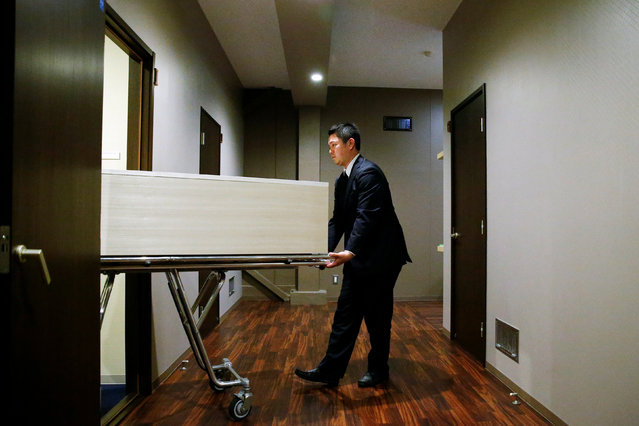
A staff member removes a coffin from a room of the “Corpse Hotel” in Kawasaki, Japan, April 20, 2016. (Photo by Thomas Peter/Reuters)

A staff member removes a coffin from a room of the “Corpse Hotel” in Kawasaki, Japan, April 20, 2016. Many so-called corpse hotels have emerged as a flourishing business in the city following a crunch in crematoriums. Families can rent a room in Sousou on a daily charge of 9,000 Japanese yen (£58, €74, $84) to keep the body of the deceased relative for up to four days until they find a crematorium. (Photo by Thomas Peter/Reuters)
Details
30 Apr 2016 09:46:00
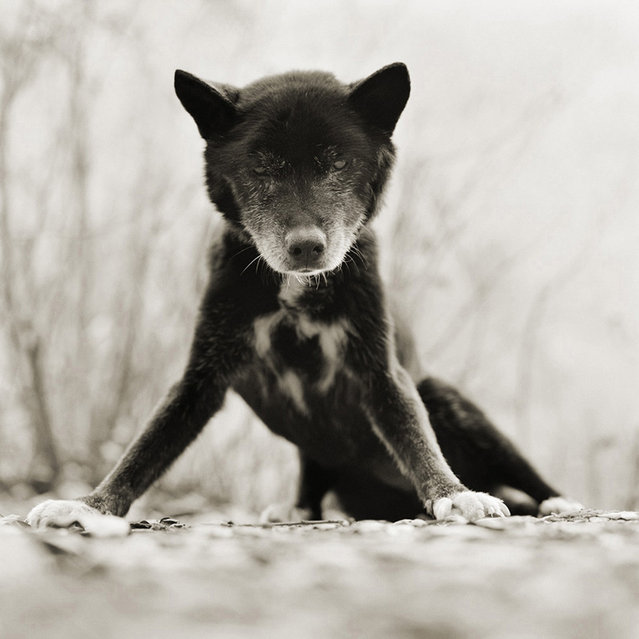
Blue, Australian Kelpie, Age 19, I

Blue, Australian Kelpie, Age 19

I am traveling to sanctuaries across the country to photograph animals that are elderly or at the end stage of their lives. I began this series shortly after I had spent a year in New Jersey helping my sister care for my mother who has Alzheimer’s disease. When mom got sick, I made a conscious decision not to photograph her. But, caring for her had a profound impact on me and I knew the experience would influence my photography. ...

Details
13 May 2012 07:33:00