Loading...
Done
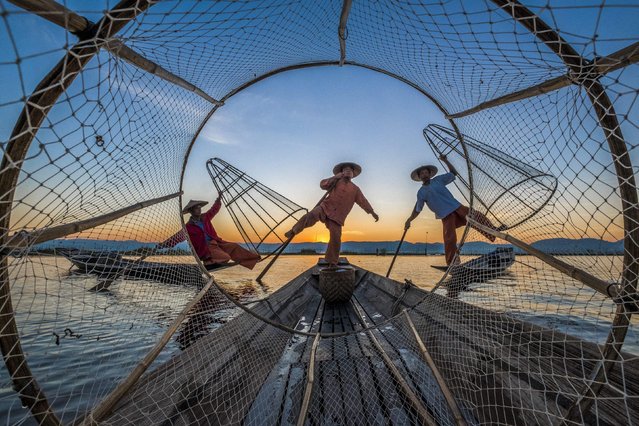
Fishermen use traditional cone-shaped nets on Inle lake in Myanmar in February 2022. The men steer their boats with an oar that they control with their feet. They throw the net into the water and push it down so it sinks to the bottom, then drag it back to the surface with the fish trapped inside. (Photo by Alahattin Kanlioglu/Solent News)

Fishermen use traditional cone-shaped nets on Inle lake in Myanmar in February 2022. The men steer their boats with an oar that they control with their feet. They throw the net into the water and push it down so it sinks to the bottom, then drag it back to the surface with the fish trapped inside. (Photo by Alahattin Kanlioglu/Solent News)
Details
27 Jun 2022 05:35:00
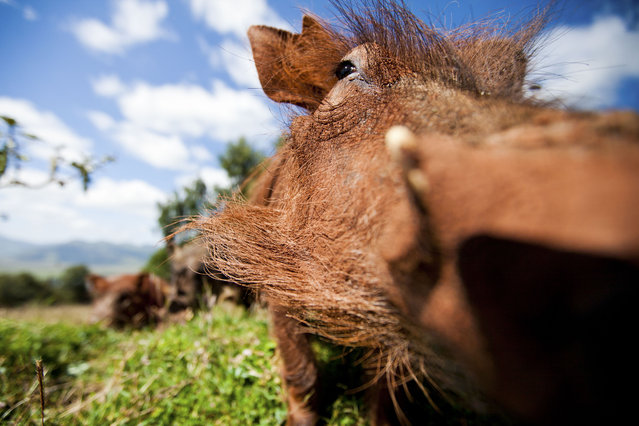
This family of warthogs regularly visited our campsite in the Ethiopian highlands so I set up a remote camera with a wide-angle lens to photograph them as they rummaged around for food. They just had a mud bath. (Photo by Will Burrard-Lucas/Caters News Agency)

This family of warthogs regularly visited our campsite in the Ethiopian highlands so I set up a remote camera with a wide-angle lens to photograph them as they rummaged around for food. They just had a mud bath. (Photo by Will Burrard-Lucas/Caters News Agency)
Details
22 Sep 2019 00:03:00
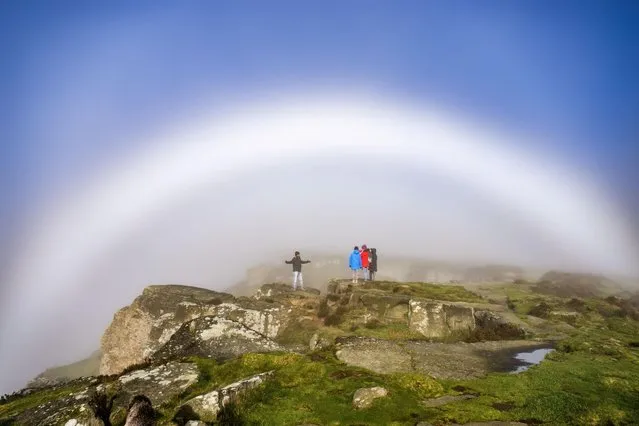
Walkers marvel at a fog bow over Curbar Edge, Derbyshire in the last decade of October 2023. The phenomenon is similar to a rainbow, but because the water droplets that cause fog are so small, its colours are very weak. (Photo by Richard Bowring/Animal News Agency)

Walkers marvel at a fog bow over Curbar Edge, Derbyshire in the last decade of October 2023. The phenomenon is similar to a rainbow, but because the water droplets that cause fog are so small, its colours are very weak. (Photo by Richard Bowring/Animal News Agency)
Details
13 Jan 2024 13:36:00
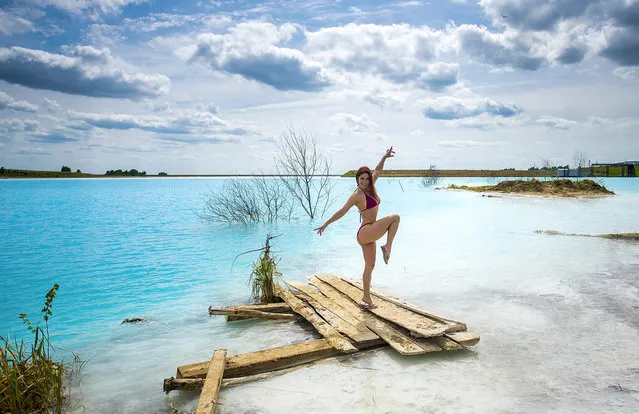
In this undated handout photo taken by mrwed54, a woman poses for a photo by a lake in the Siberian city of Novosibirsk, about 2,800 kilometers (1,750 miles) east of Moscow, Russia. Thousands of Novosibirsk residents, from scantily clad women to newlyweds have been instagramming selfies near the lake nicknamed the “Siberian Malvides” after the far-flung tropical islands in the Indian Ocean. This is in fact is a man-made dumb of coal from a nearby power station that provides for most of Novosibirsk’s energy needs. Environmentalists are warning people against coming into contact with the water. (Photo by mrwed54 via AP Photo)

In this undated handout photo taken by mrwed54, a woman poses for a photo by a lake in the Siberian city of Novosibirsk, about 2,800 kilometers (1,750 miles) east of Moscow, Russia. Thousands of Novosibirsk residents, from scantily clad women to newlyweds have been instagramming selfies near the lake nicknamed the “Siberian Malvides” after the far-flung tropical islands in the Indian Ocean. This is in fact is a man-made dumb of coal from a nearby power station that provides for most of Novosibirsk’s energy needs. Environmentalists are warning people against coming into contact with the water. (Photo by mrwed54 via AP Photo)
Details
15 Jul 2019 00:07:00
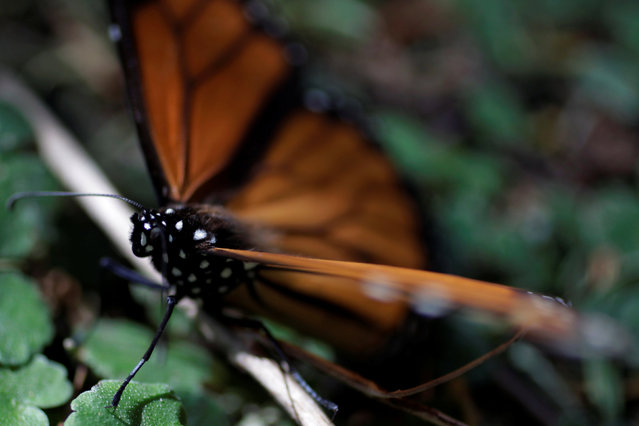
A monarch butterfly rests on the ground at the Sierra Chincua butterfly sanctuary on a mountain in Angangeo, Michoacan November 24, 2016. Angangueo is a town and municipality located in far eastern Michoacán state in central Mexico noted for its history of mining and its location in the Monarch Butterfly Biosphere Reserve. The Monarch Butterfly Biosphere Reserve is a World Heritage Site containing most of the over-wintering sites of the eastern population of the monarch butterfly. The reserve is located in the Trans-Mexican Volcanic Belt pine-oak forests ecoregion on the border of Michoacán and State of Mexico, 100 km (62 miles), northwest of Mexico City. Millions of butterflies arrive in the reserve annually. Butterflies only inhabit a fraction of the 56,000 hectares of the reserve from October–March. (Photo by Carlos Jasso/Reuters)

A monarch butterfly rests on the ground at the Sierra Chincua butterfly sanctuary on a mountain in Angangeo, Michoacan November 24, 2016. Angangueo is a town and municipality located in far eastern Michoacán state in central Mexico noted for its history of mining and its location in the Monarch Butterfly Biosphere Reserve. The Monarch Butterfly Biosphere Reserve is a World Heritage Site containing most of the over-wintering sites of the eastern population of the monarch butterfly. (Photo by Carlos Jasso/Reuters)
Details
26 Nov 2016 10:20:00
A sailor of the Marshal Shaposhnikov anti-submarine destroyer takes part in the “Vostok-2022” military exercises at the Peter the Great Gulf of the Sea of Japan outside the city of Vladivostok on September 5, 2022. The Vostok 2022 military exercises, involving several Kremlin-friendly countries including China, takes place from September 1-7 across several training grounds in Russia's Far East and in the waters off it. Over 50,000 soldiers and more than 5,000 units of military equipment, including 140 aircraft and 60 ships, are involved in the drills. (Photo by Kirill Kudryavtsev/AFP Photo)

A sailor of the Marshal Shaposhnikov anti-submarine destroyer takes part in the “Vostok-2022” military exercises at the Peter the Great Gulf of the Sea of Japan outside the city of Vladivostok on September 5, 2022. The Vostok 2022 military exercises, involving several Kremlin-friendly countries including China, takes place from September 1-7 across several training grounds in Russia's Far East and in the waters off it. Over 50,000 soldiers and more than 5,000 units of military equipment, including 140 aircraft and 60 ships, are involved in the drills. (Photo by Kirill Kudryavtsev/AFP Photo)
Details
16 Sep 2022 05:09:00
Art By Lisa Moran

Lisa Moran, an artist in Ireland, sketches images or paints them on her hands so that she can create half-masks against her own face. She made Skin Deep for Halloween. The impressive Reconstructive Surgery was just a casual image she colored between exams.
Details
25 Feb 2014 13:00:00
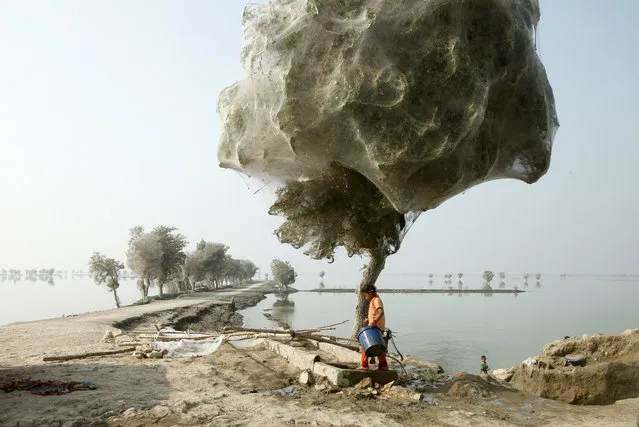
Spiderweb Cocooned Trees In Pakistan

An unexpected side-effect of the flooding in parts of Pakistan has been that millions of spiders climbed up into the trees to escape the rising flood waters. Because of the scale of the flooding and the fact that the water has taken so long to recede, many trees have become cocooned in spiders’ webs.
Details
15 May 2014 11:22:00