Loading...
Done
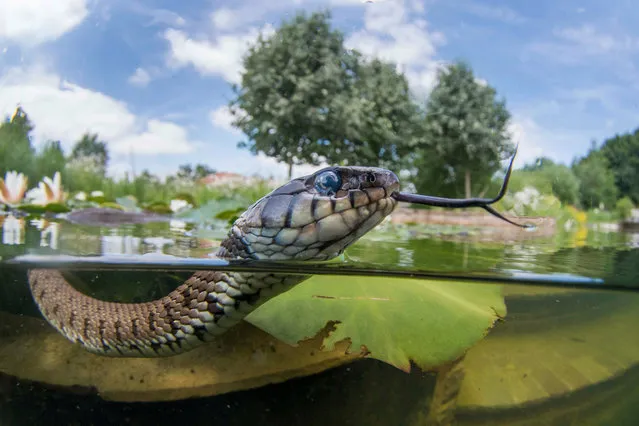
British Waters Wide Angle category runner-up. Grass snake swimming along a garden pond by Jack Perks (UK)in Nottinghamshire, UK. “I’m always on the lookout for unusual freshwater subjects and grass snakes are a species I’ve been after for years. I was told about a pond where the odd grass snake hangs around the lilly pads for frogs. I put my drysuit on and got into the water and could see one slithering along the surface. Slowly making my way towards it with my head only just poking above I got the spilt shot”. (Photo by Jack Perks/Underwater Photographer of the Year 2019)

British Waters Wide Angle category runner-up. Grass snake swimming along a garden pond by Jack Perks (UK)in Nottinghamshire, UK. “I’m always on the lookout for unusual freshwater subjects and grass snakes are a species I’ve been after for years. I was told about a pond where the odd grass snake hangs around the lilly pads for frogs. I put my drysuit on and got into the water and could see one slithering along the surface. Slowly making my way towards it with my head only just poking above I got the spilt shot”. (Photo by Jack Perks/Underwater Photographer of the Year 2019)
Details
28 Feb 2019 00:03:00
Michael Fröhlich's Jowett Javelin rotting car in his forest sculpture park in Neandertal Germany, September 11, 2016. An eccentric artist has collected fifty vintage cars and left them to rot in a forest – and now they're worth over $1 million. Former racing driver Michael Fröhlich, from Dusseldorf, Germany, has purposely crashed the cars into trees, buried them in mud and parked them on cliff faces in his estate's garden in the middle of the German Neanderthal. His collections includes a Jaguar XK120 worth $170,000, a Porsche 356 racer and a Buick worth $17,000. Perhaps his most interesting collectable is a Rolls Royce, with a purposefully misspelt “Buckingham Palace” – replacing the B with an F – emblazoned on the side with a replica of the Queen Elizabeth at the wheel. (Photo by Christoph Hagen/Barcroft Images)

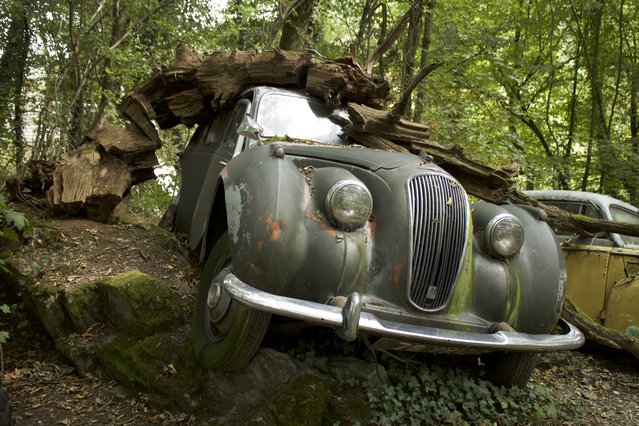
Michael Fröhlich's Jowett Javelin rotting car in his forest sculpture park in Neandertal Germany, September 11, 2016. An eccentric artist has collected fifty vintage cars and left them to rot in a forest – and now they're worth over $1 million. Former racing driver Michael Fröhlich, from Dusseldorf, Germany, has purposely crashed the cars into trees, buried them in mud and parked them on cliff faces in his estate's garden in the middle of the German Neanderthal. His collections includes a Jaguar XK120 worth $170,000, a Porsche 356 racer and a Buick worth $17,000. (Photo by Christoph Hagen/Barcroft Images)
Details
24 Sep 2016 10:56:00
Guardian of the Mangroves – Overall Winner. Tanya Houppermans, Cuba. A curious American crocodile (Crocodylus acutus) swims right up to Tanya, at Gardens of the Queen (Jardines De La Reina), an archipelago off the coast of Cuba. It has been strictly protected since 1996, and is one of the most untouched marine ecosystems in the world. ‍ “The healthy population of American crocodiles is down to the pristine condition of the mangroves and I wanted to capture close ups of this gentle giant in its natural habitat. I hope this image can illustrate that protecting areas like this is so critical”. (Photo by Tanya Griffin Houppermans/Mangrove Photographer of the Year)

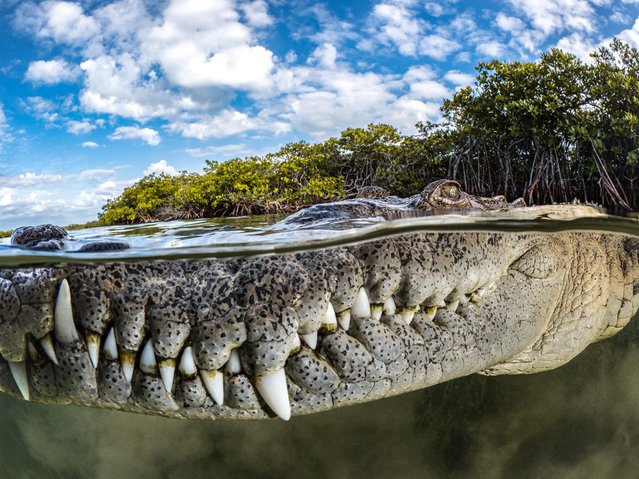
Guardian of the Mangroves – Overall Winner. Tanya Houppermans, Cuba. A curious American crocodile (Crocodylus acutus) swims right up to Tanya, at Gardens of the Queen (Jardines De La Reina), an archipelago off the coast of Cuba. It has been strictly protected since 1996, and is one of the most untouched marine ecosystems in the world. ‍ “The healthy population of American crocodiles is down to the pristine condition of the mangroves and I wanted to capture close ups of this gentle giant in its natural habitat. I hope this image can illustrate that protecting areas like this is so critical”. (Photo by Tanya Griffin Houppermans/Mangrove Photographer of the Year)
Details
05 Nov 2022 04:24:00


“The aye-aye (Daubentonia madagascariensis) is a lemur, a strepsirrhine primate native to Madagascar that combines rodent-like teeth and a special thin middle finger to fill the same ecological niche as a woodpecker. It is the world's largest nocturnal primate, and is characterized by its unusual method of finding food; it taps on trees to find grubs, then gnaws holes in the wood and inserts its narrow middle finger to pull the grubs out. The only other animal species known to find food in this way is the striped possum. From an ecological point of view the aye-aye fills the niche of a woodpecker as it is capable of penetrating wood to extract the invertebrates within”. – Wikipedia

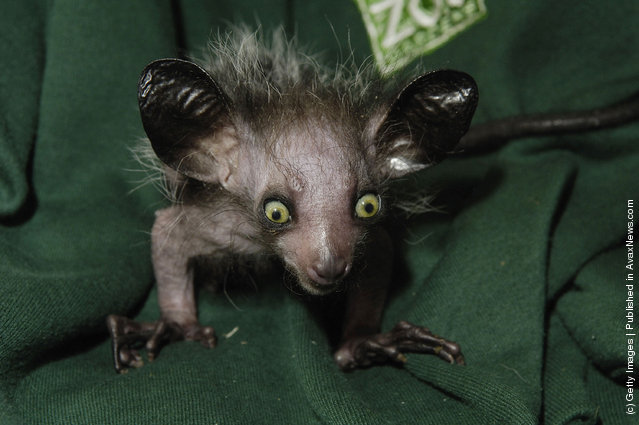
Photo: In this handout image from Bristol Zoo is seen the first captive bred aye-aye in the UK named “Kintana” (meaning star in Malagasy) April 15, 2005 at Bristol Zoo Gardens, England. The zoo announced today only the second baby aye-aye to be hand-reared in the world (the first was in Jersey Zoo) and has now made his first public appearance since his birth on 11 February 2005. (Photo by Rob Cousins/Bristol Zoo via Getty Images)
Details
13 Apr 2011 13:33:00
Going nowhere in a hurry, this friendly Javan Tree frog can be seen casually hopping aboard the slow-paced snail who like a lonely highway trucker is only too happy to have the company.  These cute critters chew the fat until froggy reaches his destination and alights at the top of the branch. (Photo by Kurit Afsheen/Media Drum World)

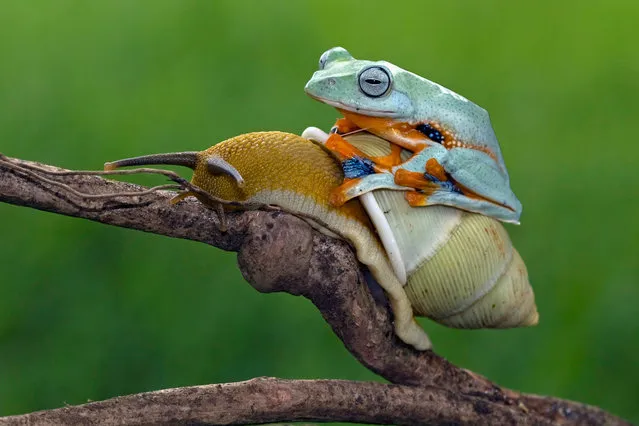
Going nowhere in a hurry, this friendly Javan Tree frog can be seen casually hopping aboard the slow-paced snail who like a lonely highway trucker is only too happy to have the company. These cute critters chew the fat until froggy reaches his destination and alights at the top of the branch. Creative Designer and amateur photographer Kurit Afsheen (34) was able to capture this special sequence while out in his back garden in Ciledug, Indonesia. (Photo by Kurit Afsheen/Media Drum World)
Details
19 Jul 2015 09:17:00
Girls of the Long Horn Miao ethnic minority group wear headdresses as they prepare gather for Tiaohua or Flower Festival as part of the Lunar New Year on February 6, 2017 in Longga village, Guizhou province, southern China. The Long Horn Miao are recognized for their declining practice of wrapping a blend of linen, wool, and the hair of their ancestors around animal horns or a wooden clip to make headdresses. Many young women say they now wear the headdresses only for special occasions and festivals, as the ornaments, which are attached by the horns to their real hair, have proved impractical for modern daily life in a fast changing world. China officially recognizes 56 different ethnic minorities, and statistics show over 7 million Chinese identifying themselves as Miao. But the small Long Horn Miao community counts only around 5000 people living in 12 villages, whose age-old traditions, language, and culture are fading. It is increasingly difficult in a modernizing China, as young people are drawn from remote rural villages to opportunities in bigger cities amongst wide-scale urbanization. Farming and labour remain the mainstays of life for the Long Horn Miao, leaving the area relatively poor in comparison with many parts of China. The government has invested significant amounts into local infrastructure and the tourism industry to try to bolster the local economy. (Photo by Kevin Frayer/Getty Images)

Girls of the Long Horn Miao ethnic minority group wear headdresses as they prepare gather for Tiaohua or Flower Festival as part of the Lunar New Year on February 6, 2017 in Longga village, Guizhou province, southern China. (Photo by Kevin Frayer/Getty Images)
Details
13 Feb 2017 00:01:00
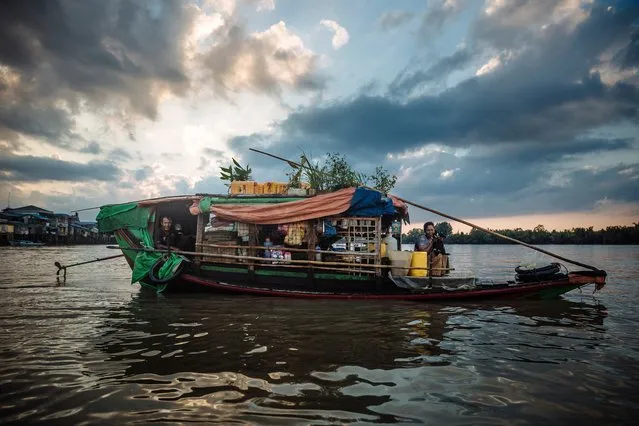
Tin and Naing win live on a small boat which they sail throughout the Delta region in Myanmar. The former gardeners once had a home on land but it was destroyed when a powerful cyclone ravaged the area in 2008. Since then, the couple have not been able to afford to rebuild their home, so they live on the boat from which they sell fish paste to make a living. (Photo by Muse Mohammed/IOM)

The ferocity of crises worldwide is forcing a record number of people to flee their homes, seeking some form of safety within their own country or across international borders. There are 65.3 million displaced people worldwide, including 21.3 million refugees. Most have lost their homes to armed conflict or natural disasters but other factors, such as extreme poverty and climate change, also drive displacement. The International Organisation for Migration commissioned photojournalist Muse Mohammed to document the plight of the displaced. (Photo by Muse Mohammed/IOM)
Details
02 Jan 2017 12:04:00
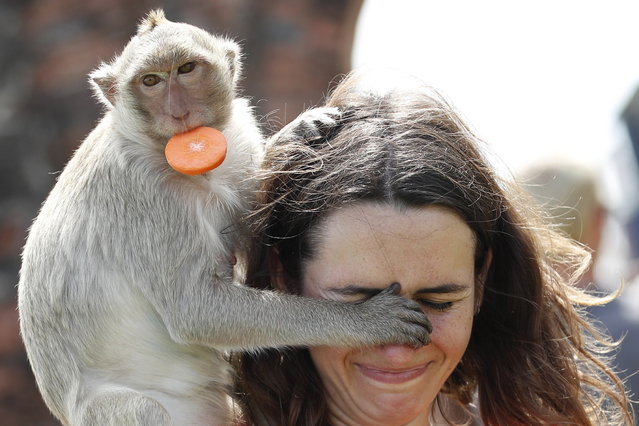
A monkey is being fed by a foreign tourist during the annual Monkey Banquet at Phra Prang Sam Yod ancient temple in Lopburi, some 180km from Bangkok, central Thailand, 24 November 2024. The annual gala has been organized since 1989 by Lopburi's entrepreneur Yongyuth Kitwatananusont, offering all-you-can-eat fruits, vegetables, and desserts for monkeys to honor the long-tailed macaques to attract tourists to visit the town to promote tourism. According to the Wildlife Department, more than 2,000 urban monkeys were captured in 2024 by authorities to control the monkey population after the growing complaints of residents that the macaques maraud food, frequently confront residents, causing accidents as well as their properties, assets, and the ancient city to be overrun and damaged by the monkeys. (Photo by Rungroj Yongrit/EPA)

A monkey is being fed by a foreign tourist during the annual Monkey Banquet at Phra Prang Sam Yod ancient temple in Lopburi, some 180km from Bangkok, central Thailand, 24 November 2024. The annual gala has been organized since 1989 by Lopburi's entrepreneur Yongyuth Kitwatananusont, offering all-you-can-eat fruits, vegetables, and desserts for monkeys to honor the long-tailed macaques to attract tourists to visit the town to promote tourism. (Photo by Rungroj Yongrit/EPA)
Details
08 Dec 2024 04:22:00