Loading...
Done
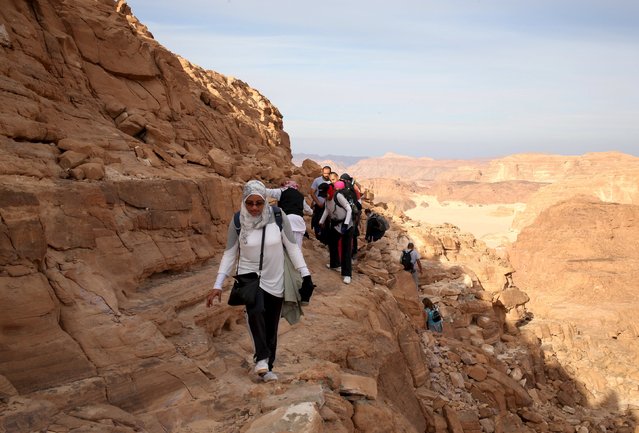
Hikers walk to reach the top of Naqba Rum area in South Sinai, Egypt, November 20, 2015. (Photo by Asmaa Waguih/Reuters)

Hikers walk to reach the top of Naqba Rum area in South Sinai, Egypt, November 20, 2015. Bedouins in the "Sinai is Safe" group guided more than 100 hikers over a 25 km (15 mile) trek over the trails of the White Canyon and the Closed Canyon. The NGO aims to challenge mainstream perceptions of the area by encouraging Nile Valley residents to explore the untamed wilderness with the Bedouin tribes. (Photo by Asmaa Waguih/Reuters)
Details
03 Dec 2015 08:00:00
Stuttgart City Library

The city of Stuttgart, Germany has officially opened a marvelous new media center, the Stuttgart City Library. This cavernous white wonder is unobtrusive in design, where the books and visitors provide the color to an otherwise neutral environment. The visual center of the Stuttgart City Library is its grand atrium, a five-story open chamber that feels like the work of a modernist MC Esher. The interior is bright without direct lighting, it is warm without paint color and intimate yet open. This work by Yi Architects is a success in design, instantly one of the world’s most beautiful libraries
Details
30 Jan 2013 14:39:00
Underwater Photography By Alexander Semenov

In 2007, I graduated from Lomonosov’s Moscow State University in the department of Zoology. I specialized in the study of invertebrate animals, with an emphasis on squid brains. Soon after, I began working at the White Sea Biological Station (WSBS) as a senior laborer. WSBS has a dive station, which is great for all sorts of underwater scientific needs, and after 4 years working there, I became chief of our diving team. I now organize all WSBS underwater projects and dive by myself with a great pleasure and always with a camera.
Details
05 Feb 2013 15:28:00
Primitive Tool By Ami Drach And Dov Ganchrow

This primitive tool set by Tel Aviv-based design studio Ami Drach and Dov Ganchrow was released at the 2012 Budapest design week. The white modernized handles are a contrasting design against the natural blades of stone. Computer imaging wraps each unique cut of stone to create a perfect fit handle. The set features knives and flint starters. We are invited to explore the usefulness of these beautiful ancient tool concepts in our everyday today.
Details
22 Feb 2013 14:36:00
San-Zhi – The Pod Village – Taiwan

San Zhi, Taiwan is an abandoned vacation resort on the northern coast of Taiwan. It was built in the early 1980s, but construction of the futuristic resort ceased after a series of fatal accidents.
Even though it never opened as a vacation resort, San Zhi can still be toured. The strange pod-like buildings act as a tourist attraction. The colors of the pod-like buildings depend on their location. The buildings in the west are green, in the east pink, in the south blue, and in the north white
Details
11 May 2013 10:27:00
Van cat walks in the snow in Yuzuncu Yil University's “cat villa” where they are carefully cared, in Van, Turkiye on January 21, 2022. One of the most important symbols of Van province of Turkiye endangered Van cats are taken under protection at the Van Cat Research and Application Center of Yuzuncu Yil University. They have been the subject of many scientific studies with their unique characteristics. Efforts are continuing to protect the extinction of the Van cat, which is known for its sensuality, friendliness, white silky fur, lion's walk, fluffy tail, different eye colors and fondness for water. (Photo by Ozkan Bilgin/Anadolu Agency via Getty Images)

Van cat walks in the snow in Yuzuncu Yil University's “cat villa” where they are carefully cared, in Van, Turkiye on January 21, 2022. One of the most important symbols of Van province of Turkiye endangered Van cats are taken under protection at the Van Cat Research and Application Center of Yuzuncu Yil University. They have been the subject of many scientific studies with their unique characteristics. Efforts are continuing to protect the extinction of the Van cat, which is known for its sensuality, friendliness, white silky fur, lion's walk, fluffy tail, different eye colors and fondness for water. (Photo by Ozkan Bilgin/Anadolu Agency via Getty Images)
Details
24 Apr 2023 03:44:00
These black-and-white photos are taken from the new book “Armoured Warfare in the First World War 1916 – 1918” by Anthony Tucker-Jones and published by Pen & Sword Military. “Interestingly the British, French and Germans took completely different approaches with varying results”. The British military produced “Little Willie” in Autumn 1915 weighing 18 tonnes, which had a crew of two plus four gunners. “Inspired by a tracked artillery tractor “Little Willie” was referred to as a water tank – hence the name tank – to ensure secrecy”, said Anthony. “This led to the strange looking Mark I with its peculiar rhomboid shape, designed to cross trenches with guns in sponsons on either side. The Germans saw the tank as unchivalrous and were slow to grasp its utility. They favoured the Stormtrooper (specialist soldiers used to infiltrate enemy trenches) and artillery, not the tank”, said Anthony. “However, they didn’t hesitate to make use of captured British tanks. Although the tank helped secure victory and German soldiers dubbed it “Germany’s Downfall” the country was ultimately brought to its knees by the Allies blockade”. Here: British troops hitch a ride on a Mark IV after the massed tank fleet spearheading attack at Cambrai on November 20, 1917. (Photo by Anthony Tucker-Jones/Mediadrumworld.com)

These black-and-white photos are taken from the new book “Armoured Warfare in the First World War 1916 – 1918” by Anthony Tucker-Jones and published by Pen & Sword Military. Here: British troops hitch a ride on a Mark IV after the massed tank fleet spearheading attack at Cambrai on November 20, 1917. (Photo by Anthony Tucker-Jones/Mediadrumworld.com)
Details
23 Feb 2017 00:02:00
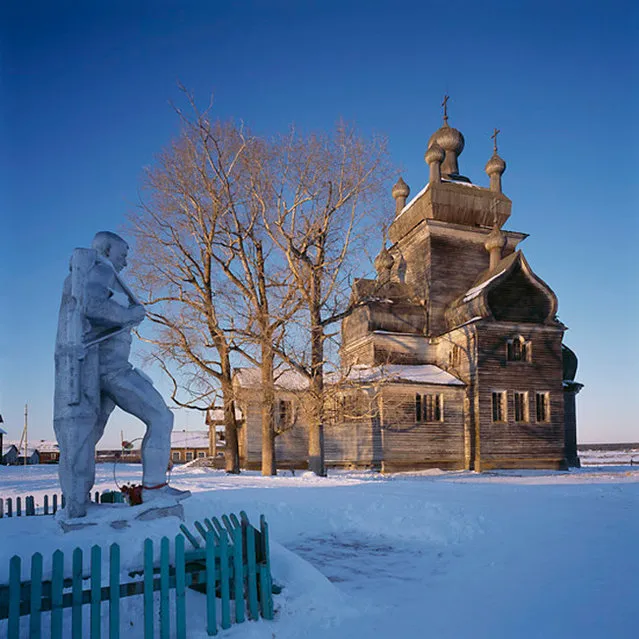
Wooden Churches - Travelling In The Russian North By Richard Davies Part 2

While communism, collectivism, worms, dry rot and casual looting failed to destroy the majestic wooden churches of Russia, it may be ordinary neglect that finally does them in. Dwindled now to several hundred remaining examples, these glories of vernacular architecture lie scattered amid the vastness of the world’s largest country. Just over a decade ago, Richard Davies, a British architectural photographer, struck out on a mission to record the fragile and poetic structures. Austerely beautiful and haunting, “Wooden Churches: Traveling in the Russian North” (White Sea Publishing; $132) is the result. Covering thousands of miles, Mr. Davies described how he and the writer Matilda Moreton tracked down the survivors from among the thousands of onion-domed structures built after Prince Vladimir converted to Christianity in 988.

See also: Wooden Churches Part1
Details
28 Nov 2013 12:13:00