Loading...
Done
Photographers gather to take pictures of pilot Andre Borschberg (C) ahead of the take off of Solar Impulse 2-a solar powered plane- in Nanjing, China, May 31, 2015. The world's largest solar-powered airplane, Solar Impulse 2, took off from eastern China's Nanjing on Sunday to continue its round-the-world voyage. The Swiss-made plane left Nanjing's Lukou International Airport at 2:39 in the early morning, with former fighter pilot Borschberg at the controls alone for the entire 8,200-kilometer flight from Nanjing to Hawaii, the toughest leg of its marathon adventure.   REUTERS/Solar Impulse/Handout via Reuters

Photographers gather to take pictures of pilot Andre Borschberg (C) ahead of the take off of Solar Impulse 2-a solar powered plane- in Nanjing, China, May 31, 2015. The world's largest solar-powered airplane, Solar Impulse 2, took off from eastern China's Nanjing on Sunday to continue its round-the-world voyage. The Swiss-made plane left Nanjing's Lukou International Airport at 2:39 in the early morning, with former fighter pilot Borschberg at the controls alone for the entire 8,200-kilometer flight from Nanjing to Hawaii, the toughest leg of its marathon adventure. (Photo by Reuters/Solar Impulse)
Details
06 Jun 2015 12:09:00
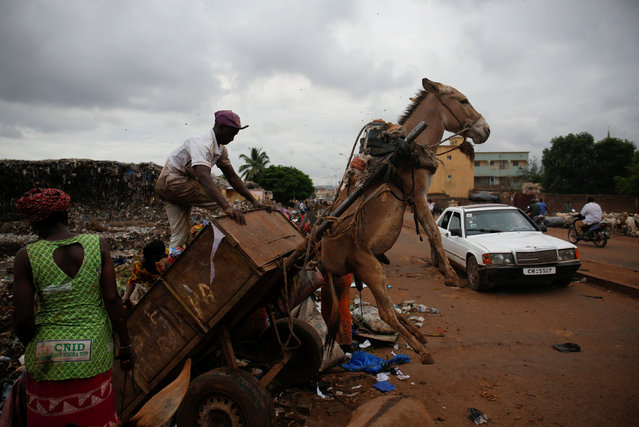
A waste picker unloads garbage at a waste transfer station in Bamako, Mali, August 19, 2018. In the Malian capital of Bamako, donkey carts driven by young men like 19-year-old Arouna Diabate play a vital role battling the fast-growing city's waste problem. Every morning before dawn, Diabate hitches his donkey to a cart and sets off on his rounds, going door-to-door to collect household garbage which he delivers to a local waste transfer station for a monthly salary of around $35. “I won't be picking up trash with a donkey cart for the rest of my life, but for now people appreciate us because we help clean up the homes of Bamako”, Diabate said. (Photo by Luc Gnago/Reuters)

A waste picker unloads garbage at a waste transfer station in Bamako, Mali, August 19, 2018. In the Malian capital of Bamako, donkey carts driven by young men like 19-year-old Arouna Diabate play a vital role battling the fast-growing city's waste problem. Every morning before dawn, Diabate hitches his donkey to a cart and sets off on his rounds, going door-to-door to collect household garbage which he delivers to a local waste transfer station for a monthly salary of around $35. “I won't be picking up trash with a donkey cart for the rest of my life, but for now people appreciate us because we help clean up the homes of Bamako”, Diabate said. (Photo by Luc Gnago/Reuters)
Details
18 Sep 2018 00:01:00
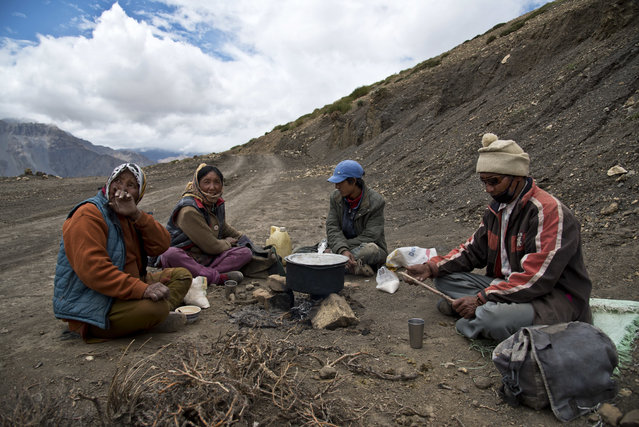
In this August 17, 2016, photo, from left to right, Chhering Chodom, 60, Tashi Yangzom, 50, Lobsang Chhering, 27, and Dorje Tandup, 58, drink milk tea on the side of the road. For centuries, the sleepy valley nestled in the Indian Himalayas remained a hidden Buddhist enclave forbidden to outsiders. Enduring the harsh year-round conditions of the high mountain desert, the people of Spiti Valley lived by a simple communal code – share the Earth's bounty, be hospitable to neighbors, and eschew greed and temptation at all turns. That's all starting to change, for better or worse. Since India began allowing its own citizens as well as outsiders to visit the valley in the early 1990s, tourism and trade have boomed. And the marks of modernization, such as solar panels, asphalt roads and concrete buildings, have begun to appear around some of the villages that dot the remote landscape at altitudes above 4,000 meters (13,000 feet). (Photo by Thomas Cytrynowicz/AP Photo)

In this August 17, 2016, photo, from left to right, Chhering Chodom, 60, Tashi Yangzom, 50, Lobsang Chhering, 27, and Dorje Tandup, 58, drink milk tea on the side of the road. For centuries, the sleepy valley nestled in the Indian Himalayas remained a hidden Buddhist enclave forbidden to outsiders. Enduring the harsh year-round conditions of the high mountain desert, the people of Spiti Valley lived by a simple communal code – share the Earth's bounty, be hospitable to neighbors, and eschew greed and temptation at all turns. That's all starting to change, for better or worse. (Photo by Thomas Cytrynowicz/AP Photo)
Details
15 Sep 2016 09:22:00
A topless Femen activist jumps on the car carrying former IMF chief Dominique Strauss-Kahn (not seen) as he arrives for his trial in Lille, northern France, on February 10, 2015. Three topless women from the protest group Femen jumped on the car of Dominique Strauss-Kahn as the former IMF chief arrived to testify at his trial for “aggravated pimping”. With slogans scrawled on their half-naked bodies and hurling insults at the car, the three protesters were quickly rounded up by police as the car entered an underground parking area. (Photo by Denis Charlet/AFP Photo)

A topless Femen activist jumps on the car carrying former IMF chief Dominique Strauss-Kahn (not seen) as he arrives for his trial in Lille, northern France, on February 10, 2015. Three topless women from the protest group Femen jumped on the car of Dominique Strauss-Kahn as the former IMF chief arrived to testify at his trial for “aggravated pimping”. With slogans scrawled on their half-naked bodies and hurling insults at the car, the three protesters were quickly rounded up by police as the car entered an underground parking area. (Photo by Denis Charlet/AFP Photo)
Details
07 Mar 2021 10:02:00


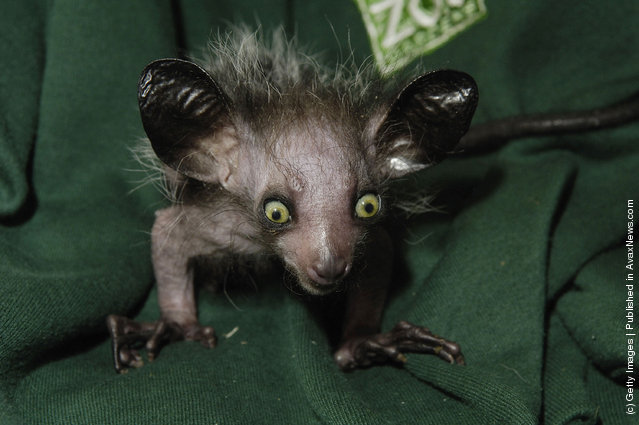
“The aye-aye (Daubentonia madagascariensis) is a lemur, a strepsirrhine primate native to Madagascar that combines rodent-like teeth and a special thin middle finger to fill the same ecological niche as a woodpecker. It is the world's largest nocturnal primate, and is characterized by its unusual method of finding food; it taps on trees to find grubs, then gnaws holes in the wood and inserts its narrow middle finger to pull the grubs out. The only other animal species known to find food in this way is the striped possum. From an ecological point of view the aye-aye fills the niche of a woodpecker as it is capable of penetrating wood to extract the invertebrates within”. – Wikipedia

Photo: In this handout image from Bristol Zoo is seen the first captive bred aye-aye in the UK named “Kintana” (meaning star in Malagasy) April 15, 2005 at Bristol Zoo Gardens, England. The zoo announced today only the second baby aye-aye to be hand-reared in the world (the first was in Jersey Zoo) and has now made his first public appearance since his birth on 11 February 2005. (Photo by Rob Cousins/Bristol Zoo via Getty Images)
Details
13 Apr 2011 13:33:00
People crowd together in an attempt to buy chickens at a Mega-Mercal, a subsidized state-run street market, in Caracas January 24, 2015. President Nicolas Maduro shook up complex currency controls on Wednesday and also prepared Venezuelans for a rise in the world's cheapest fuel prices in response to a recession worsened by plunging oil revenue. (Photo by Carlos Garcia Rawlins/Reuters)

People crowd together in an attempt to buy chickens at a Mega-Mercal, a subsidized state-run street market, in Caracas January 24, 2015. President Nicolas Maduro shook up complex currency controls on Wednesday and also prepared Venezuelans for a rise in the world's cheapest fuel prices in response to a recession worsened by plunging oil revenue. The socialist-run OPEC member's economy shrank 2.8 percent in 2014 while inflation topped 64 percent, the socialist leader announced in a speech to parliament, in what is almost certainly the worst performance in Latin America. (Photo by Carlos Garcia Rawlins/Reuters)
Details
25 Jan 2015 09:44:00
Iranians flash the victory sign from their car while celebrating on a street in northern Tehran, Iran, Thursday, April 2, 2015, after Iran's nuclear agreement with world powers in Lausanne, Switzerland. (Photo by Ebrahim Noroozi/AP Photo)

Iranians flash the victory sign from their car while celebrating on a street in northern Tehran, Iran, Thursday, April 2, 2015, after Iran's nuclear agreement with world powers in Lausanne, Switzerland. The United States, Iran and five other world powers on Thursday announced an understanding outlining limits on Iran's nuclear program so it cannot lead to atomic weapons, directing negotiators toward achieving a comprehensive agreement within three months. (Photo by Ebrahim Noroozi/AP Photo)
Details
03 Apr 2015 12:56:00
Revellers enjoy a night out in central Liverpool, northwest England, on December 30, 2020 before hightened Tier 3 restrictions closing hospitality venues, and bars indoor and outdoor socialising between households are imposed in the city amid surging cases of the novel coronavirus. Tighter coronavirus restrictions will be extended across England from on December 30 the British government announced, with a new Covid-19 variant blamed for a rapid surge in cases. Liverpool enters Tier 3, which closes hospitality venues, and bars indoor and outdoor socialising between households with the highest Tier 4 rules, which require all non-essential shops, hairdressers as well as leisure and entertainment venues to close, will now apply to more than 44 million people. (Photo by Oli Scarff/AFP Photo)

Revellers enjoy a night out in central Liverpool, northwest England, on December 30, 2020 before hightened Tier 3 restrictions closing hospitality venues, and bars indoor and outdoor socialising between households are imposed in the city amid surging cases of the novel coronavirus. (Photo by Oli Scarff/AFP Photo)
Details
01 Mar 2021 08:47:00