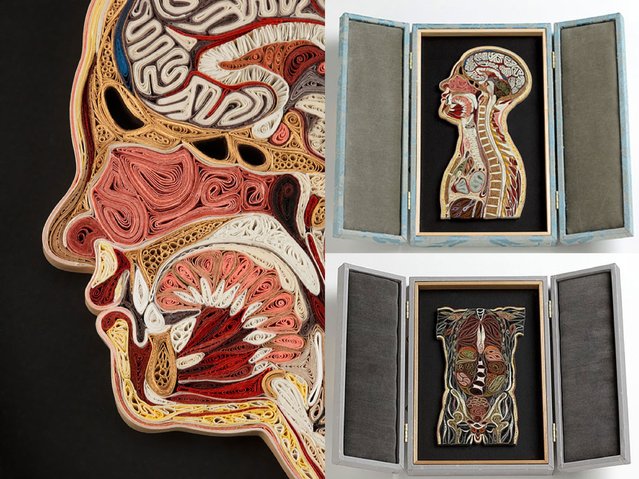
These pieces are made of Japanese mulberry paper and the gilded edges of old books. They are constructed by a technique of rolling and shaping narrow strips of paper called quilling or paper filigree. Quilling was first practiced by Renaissance nuns and monks who are said to have made artistic use of the gilded edges of worn out bibles, and later by 18th century ladies who made artistic use of lots of free time. I find quilling exquisitely satisfying for rendering the densely squished and lovely internal landscape of the human body in cross section.
A model dressed in an outfit made with chocolate presents a creation at the Brussels “Le Salon du Chocolat” chocolate fair February 5, 2016. (Photo by Yves Herman/Reuters)
A model prepares backstage at The Blonds fashion show during Fall 2016 MADE Fashion Week at Milk Studios on February 17, 2016 in New York City. (Photo by Monica Schipper/Getty Images)
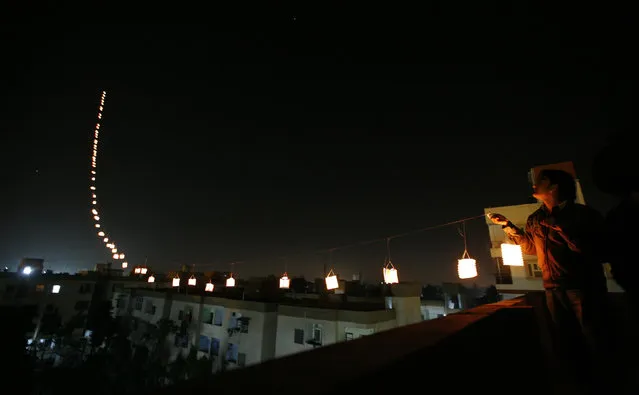
A man flies a kite made of 110 Tukkal or paper lanterns for the Hindu festival of “Makar Sankranti”, which marks the start of spring, in Ahmedabad January 13, 2011. (Photo by Amit Dave/Reuters)
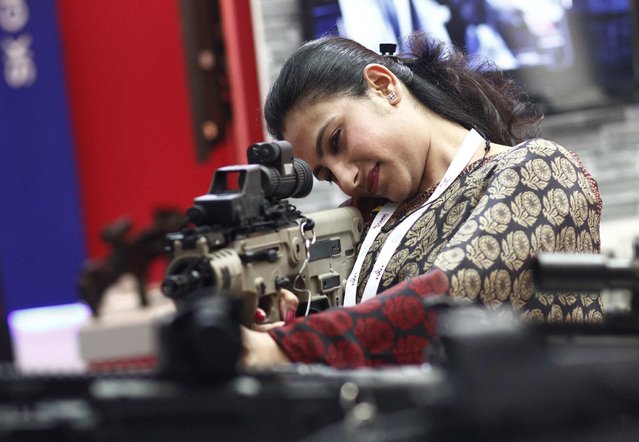
A visitor holds an Israeli-made rifle during the 8th International Land and Naval Defense system exhibition, in New Delhi, India, on February 6, 2014. (Photo by Anindito Mukherjee/Reuters)
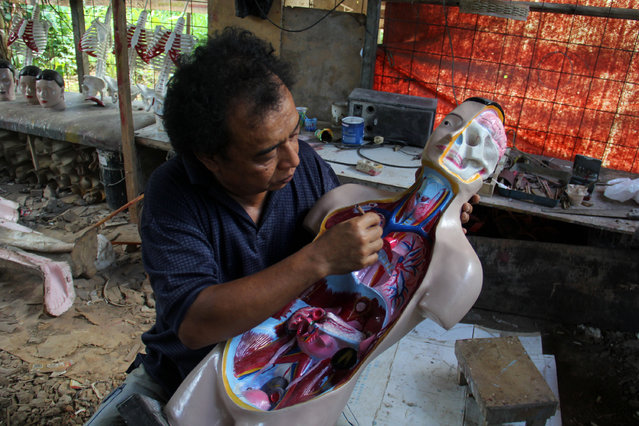
A craftsman works on making human anatomy mannequins on April 23, 2014 in Depok, West Java, Indonesia. The mannequins are made from fiberglass and will be used in schools, hospitals and laboratories. (Photo by Nurcholis Anhari Lubis/Getty Images)