Loading...
Done
Nicolas Silberfaden: Superheroes

Due to the current economic, social and cultural crisis in The United States of America today, I have decided to do a photographic project consisting of a series of studio portraits of superhero and celebrity impersonators that live and work in the city of Los Angeles. Most of them unemployed Americans, they decided to suit up with their costumes and hit the streets, animate parties and events in efforts to make ends meet. Making them pose in their costumes against a colorful backdrop, I ask them to manifest feelings of genuine sadness – honest emotions that are a consequence of our current times. The result is a somber, striking visual image that contradicts the iconic nature of strength and moral righteousness typical in American superhero and celebrity imagery. Creating the illusion that Superman does exist – that he too was fallible and affected by America’s downturn.

Nicolas Silberfaden
Details
06 Dec 2012 12:13:00


“Chameleons (family Chamaeleonidae) are a distinctive and highly specialized clade of lizards. They are distinguished by their parrot-like zygodactylous feet, their separately mobile and stereoscopic eyes, their very long, highly modified, and rapidly extrudable tongues, their swaying gait, the possession by many of a prehensile tail, crests or horns on their distinctively shaped heads, and the ability of some to change color. Uniquely adapted for climbing and visual hunting, the approximately 160 species of chameleon range from Africa, Madagascar, Spain and Portugal, across south Asia, to Sri Lanka, have been introduced to Hawaii, California and Florida, and are found in warm habitats that vary from rain forest to desert conditions”. – Wikipedia

Photo: A woman with the latest fashion accessory, a chameleon. (Photo by Fox Photos/Getty Images). Circa 1926
Details
20 Mar 2011 15:45:00
Brian Tomlinsons ink artwork. (Photo by Brian Tomlinsons/Caters News Agency)

These ink-redible, explosive masterpieces are like say-what-you see inkblots tests only in water. The vibrant colors burst from Brian Tomlinsons works, appearing as though they may be coloured ash clouds from an erupting volcano, rather than simply everyday substances. By doing so, Brian challenges viewers to identify what images can be imagined when mixing one fluid with another. In order to shoot the series, entitled Liquid Ink Art, Brain, 40, drops different coloured inks into a fish tank full of water before capturing high-speed shots with a flash. Here: Brian Tomlinsons ink artwork. (Photo by Brian Tomlinsons/Caters News Agency)
Details
15 Jun 2017 08:32:00
Children pour cold water on themselves under the control of fitness coach Margarita Filimonova (R) at local kindergarten number 317, with the air temperature at about minus 23 degrees Celsius (minus 9.4 degrees Fahrenheit), in Russia's Siberian city of Krasnoyarsk, February 5, 2013. (Photo by Ilya Naymushin/Reuters)

Children pour cold water on themselves under the control of fitness coach Margarita Filimonova (R) at local kindergarten number 317, with the air temperature at about minus 23 degrees Celsius (minus 9.4 degrees Fahrenheit), in Russia's Siberian city of Krasnoyarsk, February 5, 2013. (Photo by Ilya Naymushin/Reuters)

P.S. All pictures are presented in high resolution. To see Hi-Res images – just TWICE click on any picture. In other words, click small picture – opens the BIG picture. Click BIG picture – opens VERY BIG picture (if available; this principle works anywhere on the site AvaxNews).
Details
17 Feb 2013 15:40:00
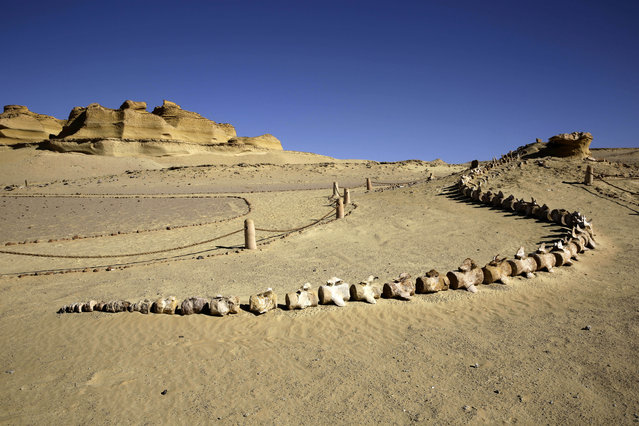
Fossilized whale bones are on display  outside the Wati El Hitan Fossils and Climate Change Museum, a UNESCO natural World Heritage site, on the opening day, in the Fayoum oasis, Egypt, Thursday, January 14, 2016. Egypt has cut the ribbon on the Middle East's first fossil museum housing the world's largest intact skeleton of a "walking whale" in an attempt to attract much-needed tourists driven off by recent militant attacks. The construction of the much-hyped Fossils and Climate Change Museum was covered a 2 billion euros (2. 17 billion dollars) grant from Italy, according to Italian Ambassador Maurizio Massari. (Photo by Thomas Hartwell/AP Photo)

Fossilized whale bones are on display outside the Wati El Hitan Fossils and Climate Change Museum, a UNESCO natural World Heritage site, on the opening day, in the Fayoum oasis, Egypt, Thursday, January 14, 2016. Egypt has cut the ribbon on the Middle East's first fossil museum housing the world's largest intact skeleton of a "walking whale" in an attempt to attract much-needed tourists driven off by recent militant attacks. The construction of the much-hyped Fossils and Climate Change Museum was covered a 2 billion euros (2. 17 billion dollars) grant from Italy, according to Italian Ambassador Maurizio Massari. Its centerpiece is an intact, 37-million-year-old and 20-meter-long skeleton of a legged form of whale that testifies to how modern-day whales evolved from land mammals. The sand-colored, dome-shaped museum is barely discernible in the breathtaking desert landscape that stretches all around. (Photo by Thomas Hartwell/AP Photo)
Details
16 Jan 2016 08:06:00
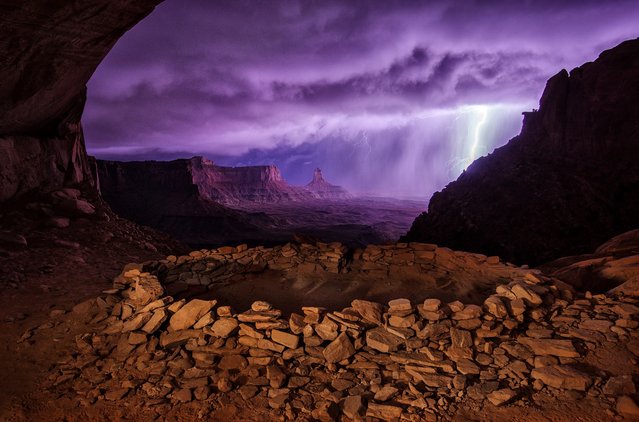
Second Place Winner: “Thunderstorm at False Kiva”. I hiked out to these ruins at night hoping to photograph them with the Milky Way, but instead a thunderstorm rolled through, creating this dramatic image. – Max Seigal. (Photo and caption by Max Seigal/National Geographic Traveler Photo Contest)

Second Place Winner: “Thunderstorm at False Kiva”. I hiked out to these ruins at night hoping to photograph them with the Milky Way, but instead a thunderstorm rolled through, creating this dramatic image. – Max Seigal. National Geographic Traveler Director of Photography Dan Westergren, one of this year's judges, shares his thoughts on the second place winner: “This photo combines two different scenes into one: the small kiva in a cliff dwelling and the grand vista of Canyonlands National Park across the valley. I really like the two different color palettes – warm inside and purple outside. This two-for-one scene was caused by the lightning storm outside the dwelling, which lit up the landscape like it was a huge electronic flash. Looking at this picture I can imagine what a wonderful sight it must have been for the ancient people who lived here. It doesn't seem too amazing now in our modern world, but might have been mind-blowing for the prehistoric residents”. Location: Utah. (Photo and caption by Max Seigal/National Geographic Traveler Photo Contest)
Details
02 Aug 2013 06:16:00
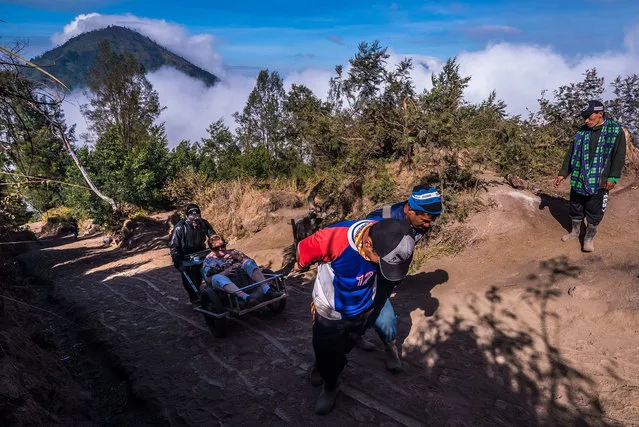
Miners pulling up lazy tourists to the rim of Kawah Ijen (Ijen Volcano), East Java, Indonesia on September 21, 2017. They will earn as much as they would bring down a load of sulfur. Nomadic Explorer, Cultural Lifestyle Photographer Claudio Sieber captured striking images of miners working at Ijen volcanic range in East Java, Indonesia. The sulphur miners risk their lives daily as they climb the active volcano carrying heavy loads, which they sell to sugar refineries. Shortly after midnight curious tourists are flocking in hundreds through the gate of Ijen's foothills to be right on time, driven by the images others took before them. Kawah Ijen is the one of the world's largest acidic volcanic crater lake; famous for its turquoise color as well as the unreal atmosphere it offers during darkness. A dusty path zigzags 3 kilometers up to the crater rim. This doesn't mean anything challenging; in particular, special sights have to be deserved anyway. The irritating smell of sulfur announces the near of the crater's existence. Arriving on the crater's rim the reward for the torture becomes visible. Blue fire darts its tongues through the fumes of sulfur dioxide. Somehow, the spectacle isn't as romantic as expected, since it is also the rough working space of approx. 150 sulfur miners who start their shift at 1 am. Lately, harvesting the abundance of devil's gold received international attention. This did obviously not really improve a miner's lifestyle; neither did it contribute to a better wage. (Photo by Claudio Sieber/Barcroft Images)

Miners pulling up lazy tourists to the rim of Kawah Ijen (Ijen Volcano), East Java, Indonesia on September 21, 2017. They will earn as much as they would bring down a load of sulfur. Nomadic Explorer, Cultural Lifestyle Photographer Claudio Sieber captured striking images of miners working at Ijen volcanic range in East Java, Indonesia. The sulphur miners risk their lives daily as they climb the active volcano carrying heavy loads, which they sell to sugar refineries. (Photo by Claudio Sieber/Barcroft Images)
Details
02 Oct 2017 08:31:00
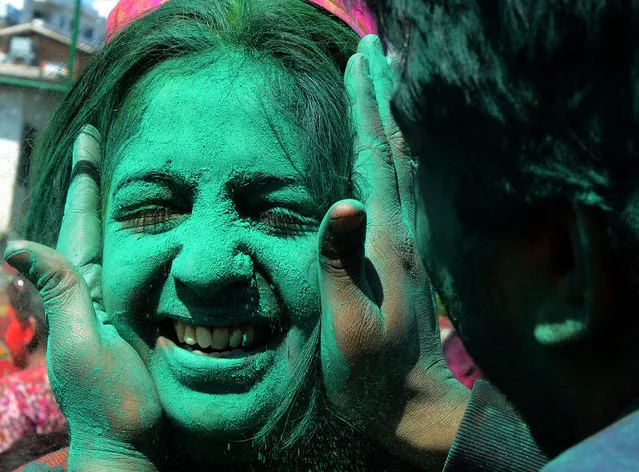
A students with her face smeared in coloured powder, celebrates Holi at a university campus in Chandigarh, India  March 23, 2016. (Photo by Ajay Verma/Reuters)

A students with her face smeared in coloured powder, celebrates Holi at a university campus in Chandigarh, India March 23, 2016. (Photo by Ajay Verma/Reuters)
Details
24 Mar 2016 12:08:00