Loading...
Done
In this October 16, 2014 photo, a man cleans his American classic car before going to work in Havana, Cuba. While the U.S. embargo that took effect in 1961 stopped the flow of new cars, and most parts, a few Cubans now manage to bring in replacement parts when friends or family visit from the U.S. (Photo by Franklin Reyes/AP Photo)

In this October 16, 2014 photo, a man cleans his American classic car before going to work in Havana, Cuba. While the U.S. embargo that took effect in 1961 stopped the flow of new cars, and most parts, a few Cubans now manage to bring in replacement parts when friends or family visit from the U.S. (Photo by Franklin Reyes/AP Photo)
Details
20 Oct 2014 09:01:00
Palestinians and Israelis enjoy the Mediterranean sea during the first day of the Eid al-Fitr holiday in Tel Aviv, Israel, Thursday, August 8, 2013. The three-day Eid al-Fitr holiday marks the end of the holy fasting month of Ramadan. One of the most important holidays in the Muslim world, Eid al-Fitr, is marked with prayers, family reunions and other festivities. (Photo by Oded Balilty/AP Photo)

Palestinians and Israelis enjoy the Mediterranean sea during the first day of the Eid al-Fitr holiday in Tel Aviv, Israel, Thursday, August 8, 2013. The three-day Eid al-Fitr holiday marks the end of the holy fasting month of Ramadan. One of the most important holidays in the Muslim world, Eid al-Fitr, is marked with prayers, family reunions and other festivities. (Photo by Oded Balilty/AP Photo)
Details
13 Aug 2013 11:02:00
Members of Brazil's Movimento dos Sem-Teto (Roofless Movement) stand in the hallway of one of the 11 empty buildings that the movement took over recently, in the centre of Sao Paulo, November 6, 2012. According to City Hall, there are some 400,000 people in need of stable housing, including the 4,000 families of the Roofless Movement who are squatting in abandoned or vacant buildings that range from apartment blocks to hotels, in Sao Paulo, the largest city in South America. Picture taken November 6, 2012

Members of Brazil's Movimento dos Sem-Teto (Roofless Movement) stand in the hallway of one of the 11 empty buildings that the movement took over recently, in the centre of Sao Paulo, November 6, 2012. According to City Hall, there are some 400,000 people in need of stable housing, including the 4,000 families of the Roofless Movement who are squatting in abandoned or vacant buildings that range from apartment blocks to hotels, in Sao Paulo, the largest city in South America. (Photo by Nacho Doce/Reuters)
Details
18 Dec 2012 09:40:00
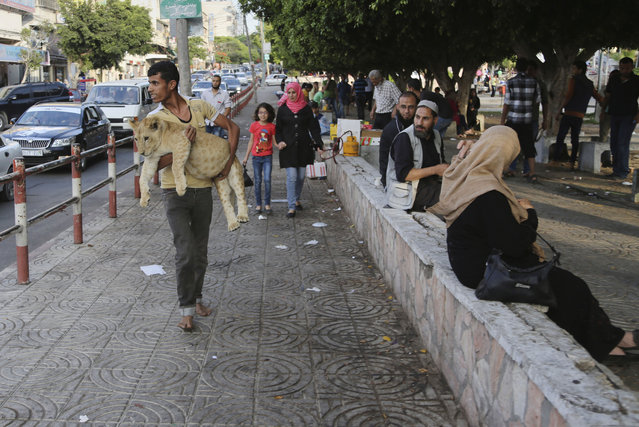
In this Monday, June 15, 2015 photo, Ahmad Abu Jereda, 16, carries Max, the male lion cub, as he passes by Palestinians at the main garden in Gaza City, in the northern Gaza Strip. (Photo by Adel Hana/AP Photo)

In this Monday, June 15, 2015 photo, Ahmad Abu Jereda, 16, carries Max, the male lion cub, as he passes by Palestinians at the main garden in Gaza City, in the northern Gaza Strip. A pair of lion cubs are stuck at a Gaza-Israel border crossing en route to a Jordan animal sanctuary, after being kept for a year by a family in crowded Gaza. Saduldin al-Jamal had bought the cubs from the Gaza zoo, hit during last summer's Israel-Hamas war. His family would take them to parks or the beach and children – those brave enough – would come up to pet them. (Photo by Adel Hana/AP Photo)
Details
04 Jul 2015 11:07:00
Irwan bathes a domesticated crocodile at his house in Bogor, Indonesia on January 22, 2018. Irwan found it as a baby and now it has been living with Irwans family for 20 years. Indonesia is known as a hotbed of exotic pet domestication and trade. People have been known to keep endangered animals such as slow lorises, eagles and pangolins, angering conservationists and animal rights activists. (Photo by Eko Siswono Toyudho/Anadolu Agency/Getty Images)

Irwan bathes a domesticated crocodile at his house in Bogor, Indonesia on January 22, 2018. Irwan found it as a baby and now it has been living with Irwans family for 20 years. Indonesia is known as a hotbed of exotic pet domestication and trade. People have been known to keep endangered animals such as slow lorises, eagles and pangolins, angering conservationists and animal rights activists. (Photo by Eko Siswono Toyudho/Anadolu Agency/Getty Images)
Details
28 Jan 2018 07:57:00
Sage Colina holds Rhianna as she is prepared to be adopted from the Humane Society of Greater Miami on December 13, 2023 in Miami, Florida. The shelter is experiencing an overcrowding crisis, like many nationwide, with people releasing their family pets to animal shelters since they can no longer afford to take care of them, after the high cost of pet care and the expense of veterinarian services, among other reasons. (Photo by Joe Raedle/Getty Images)

Sage Colina holds Rhianna as she is prepared to be adopted from the Humane Society of Greater Miami on December 13, 2023 in Miami, Florida. The shelter is experiencing an overcrowding crisis, like many nationwide, with people releasing their family pets to animal shelters since they can no longer afford to take care of them, after the high cost of pet care and the expense of veterinarian services, among other reasons. (Photo by Joe Raedle/Getty Images)
Details
20 Dec 2023 22:15:00
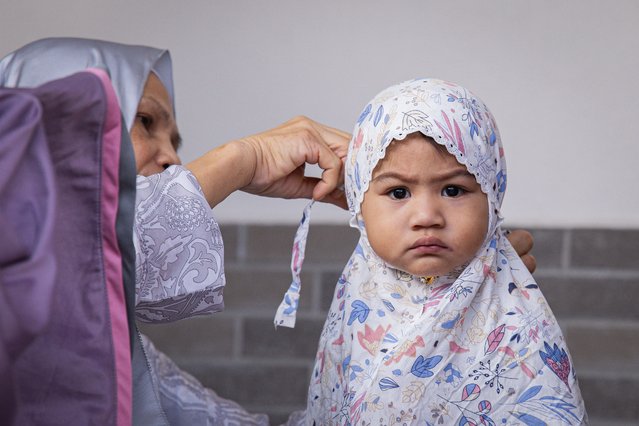
A young Muslim girl looks on as an elder helps her tie her hijab before the Eid al-Fitr prayer at Masjid Jamek Cina Muslim Klang on March 31, 2025, in Selangor, Malaysia. The mosque, inspired by the Great Mosque of Xi’an, blends Chinese and Islamic architectural influences, reflecting the nation’s rich cultural harmony. Eid al-Fitr, marking the end of Ramadan, is a time of prayers, family reunions, and celebration for Muslims worldwide. (Photo by Annice Lyn/Getty Images)

A young Muslim girl looks on as an elder helps her tie her hijab before the Eid al-Fitr prayer at Masjid Jamek Cina Muslim Klang on March 31, 2025, in Selangor, Malaysia. The mosque, inspired by the Great Mosque of Xi’an, blends Chinese and Islamic architectural influences, reflecting the nation’s rich cultural harmony. Eid al-Fitr, marking the end of Ramadan, is a time of prayers, family reunions, and celebration for Muslims worldwide. (Photo by Annice Lyn/Getty Images)
Details
08 Sep 2025 03:58:00
Mayu adjusts Koiku’s kimono, as Koiku wears a protective face mask while posing for a photograph, before they work at a party where they will entertain with other geisha at Japanese luxury restaurant Asada in Tokyo, Japan, June 23, 2020. The coronavirus pandemic has made Tokyo's geisha fear for their centuries-old profession as never before. Though the number of geisha - famed for their witty conversation, beauty and skill at traditional arts - has been falling for years, they were without work for months due to Japan's state of emergency and now operate under awkward social distancing rules. Engagements are down 95 percent, and come with new rules: no pouring drinks for customers or touching them even to shake hands, and sitting 2 meters apart. Masks are hard to wear with their elaborate wigs, so they mostly don't. “I was just full of anxiety”, said Mayu, 47. “I went through my photos, sorted my kimonos ... The thought of a second wave is terrifying”. (Photo by Kim Kyung-Hoon/Reuters)

Mayu adjusts Koiku’s kimono, as Koiku wears a protective face mask while posing for a photograph, before they work at a party where they will entertain with other geisha at Japanese luxury restaurant Asada in Tokyo, Japan, June 23, 2020. (Photo by Kim Kyung-Hoon/Reuters)
Details
23 Jul 2020 00:03:00