Loading...
Done
The best man in a wedding party, who all declined to be identified, holds an AR-10 rifle he was handed while the party was having their pre-wedding portraits taken on the steps of the capitol before a rally nearby by gun-rights advocates to protest a new expanded gun background check law in Washington state Saturday, December 13, 2014, in Olympia, Wash. (Photo by Elaine Thompson/AP Photo)

The best man in a wedding party, who all declined to be identified, stands near the bride and groom as he holds an AR-10 rifle he was handed while the party was having their pre-wedding portraits taken on the steps of the capitol before a rally nearby by gun-rights advocates to protest a new expanded gun background check law in Washington state Saturday, December 13, 2014, in Olympia, Wash. The wedding party was not part of the protest, but posed for pictures with it after being handed it by gun activist Brandon Lyons, who said “we've all just broken the law”, by handing the gun over. Saturday's protest was called the “I Will Not Comply” rally, and those attending said they will openly exchange firearms in opposition to the state's new voter-approved universal background check law, Initiative 594. The law, which took effect on December 4, requires background checks on all sales and transfers, including private transactions and many loans and gifts. (Photo by Elaine Thompson/AP Photo)
Details
15 Dec 2014 11:17:00
An engineer (L) talks to a driver of a dump truck loaded with gold-bearing soil at the Vostochny opencast of the Olimpiada gold operation, owned by Polyus Gold International company, in Krasnoyarsk region, Eastern Siberia, Russia, June 30, 2015. (Photo by Ilya Naymushin/Reuters)

An engineer (L) talks to a driver of a dump truck loaded with gold-bearing soil at the Vostochny opencast of the Olimpiada gold operation, owned by Polyus Gold International company, in Krasnoyarsk region, Eastern Siberia, Russia, June 30, 2015. Polyus Gold International is the largest gold producer in Russia and one of the top 10 gold miners globally by ounces produced, according to the official web site of the company. Olimpiada is Polyus Gold's largest operation. (Photo by Ilya Naymushin/Reuters)
Details
04 Jul 2015 11:12:00
Small transportation boats, known as bumboats, leave trails of light as they travel across Marina Bay past the skyline of Singapore in this photo taken in 2004. Singapore holds a Jubilee weekend from 7 to 10 August to celebrate the 50th anniversary of its independence. (Photo by Edgar Su/Reuters)

Small transportation boats, known as bumboats, leave trails of light as they travel across Marina Bay past the skyline of Singapore in this photo taken in 2004. Singapore holds a Jubilee weekend from 7 to 10 August to celebrate the 50th anniversary of its independence. Fifty years ago, hundreds of small boats lined the Singapore river in the city centre. Today, most small boats are gone, except a handful of neon-lit tourist ferries. Maritime trade is still the backbone of the city-state but after decades of rapid growth Singapore, which at less than half the size of London is among the world’s most densely populated nations, is also a popular tourist destination and a thriving global financial hub. (Photo by Edgar Su/Reuters)
Details
01 Aug 2015 12:26:00
“The sustainable development goals cannot be met unless waste management is addressed as a priority”, says UK waste management charity Waste Aid. “E-waste is one of the fastest growing categories of the 7-10bn tonnes of waste produced globally every year”, adds director Mike Webster. “In our view, decent waste management is a basic right and we want governments around the world take this issue much more seriously – in 2012 only 0.2% of international aid went on improving solid waste management – it’s just not enough”. (Photo by Kai Loeffelbein/laif Agentur)

Sustainable development goal target 12.5 is to reduce waste. But with a planet increasingly dependent on technology, is that even possible? As of today, over 30m tonnes of electronic waste has been thrown out so far this year, according to the World Counts. Most e-waste is sent to landfills in Asia and Africa where it is recycled by hand, exposing the people who do it to environmental hazards. Kai Loeffelbein’s photographs of e-waste recycling in Guiyu, southern China show what happens to discarded computers. (Photo by Kai Loeffelbein/laif Agentur)
Details
19 Oct 2016 12:14:00
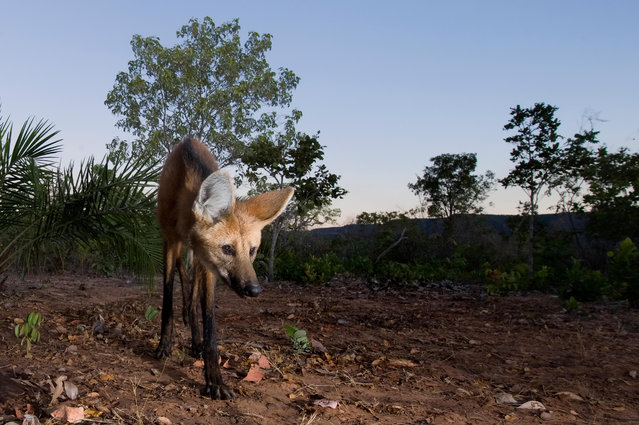
The maned wolf is among the large mammals in the Brazilian Cerrado that are threatened by the increasing conversion of grasslands into farmland for grazing and growing crops. (Photo by Ben Cranke/Nature Picture Library/Alamy Stock Photo)

Global wildlife populations will decline by 67% by 2020 unless urgent action is taken to reduce human impact on species and ecosystems, warns the biennial Living Planet Index report from WWF (World Wide Fund for Nature) and ZSL (Zoological Society of London). From elephants to eels, here are some of the wildlife populations most affected by human activity. Here: The maned wolf is among the large mammals in the Brazilian Cerrado that are threatened by the increasing conversion of grasslands into farmland for grazing and growing crops. (Photo by Ben Cranke/Nature Picture Library/Alamy Stock Photo)
Details
28 Oct 2016 10:47:00
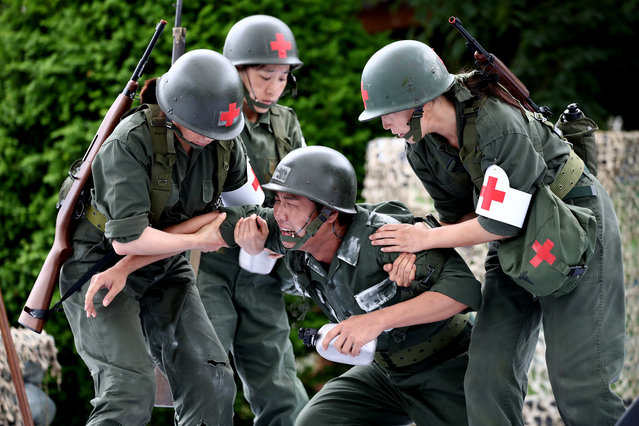
South Korean performers participate in a re-enactment of the battle of the Korean war during the ceremony to mark the 70th anniversary of the Korean War in Cheorwon, near the border with North Korea on June 25, 2020 in Cheorwon, South Korea. Over 66,000 South Koreans have been separated from their families during the Korean War which started on June 25, 1950, and effectively split the Korean Peninsula into two over the 3-year conflict. The fighting between North and South Korea ended on July 27, 1953, with the signing of the Korean Armistice Agreement and the heavily guarded Demilitarized Zone was created, however, both countries remain technically still at war since no peace agreement was signed and many Koreans died before they could reunite with their loved ones. (Photo by Chung Sung-Jun/Getty Images)

South Korean performers participate in a re-enactment of the battle of the Korean war during the ceremony to mark the 70th anniversary of the Korean War in Cheorwon, near the border with North Korea on June 25, 2020 in Cheorwon, South Korea. Over 66,000 South Koreans have been separated from their families during the Korean War which started on June 25, 1950, and effectively split the Korean Peninsula into two over the 3-year conflict. (Photo by Chung Sung-Jun/Getty Images)
Details
27 Jun 2020 00:03:00
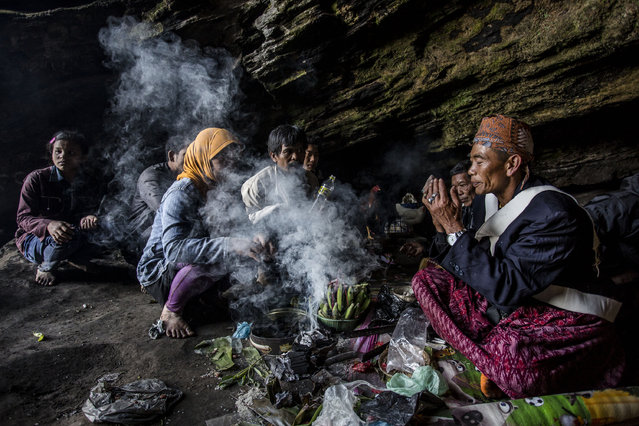
A Tenggerese shaman praying for worshippers at Widodaren cave during the Tenggerese Hindu Yadnya Kasada festival on July 31, 2015 in Probolinggo, East Java, Indonesia. The festival is the main festival of the Tenggerese people and lasts about a month. On the fourteenth day, the Tenggerese make the journey to Mount Bromo to make offerings of rice, fruits, vegetables, flowers and livestock to the mountain gods by throwing them into the volcano's caldera. (Photo by Ulet Ifansasti/Getty Images)

A Tenggerese shaman praying for worshippers at Widodaren cave during the Tenggerese Hindu Yadnya Kasada festival on July 31, 2015 in Probolinggo, East Java, Indonesia. The festival is the main festival of the Tenggerese people and lasts about a month. On the fourteenth day, the Tenggerese make the journey to Mount Bromo to make offerings of rice, fruits, vegetables, flowers and livestock to the mountain gods by throwing them into the volcano's caldera. The origin of the festival lies in the 15th century when a princess named Roro Anteng started the principality of Tengger with her husband Joko Seger, and the childless couple asked the mountain Gods for help in bearing children. The legend says the Gods granted them 24 children but on the provision that the 25th must be tossed into the volcano in sacrifice. The 25th child, Kesuma, was finally sacrificed in this way after initial refusal, and the tradition of throwing sacrifices into the caldera to appease the mountain Gods continues today. (Photo by Ulet Ifansasti/Getty Images)
Details
01 Aug 2015 12:07:00
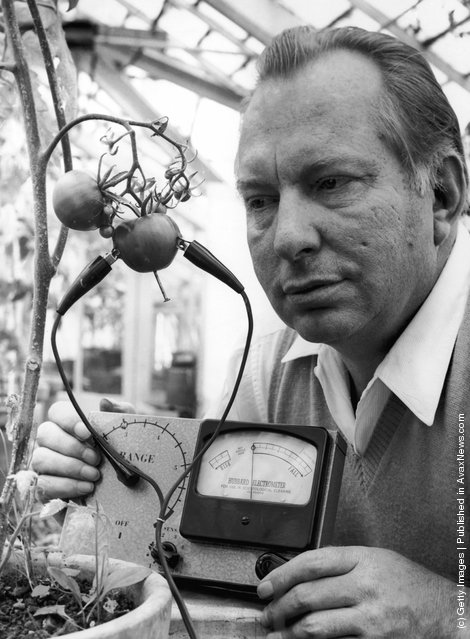
American science fiction writer L. Ron Hubbard, founder of the Church of Scientology, uses his Hubbard Electrometer

“Lafayette Ronald Hubbard (March 13, 1911 – January 24, 1986), better known as L. Ron Hubbard (and often referred to by his initials, LRH), was an American pulp fiction author and religious leader who founded the Church of Scientology. After establishing a career as a writer, becoming best known for his science fiction and fantasy stories, he developed a self-help system called Dianetics which was first published in May 1950. He subsequently developed his ideas into a wide-ranging set of doctrines and rituals as part of a new religious movement that he called Scientology. His writings became the guiding texts for the Church of Scientology and a number of affiliated organizations that address such diverse topics as business administration, literacy and drug rehabilitation”. – Wikipedia

Photo: American science fiction writer L. Ron Hubbard, founder of the Church of Scientology, uses his Hubbard Electrometer (patent pending) to determine whether tomatoes experience pain, 1959. His work led him to the conclusion that tomatoes “scream when sliced”. (Photo by Scott Lauder/Evening Standard/Hulton Archive/Getty Images)
Details
09 Sep 2011 09:34:00