Loading...
Done
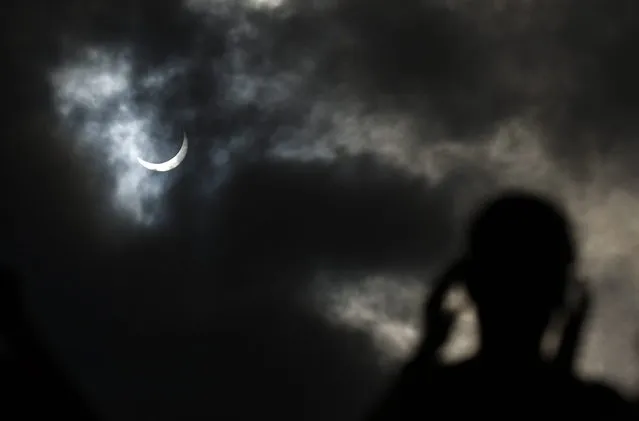
A tourist watches as the moon passing in front of the sun as it approaches a full solar eclipse in the northern Australian city of Cairns November 14, 2012. (Photo by Tim Wimborne/Reuters)

A tourist watches as the moon passing in front of the sun as it approaches a full solar eclipse in the northern Australian city of Cairns November 14, 2012. (Photo by Tim Wimborne/Reuters)
Details
14 Nov 2012 09:38:00


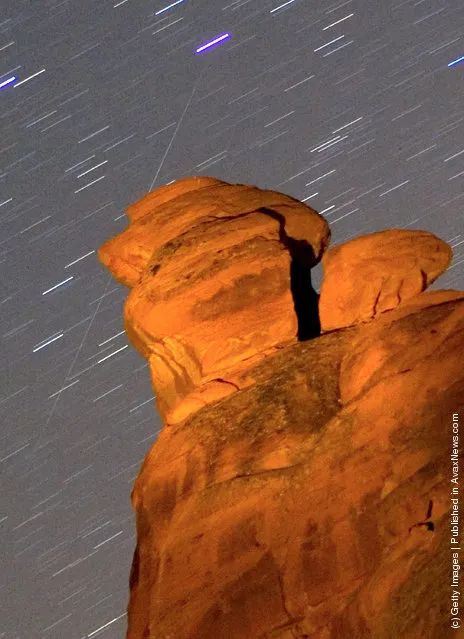
A Geminid meteor streaks diagonally across the sky against a field of star trails behind one of the peaks of the Seven Sisters rock formation in this long exposure early December 14, 2007 in the Valley of Fire State Park in Nevada. The meteor display, known as the Geminid meteor shower because it appears to radiate from near the star Castor in the constellation Gemini, is thought to be the result of debris cast off from an asteroid-like object called 3200 Phaethon. The shower is visible every December. (Photo by Ethan Miller/Getty Images)
Details
07 Jul 2011 10:34:00
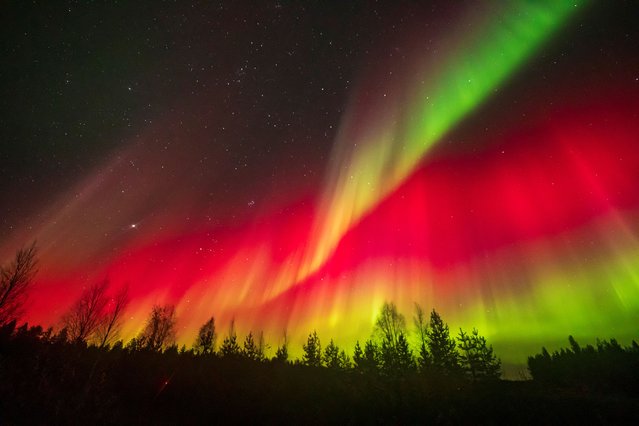
A view of northern lights over the skies of Sodankyla, Lapland, Finland, on October 7, 2024. (Photo by Alexander Kuznetsov/All About Lapland/Handout via Reuters)

A view of northern lights over the skies of Sodankyla, Lapland, Finland, on October 7, 2024. (Photo by Alexander Kuznetsov/All About Lapland/Handout via Reuters)
Details
28 Nov 2024 02:21:00
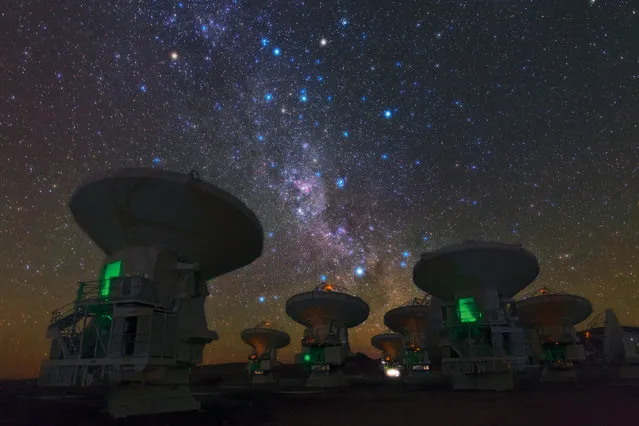
The antennas of the European Southern Observatory's Atacama Large Millimeter/Submillimeter Array, also known as ALMA, are set against the splendor of the Milky Way in this picture by Babak Tafreshi

The antennas of the European Southern Observatory's Atacama Large Millimeter/Submillimeter Array, also known as ALMA, are set against the splendor of the Milky Way in this picture by Babak Tafreshi. Construction of the full ALMA array is due to be completed in Chile's Atacama Desert in 2013, but the facility is already making scientific observations with a partial array of antennas. (Photo by ESO/B. Tafreshi/TWAN)
Details
03 Jun 2012 11:57:00
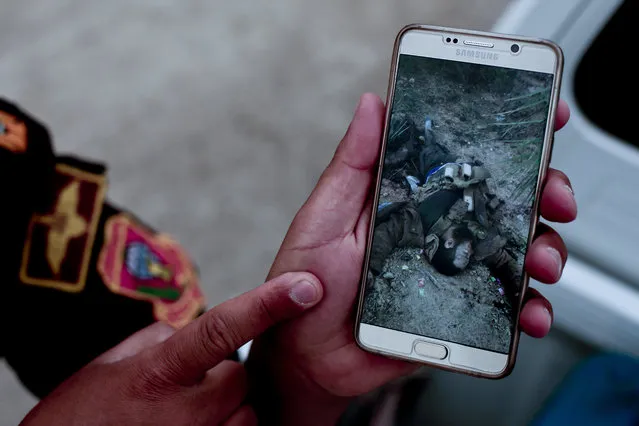
In this March 20, 2016 photo, Maj. Mohammed Hussein, an officer with Iraq's elite counterterrorism forces, shows a photo of a slain Islamic State group militant still wearing in a suicide vest, taken during fighting that freed the city of Ramadi from IS control earlier this year. As they fled, the militants destroyed some buildings and booby-trapped others with explosives, leaving behind an empty prize for government forces retaking the city. (Photo by Maya Alleruzzo/AP Photo)

In this March 20, 2016 photo, Maj. Mohammed Hussein, an officer with Iraq's elite counterterrorism forces, shows a photo of a slain Islamic State group militant still wearing in a suicide vest, taken during fighting that freed the city of Ramadi from IS control earlier this year. As they fled, the militants destroyed some buildings and booby-trapped others with explosives, leaving behind an empty prize for government forces retaking the city. (Photo by Maya Alleruzzo/AP Photo)
Details
05 May 2016 12:57:00
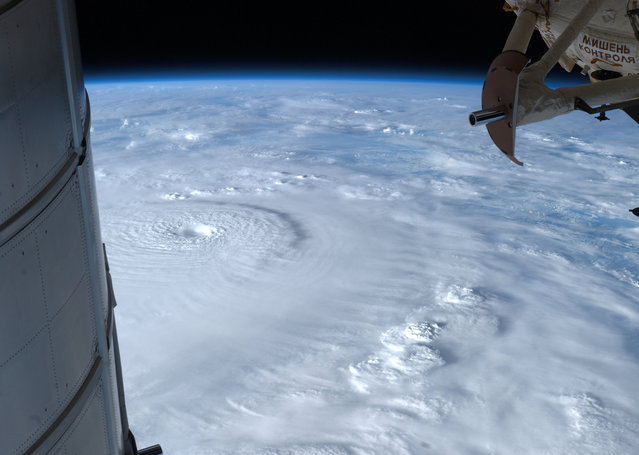
Typhoon Bopha moves toward the Philippines, observed from the ISS, on December 2, 2012. (Photo by AP Photo/NASA/The Atlantic)

Typhoon Bopha moves toward the Philippines, observed from the ISS, on December 2, 2012. (Photo by AP Photo/NASA via The Atlantic)
Details
02 Apr 2013 12:22:00
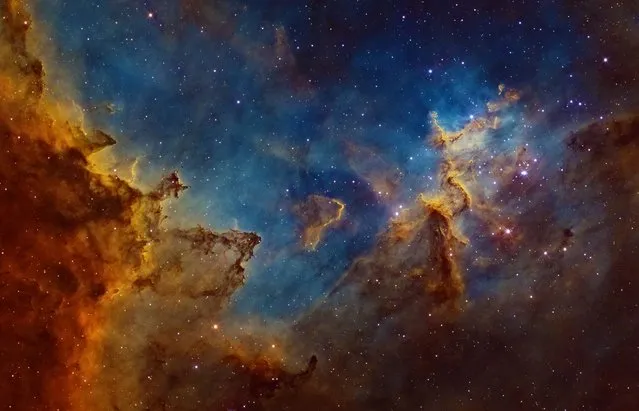
Centre of the Heart Nebula by Ivan Eder (Hungary). Situated 7500 light years away in the ‘W’-shaped constellation of Cassiopeia, the Heart Nebula is a vast region of glowing gas, energized by a cluster of young stars at its centre. The image depicts the central region, where dust clouds are being eroded and moulded into rugged shapes by the searing cosmic radiation. (Photo by Ivan Eder)

The competition, which is run by the Royal Observatory Greenwich in association with BBC Sky at Night Magazine, is now in its sixth year and has received over 2,500 entries. Photo: Centre of the Heart Nebula by Ivan Eder (Hungary). Situated 7500 light years away in the “W”-shaped constellation of Cassiopeia, the Heart Nebula is a vast region of glowing gas, energized by a cluster of young stars at its centre. The image depicts the central region, where dust clouds are being eroded and moulded into rugged shapes by the searing cosmic radiation. (Photo by Ivan Eder)
Details
03 Jul 2014 11:59:00
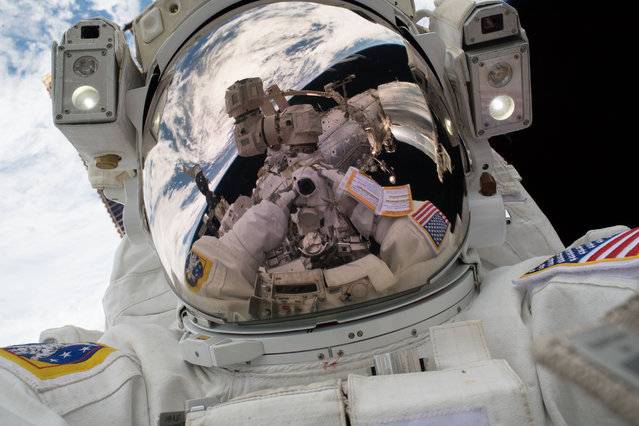
Spacewalker Mark Vande Hei took his own photograph during the first spacewalk of 2018,  on January 23, 2018. These sky-high pictures are better known as “space-selfies”. (Photo by Mark Vande Hei/NASA)

Spacewalker Mark Vande Hei took his own photograph during the first spacewalk of 2018, on January 23, 2018. These sky-high pictures are better known as “space-selfies”. (Photo by Mark Vande Hei/NASA)
Details
05 Feb 2018 06:27:00