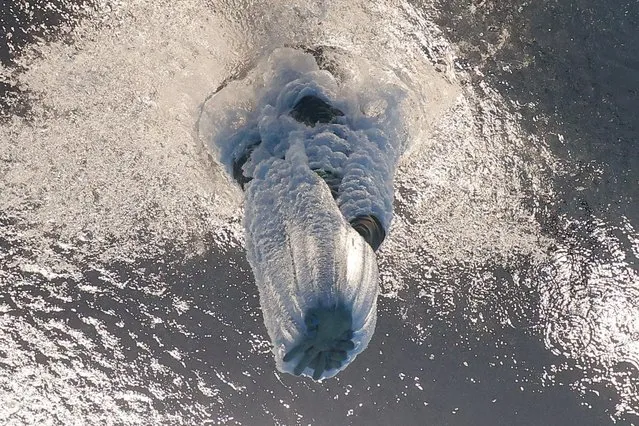
A diving competitor during a practice session at Tokyo Aquatics Centre ahead of the Tokyo 2020 Olympic Games in Japan on Wednesday, July 21, 2021. (Photo by Stefan Wermuth/Reuters)
A New Orleans Saints fan parties in the stands in the first half of an NFL preseason football game against the Jacksonville Jaguars in New Orleans, Monday, August 23, 2021. Last season the team played with a marginal number of fans in a largely empty Superdome due to the coronavirus pandemic, but this year fans are allowed with proof of vaccination. (Photo by Derick Hingle/AP Photo)
Police in Stanley, the Falklands capital, had to temporarily close a road after a pair of sea lions picked an awkward spot to get frisky on Sunday, December 5, 2021. (Photo by Genti Cena Photography/Triangle)
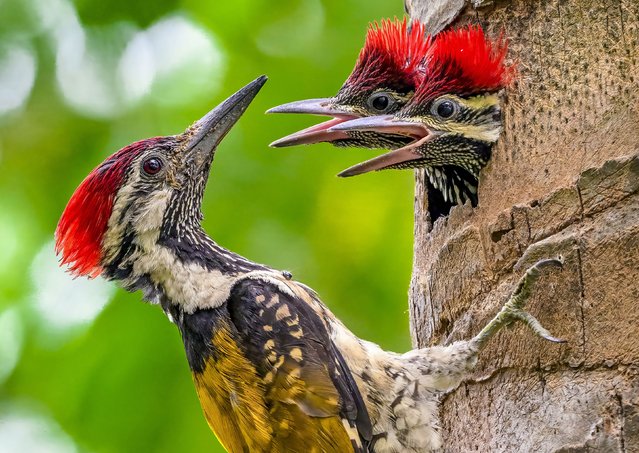
An adult black-rumped flameback woodpecker is pestered by a pair of hungry chicks in Rajarhat, India in the second decade of May 2024. (Photo by Kalyan Acharya/Solent News)
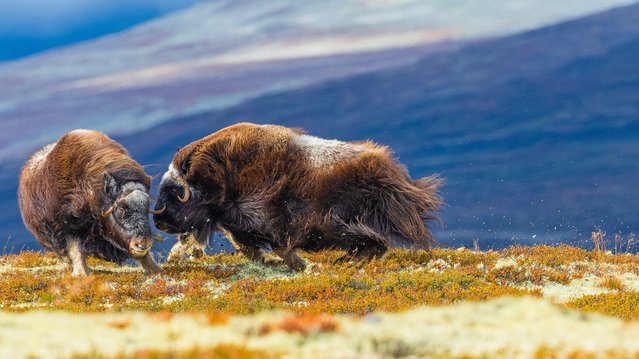
A fight between two female musk oxen, Norway, 2021. The image was captured in Norway’s Dovrefjell national park, where the musk ox (Ovibos moschatus) was reintroduced several years ago for its conservation. It is normal for males of this species to engage in fierce battles during the mating season but unusual for two females. (Photo by Miquel Angel Artús Illana)
People walk near an artwork depicting Pope Francis, following the death of the pontiff, in Rome, Italy, on April 22, 2025. (Photo by Dylan Martinez/Reuters)
Tattoo artist Tokyo Hiro draws a scorpion to be tattooed on a customer at the Tattoo the Earth Festival August 9, 2002 in Oakland, California. The Tattoo the Earth festival focuses on the tattooing culture and is the largest tattoo event of its kind. (Photo by Justin Sullivan/Getty Images)
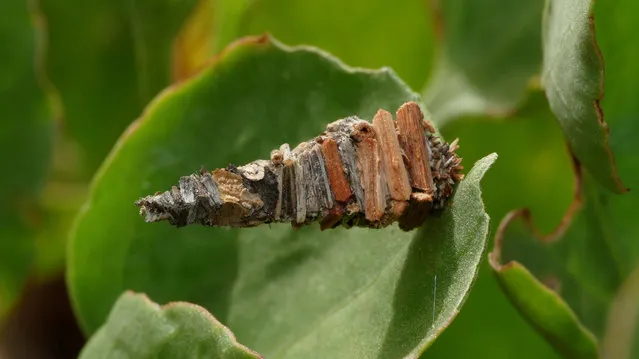
An undated handout photo made available by the Zerynthia Association shows the pupa of an amicta moneiba, a recently discovered species of moth endemic to La Gomera and El Hierro islands in the Canary Islands, Spain (issued 01 July 2020), as those two islands pulled apart from the rest of the Canary Islands 2.5 million years ago. The Institute of Evolutionary Biology of the Spanish National Research Council (CSIC) and the Zerynthia Association have recently discovered two new moth species in El Hierro and La Gomera. (Photo by Yeray Monasterio/Zerynthia/EPA/EFE)