Loading...
Done
A reveller of a street party known as blocos, dances during a protest against restrictions by city officials in Rio de Janeiro, Brazil, Wednesday, April 13, 2022. City Hall has banned the street parties during Carnival celebrations, which were delayed by almost two months due to the pandemic. (Photo by Silvia Izquierdo/AP Photo)

A reveller of a street party known as blocos, dances during a protest against restrictions by city officials in Rio de Janeiro, Brazil, Wednesday, April 13, 2022. City Hall has banned the street parties during Carnival celebrations, which were delayed by almost two months due to the pandemic. (Photo by Silvia Izquierdo/AP Photo)
Details
15 Apr 2022 06:22:00
Anilson Costa, reveller of the annual block party “Ceu na Terra”, walks along the Santa Teresa neighborhood where the block party used to be celebrated, as Carnival celebrations have been canceled, amid the coronavirus disease (COVID-19) pandemic, in Rio de Janeiro, Brazil on February 12, 2021. (Photo by Pilar Olivares/Reuters)

Anilson Costa, reveller of the annual block party “Ceu na Terra”, walks along the Santa Teresa neighborhood where the block party used to be celebrated, as Carnival celebrations have been canceled, amid the coronavirus disease (COVID-19) pandemic, in Rio de Janeiro, Brazil on February 12, 2021. (Photo by Pilar Olivares/Reuters)
Details
13 Feb 2021 10:42:00
This aerial image shows a gossan reservoir at the Riotinto mines in Minas de Riotinto, near of Huelva on September 30, 2022. Although the Rio Tinto Company began to exploit these mines in 1873, this mining site already supplied minerals to the ancient Greeks and Romans. (Photo by Jorge Guerrero/AFP Photo)

This aerial image shows a gossan reservoir at the Riotinto mines in Minas de Riotinto, near of Huelva on September 30, 2022. Although the Rio Tinto Company began to exploit these mines in 1873, this mining site already supplied minerals to the ancient Greeks and Romans. (Photo by Jorge Guerrero/AFP Photo)
Details
29 Oct 2022 04:09:00
A farmer uses a GoPro as he takes a picture of his carabao kneeling during the annual Carabao Festival in Pulilan, Bulacan in northern Philippines May 14, 2015. (Photo by Lorgina Minguito/Reuters)

A farmer uses a GoPro as he takes a picture of his carabao kneeling during the annual Carabao Festival in Pulilan, Bulacan in northern Philippines May 14, 2015. Water buffalos, locally known as carabaos, are led during a parade in the streets of the town to honour its patron saint San isidro Labrador, and carabaos will kneel in front of the church to give thanks for a year-long bountiful harvest. (Photo by Lorgina Minguito/Reuters)
Details
15 May 2015 10:30:00
Cheng Chen (R), a 27-year-old worker at a state-owned enterprise, poses for a photograph with his nephew who is wearing his home-made Iron Man armour, in Xuzhou, Jiangsu province April 13, 2015. (Photo by Reuters/Stringer)

Cheng Chen (R), a 27-year-old worker at a state-owned enterprise, poses for a photograph with his nephew who is wearing his home-made Iron Man armour, in Xuzhou, Jiangsu province April 13, 2015. It cost Cheng about 500 yuan ($81 USD) to make the armour, which weighs about 4 kilograms, with plastic boards and LED lights, local media reported. (Photo by Reuters/Stringer)
Details
18 Apr 2015 10:12:00
Illuminated Cut Paper Light Boxes By Hari And Deepti

Illuminated Cut Paper Light Boxes by Hari & DeeptiDeepti Nair and Harikrishnan Panicker (known collectively as Hari & Deepti) are an artist couple who create paper cut light boxes. Each diorama is made from layers of cut watercolor paper placed inside a shadow box and is lit from behind with flexible LED light strips. The small visual narratives depicted in each work often play off aspects of light including stars, flames, fireflies, and planets.
Details
17 Jun 2014 12:07:00
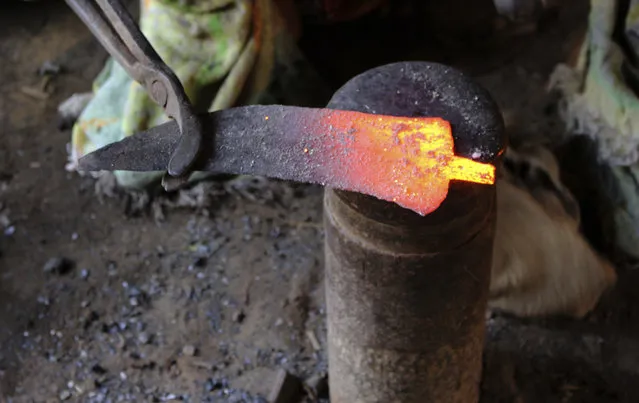
In this October 6, 2018, photo, a craftsman makes daggers or “Jambiyya” in Yemeni Arabic, made out of remains of missiles, at his workshop, in Hajjah, Yemen. (Photo by Hammadi Issa/AP Photo)

In this October 6, 2018, photo, a craftsman makes daggers or “Jambiyya” in Yemeni Arabic, made out of remains of missiles, at his workshop, in Hajjah, Yemen. Missiles raining on Yemen from the jets of the Saudi-led coalition fighting Houthi rebels are killing thousands of civilians and militiamen alike, but amid crashing economy, some Yemenis see the bright side of it: they make daggers out of the fragments of the missiles for ordinary men traditionally wear for prestige and a show of courage. (Photo by Hammadi Issa/AP Photo)
Details
10 Oct 2018 00:01:00
This picture taken on January 17, 2019 shows jeepneys during rush hour in Manila, Philippines. (Photo by Noel Celis/AFP Photo)

This picture taken on January 17, 2019 shows jeepneys during rush hour in Manila, Philippines. Hand-painting custom decor on jeepneys adorned with images of everything from Batman to babies, as well as disco lights and chrome wheels, have for decades provided cheap transport for millions. But pollution and safety concerns have led to a modernisation programme, with jeepneys 15 years or older to be taken off the streets by 2020. (Photo by Noel Celis/AFP Photo)
Details
30 Jan 2019 00:03:00