Loading...
Done
Black women in Brazil sit at the intersection of racism and misogyny, and have in recent years been at the forefront of a movement that challenges issues ranging from sexual and domestic violence to police brutality and stereotyping. Kolor Collective considers itself to be a part of this movement and questions expectations imposed on black women with satirical and subversive images, as seen here. (Photo by Kolor Art Collective/The Guardian)

Photographer Pol Kurucz’s vivid collection of photos explores issues faced by black Brazilian women, from political misrepresentation to unrealistic beauty standards. Kolor Collective is a Rio de Janeiro-based creative group that challenges the struggle faced by black women in Brazil through theatrical and provocative art. It was founded in 2015 by Franco-Hungarian photographer Pol Kurucz, who often touches on his own experiences of discrimination to call out sensitive social problems. (Photo by Kolor Art Collective/The Guardian)
Details
28 Dec 2016 07:24:00
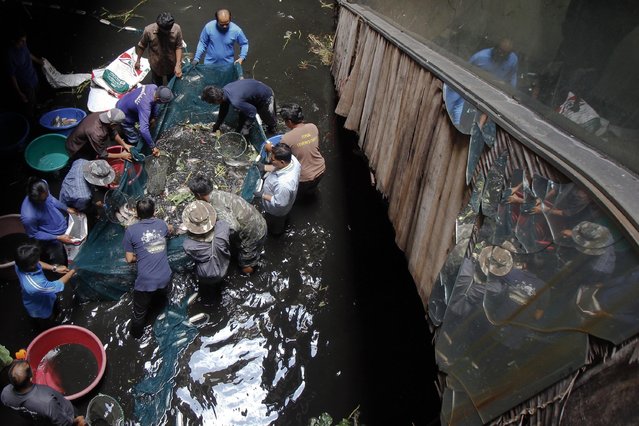
Workers collect fish inside an abandoned department store in Bangkok, Thailand January 13, 2015. Staff from Bangkok Metropolitan Administration (BMA) office were catching fish on Tuesday at the ground floor of the roofless New World department store that was closed down in 1997. (Photo by Chaiwat Subprasom/Reuters)

Workers collect fish inside an abandoned department store in Bangkok, Thailand January 13, 2015. Staff from Bangkok Metropolitan Administration (BMA) office were catching fish on Tuesday at the ground floor of the roofless New World department store that was closed down in 1997. Thousands of fish such as catfishes, fancy carps as well as black and red tilapias were released into the ground floor of the building, flooded with rainwater, as local vendors tried to control mosquitoes in the area, local media reported. BMA recently decided to remove the fish and release the water. (Photo by Chaiwat Subprasom/Reuters)
Details
14 Jan 2015 11:57:00
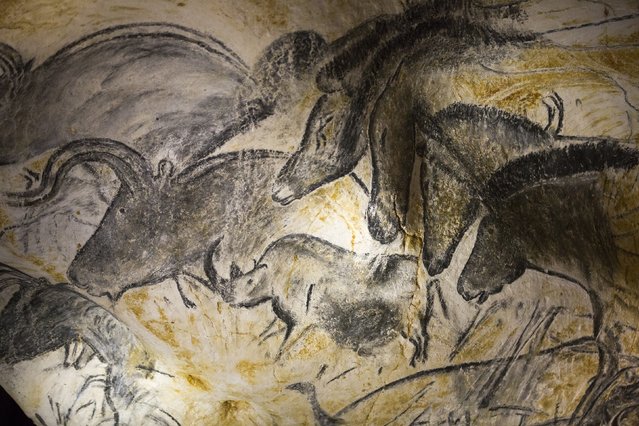
A replica of pre-historic drawings showing horses, rhinoceros and aurochs is seen on a wall during a press visit at the site of the Cavern of Pont-d'Arc project in Vallon Pont d'Arc April 8, 2015. (Photo by Robert Pratta/Reuters)

A replica of pre-historic drawings showing horses, rhinoceros and aurochs is seen on a wall during a press visit at the site of the Cavern of Pont-d'Arc project in Vallon Pont d'Arc April 8, 2015. The Cavern of Pont-d'Arc project is a replica of the pre-historic Decorated Cave of Pont-d'Arc known as Grotte Chauvet, in Vallon Pont-d'Arc in the Ardeche region, containing the world's earliest known art which was recently named a UNESCO World Heritage site. The facsimile cavern, which condenses some 8000m² of the original site into 3000m², will display faithful reproductions of paintings and engravings and will be inaugurated on April 10 and will open to the public on April 25. (Photo by Robert Pratta/Reuters)
Details
09 Apr 2015 14:23:00
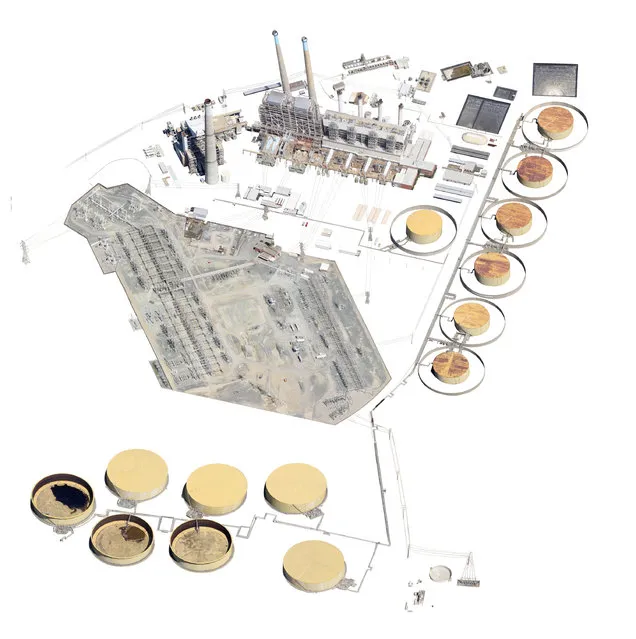
Natural gas plant in Pittsburg, CA (detail of Power Landscape), 2013. (Photo by Jenny Odell)

Jenny Odell repurposes online imagery mostly from Google Maps, but also from YouTube, Craigslist, and other sites. In her “Satellite Collections”, for example, she incorporated aerial views of swimming pools, basketball courts, parking lots, and other recognizable structures, seen from space. Her more recent series, “Satellite Landscapes”, includes painstakingly isolated Google Maps imagery of oil refineries, wastewater treatment plants, solar farms, etc. This work is meant as a reminder of our physically determined and vulnerable existence, since we depend on many of these things for survival and maintenance of our way of life. Photo: Natural gas plant in Pittsburg, CA (detail of Power Landscape), 2013. (Photo by Jenny Odell)
Details
19 Mar 2014 07:28:00
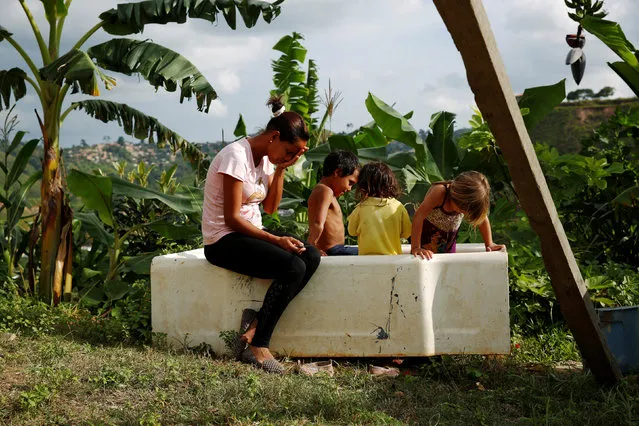
Lisibeht Martinez (L), 30, who was sterilized one year ago, sits next to her children while they play in a bathtub in the backyard of their house in Los Teques, Venezuela July 19, 2016. (Photo by Carlos Garcia Rawlins/Reuters)

Venezuela's food shortages, inflation and crumbling medical sector have become such a source of anguish that a growing number of young women are reluctantly opting for sterilizations rather than face the hardship of pregnancy and child-rearing. Traditional contraceptives like condoms or birth control pills have virtually vanished from store shelves, pushing women towards the hard-to-reverse surgery. While no recent national statistics on sterilizations are available, doctors and health workers say demand for the procedure is growing. (Photo by Carlos Garcia Rawlins/Reuters)
Details
04 Aug 2016 12:22:00
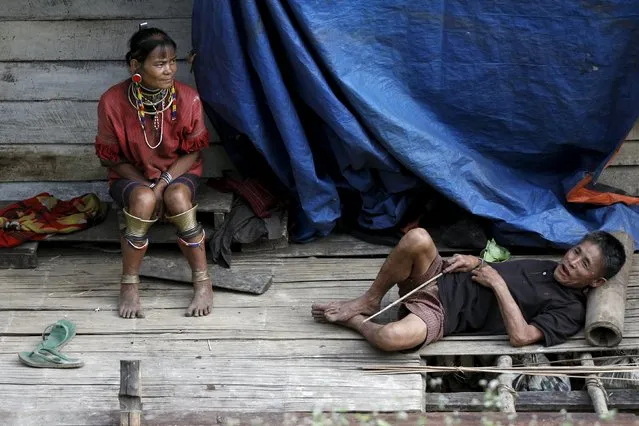
An ethnic Kayaw couple Mu Htoo and her husband Htaw Eili rest at their home at Htaykho village in the Kayah state, Myanmar September 12, 2015. (Photo by Soe Zeya Tun/Reuters)

An ethnic Kayaw couple Mu Htoo and her husband Htaw Eili rest at their home at Htaykho village in the Kayah state, Myanmar September 12, 2015. With about 30,000 members, the Kayaw are one of the smallest ethnic minorities among Myanmar's 135 groups. Their village has for decades been off-limits, as armed rebels fought the military before a recent ceasefire stopped the bloody conflict here. The rebels in the area have put down their guns and taken to the hills to grow rice and corn, but slash-and-burn cultivation methods mean they struggle to find new places to farm. (Photo by Soe Zeya Tun/Reuters)
Details
21 Oct 2015 08:03:00
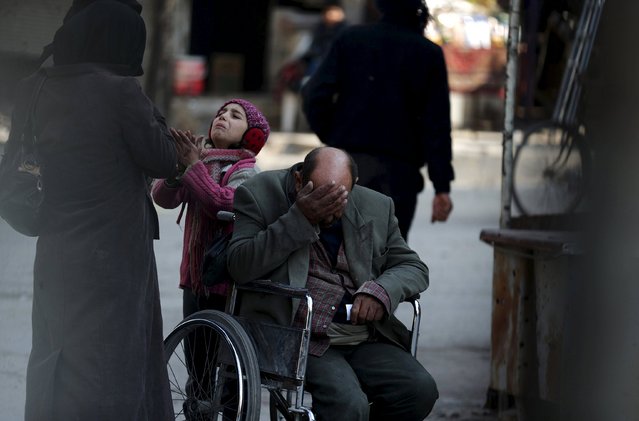
A girl asks a passerby for help to pay a medical bill as her father sits in his wheelchair in the Douma neighbourhood of Damascus Syria February 3, 2016. (Photo by Bassam Khabieh/Reuters)

Hadeel, 10, asks a passerby for help to pay a medical bill as her father Shahrour, 54, sits in his wheelchair in the Douma neighbourhood of Damascus Syria February 3, 2016. Shahrour said he developed diabetes at the beginning of the war in Syria. A lack of insulin led to his medical condition worsening and his right foot had to be amputated. Recently he also suffered a stroke that paralysed half his face. He and part of his extended family, a total of 18 people, live together and struggle to get by. (Photo by Bassam Khabieh/Reuters)
Details
12 Feb 2016 12:46:00
Florin Bors, aged 8 from Bacau, northern Romania, wearing a bear fur takes a break from performing a holiday season ritual in Bucharest, Romania, Tuesday, December 16, 2014. In pre-Christian rural traditions, dancers wearing colored costumes or animal furs, touring house to house in villages singing and dancing to ward off evil. (Photo by Octav Ganea/AP Photo/Mediafax)

Florin Bors, aged 8 from Bacau, northern Romania, wearing a bear fur takes a break from performing a holiday season ritual in Bucharest, Romania, Tuesday, December 16, 2014. In pre-Christian rural traditions, dancers wearing colored costumes or animal furs, touring house to house in villages singing and dancing to ward off evil. In recent years following the economic downturn in Romania, a European Union member since 2007, the tradition has moved to Romania's cities where dancers travel to perform the ritual for money. (Photo by Octav Ganea/AP Photo/Mediafax)
Details
20 Dec 2014 12:07:00