Loading...
Done
A man sets himself on fire during protest rallies in front of the presidential office in Kiev, Ukraine on February 26, 2020. The man, who called himself Oleksandr Burlakov, said subsequently that his motive was to draw the attention of the authorities to his plight, related to the ownership of the land parcel. (Photo by Ihor Behus/Reuters)

A man sets himself on fire during protest rallies in front of the presidential office in Kiev, Ukraine on February 26, 2020. The man, who called himself Oleksandr Burlakov, said subsequently that his motive was to draw the attention of the authorities to his plight, related to the ownership of the land parcel. (Photo by Ihor Behus/Reuters)
Details
29 Feb 2020 00:01:00
A young woman holds a weapon during a basic combat training for civilians, organized by the Special Forces Unit Azov, of Ukraine's National Guard, in Mariupol, Donetsk region, eastern Ukraine, Sunday, February 13, 2022. The United States is evacuating almost all of the staff from its embassy in Kyiv as Western intelligence officials warn that a Russian invasion of Ukraine is increasingly imminent. (Photo by Vadim Ghirda/AP Photo)

A young woman holds a weapon during a basic combat training for civilians, organized by the Special Forces Unit Azov, of Ukraine's National Guard, in Mariupol, Donetsk region, eastern Ukraine, Sunday, February 13, 2022. The United States is evacuating almost all of the staff from its embassy in Kyiv as Western intelligence officials warn that a Russian invasion of Ukraine is increasingly imminent. (Photo by Vadim Ghirda/AP Photo)
Details
11 Mar 2022 05:53:00


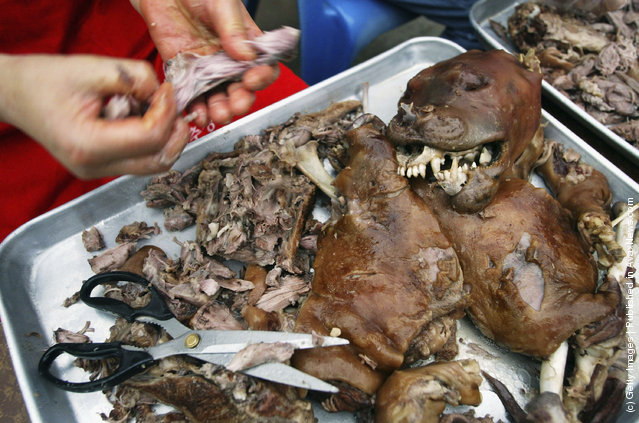
“Dog meat refers to edible parts and the flesh derived from (predominantly domestic) dogs. Human consumption of dog meat has been recorded in many parts of the world, including ancient China, ancient Mexico, and ancient Rome. According to contemporary reports, dog meat is consumed in a variety of countries such as Switzerland, China, Vietnam, the Philippines, and Korea. In addition, dog meat has also been used as survival food in times of war and/or other hardships”. – Wikipedia

Photo: A chef prepares dog meat at a restaurant on July 4, 2005 in Gwacheon, South Korea. Dog meat is a traditional dish in Korea dating back to the Samkuk period (period of the three kingdoms BC 57 – AD 668). Although many recipes existed historically for dog meat, now chefs only make soups, or dishes using boiled or roasted meat. Koreans traditionally eat dog meat on the hottest day of the summer, for it's reputed benefits of virility, invigoration and health. (Photo by Chung Sung-Jun/Getty Images)

Details
24 Jul 2011 13:21:00
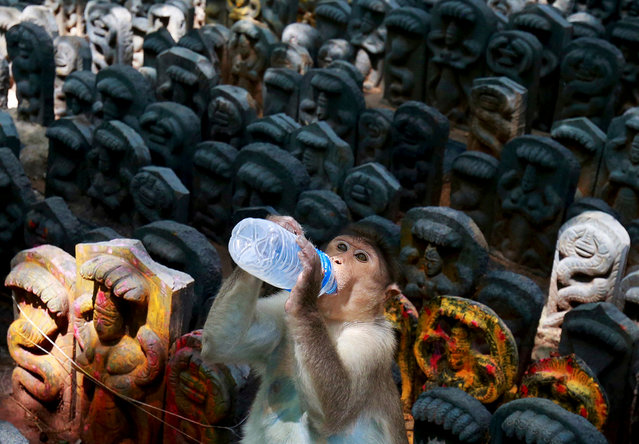
A bonnet macaque sits on consecrated idols of snakes as it drinks milk offered by a devotee during the Hindu festival of Nag Panchami, which is celebrated by worshipping snakes to honour the serpent god, inside a temple on the outskirts of Bengaluru, India, July 27, 2017. (Photo by Abhishek N. Chinnappa/Reuters)

A bonnet macaque sits on consecrated idols of snakes as it drinks milk offered by a devotee during the Hindu festival of Nag Panchami, which is celebrated by worshipping snakes to honour the serpent god, inside a temple on the outskirts of Bengaluru, India, July 27, 2017. (Photo by Abhishek N. Chinnappa/Reuters)
Details
28 Jul 2017 10:02:00
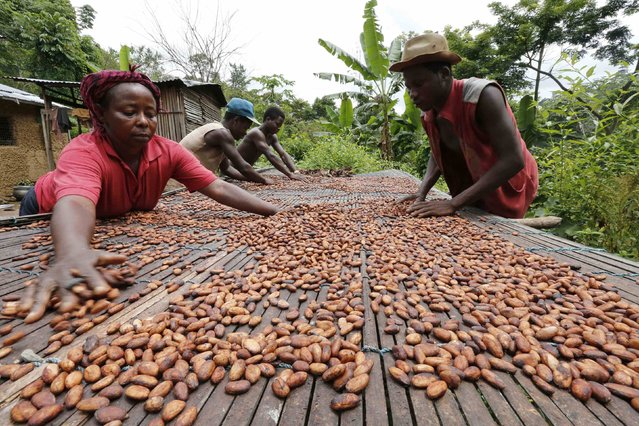
People work with cocoa beans in Enchi June 17, 2014. Picture taken June 17, 2014. Ghana emerged as a success story during the 2000s, when war, political instability and a disastrous liberalization brought Ivory Coast's cocoa sector to its knees. Ghana's output more than tripled from 340,000 tons in the 2001/02 season to a record 1,025,000 tons a decade later. Strict controls cemented its reputation as a producer of top quality beans, establishing a brand that fetches a premium. (Photo by Thierry Gouegnon/Reuters)

People work with cocoa beans in Enchi June 17, 2014. Picture taken June 17, 2014. Ghana emerged as a success story during the 2000s, when war, political instability and a disastrous liberalization brought Ivory Coast's cocoa sector to its knees. Ghana's output more than tripled from 340,000 tons in the 2001/02 season to a record 1,025,000 tons a decade later. Strict controls cemented its reputation as a producer of top quality beans, establishing a brand that fetches a premium. (Photo by Thierry Gouegnon/Reuters)
Details
03 Aug 2014 07:17:00
People pose for souvenir photos along peach blossom flowers at a field in Hanoi February 6, 2015. The peach blossom, believed to bring luck to families, is used to decorate homes during the Vietnamese “Tet” (Lunar New Year festival), which will take place from February 14 to February 24. (Photo by Reuters/Kham)

People pose for souvenir photos along peach blossom flowers at a field in Hanoi February 6, 2015. The peach blossom, believed to bring luck to families, is used to decorate homes during the Vietnamese “Tet” (Lunar New Year festival), which will take place from February 14 to February 24. (Photo by Reuters/Kham)
Details
08 Feb 2015 12:20:00
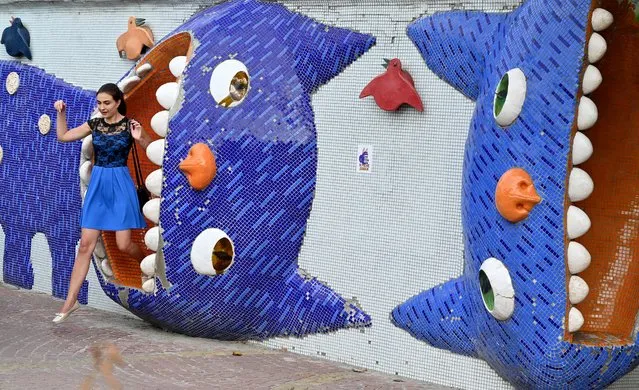
A woman jumps out of a street art object in the center of the Ukrainian capital of Kiev during a warm autumn day on September 25, 2020. (Photo by Sergei Supinsky/AFP Photo)

A woman jumps out of a street art object in the center of the Ukrainian capital of Kiev during a warm autumn day on September 25, 2020. (Photo by Sergei Supinsky/AFP Photo)
Details
09 Oct 2020 00:05:00
Two styles of cleaned bird's nest, Yan Zhan (L) and Su Zhan (R) await repacking at a processing plant in Kuala Lumpur, February 17, 2015. Prized in China for is alleged health benefits for hundreds of years, nests made from swiftlets' saliva are being mixed into coffee and cereal as the Southeast Asian producers of the delicacy seek to broaden its appeal, and their profit margins. (Photo by Olivia Harris/Reuters)

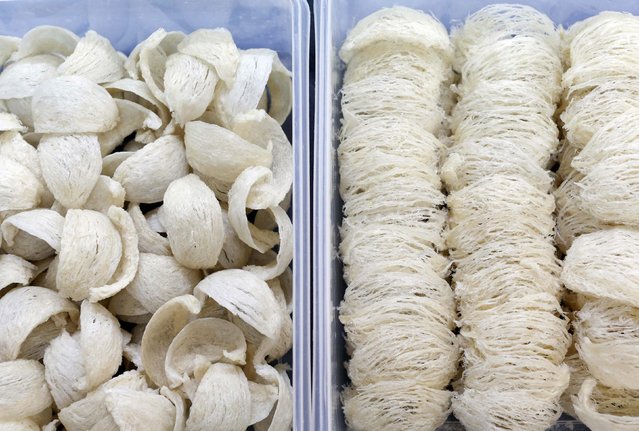
Two styles of cleaned bird's nest, Yan Zhan (L) and Su Zhan (R) await repacking at a processing plant in Kuala Lumpur, February 17, 2015. Prized in China for is alleged health benefits for hundreds of years, nests made from swiftlets' saliva are being mixed into coffee and cereal as the Southeast Asian producers of the delicacy seek to broaden its appeal, and their profit margins. The nests are among the world's most expensive foods, selling for up to $2,500 a kg and the swiftlets that weave them are indigenous to Indonesia, Malaysia, Thailand and Vietnam. (Photo by Olivia Harris/Reuters)
Details
24 Feb 2015 13:57:00