Loading...
Done
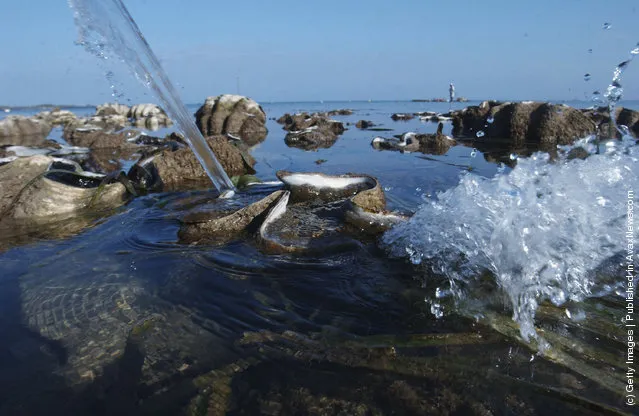
Tridacna Gigas, or Giant Clams

“The giant clam, Tridacna gigas (known as pā’ua in Cook Islands Māori), is the largest living bivalve mollusc. T. gigas is one of the most endangered clam species. It was mentioned as early as 1825 in scientific reports. One of a number of large clam species native to the shallow coral reefs of the South Pacific and Indian oceans, they can weigh more than 200 kilograms (440 lb) measure as much as 120 cm (47 in) across, and have an average lifespan in the wild of 100 years or more”. – Wikipedia

Photo: Tridacna Gigas, or Giant Clams spew water as a traditional fisherman passes by a small sanctuary on January 23, 2004 near Bolinao in the Northern Philippines. The clams, prime builders for coral reefs and providing shelter for spawning fish and other marine life, are exposed by low tides in the sanctuary. Overfishing and pollution throughout the country are not only threatening food security, but are also starting to choke one of the few working clam sanctuaries in the world. (Photo by David Greedy/Getty Images)
Details
01 Oct 2011 13:10:00
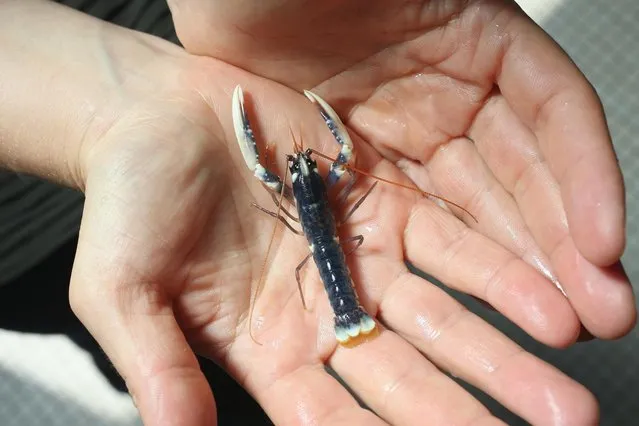
Isabel Schmalenbach, an environmental scientist with the Helgoland Biological Institute (Biologische Anstalt Helgoland), part of the Alfred Wegener Institute for Polar and Marine Research, holds a one-year old baby European lobster (Homarus gammarus) raised at the institute on August 3, 2013 on Helgoland Island, Germany. (Photo by Sean Gallup/Getty Images)

Isabel Schmalenbach, an environmental scientist with the Helgoland Biological Institute (Biologische Anstalt Helgoland), part of the Alfred Wegener Institute for Polar and Marine Research, holds a one-year old baby European lobster (Homarus gammarus) raised at the institute on August 3, 2013 on Helgoland Island, Germany. Later in the day Schmalenbach and her colleagues released a total of 415 one-year old lobsters into the North Sea as part of an effort to repopulate the lobster population around Helgoland (also called Heligoland). In the 19th century local fishermen caught up to 80,000 lobsters a year in the surrounding waters, combined with the heavy allied bombing of the island during and after World War II, as well as other environmental factors, decimated the lobster population. (Photo by Sean Gallup)
Details
05 Aug 2013 08:39:00
A member of the Indian company Margi Kathakali theatre performs during “Kijote Kathakali”, a Kathakali recital based on the Spanish classic “Don Quixote”, at the Niemeyer Center in Aviles, northern Spain, July 29, 2016. The performance and text captured the essence of the novel while sticking to the format of Kathakali. Kathakali is one of the major forms of classical Indian dance. It is another “story play” genre of art, but one distinguished by its elaborately colorful make-up, costumes and face masks wearing actor-dancers, who have traditionally been all males. (Photo by Eloy Alonso/Reuters)

A member of the Indian company Margi Kathakali theatre performs during “Kijote Kathakali”, a Kathakali recital based on the Spanish classic “Don Quixote”, at the Niemeyer Center in Aviles, northern Spain, July 29, 2016. The performance and text captured the essence of the novel while sticking to the format of Kathakali. Kathakali is one of the major forms of classical Indian dance. (Photo by Eloy Alonso/Reuters)
Details
31 Jul 2016 11:02:00
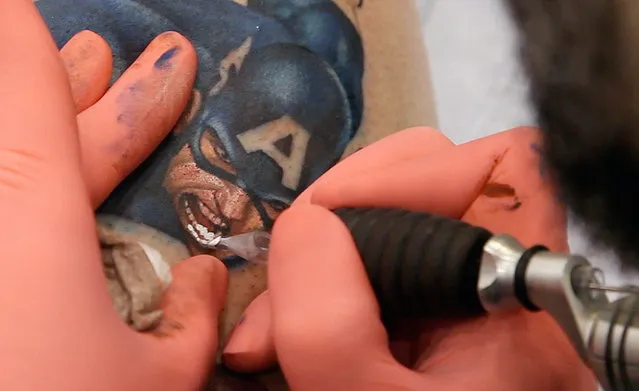
A tattoo of Captain America drawn by artist Sean Karon on the leg of client Ron Raucci at the Hampton Roads Tattoo Festival in Virginia, on March 2, 2012. The tattoo was completed from start to finish in one five-and-a-half hour session and won the prestigious “tattoo of the day” contest. (Photo by Jason Reed/Reuters)

A tattoo of Captain America drawn by artist Sean Karon on the leg of client Ron Raucci at the Hampton Roads Tattoo Festival in Virginia, on March 2, 2012. The tattoo was completed from start to finish in one five-and-a-half hour session and won the prestigious “tattoo of the day” contest. (Photo by Jason Reed/Reuters)
Details
19 Aug 2012 10:13:00


“A guide horse is an experimental mobility option for blind people who do not wish to or cannot use a guide dog. They are provided by The Guide Horse Foundation, founded in 1999 to provide miniature horses as assistance animals to blind users living in rural environments”. – Wikipedia

Photo: Shari Bernstiel, of Lansdale, Pennsylvania is helped along the sidewalk by Tonto, her guide horse March 19, 2004 in Lansdale, Pennsylvania. Tonto, a minature horse who went through one year of training, acts as Sheri's seeing eye dog and is one of three working guide horses in the United States. (Photo by William Thomas Cain/Getty Images)
Details
20 Jun 2011 14:05:00
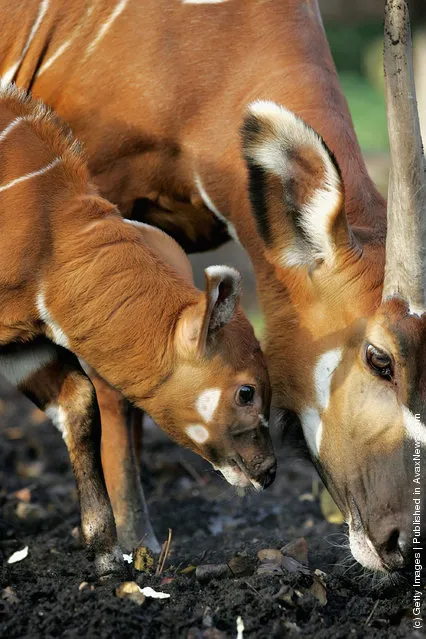
The one month old newborn Bongo Antelope

“The western or lowland bongo is a herbivorous, mostly nocturnal forest ungulate and among the largest of the African forest antelope species. Bongos are characterised by a striking reddish-brown coat, black and white markings, white-yellow stripes and long slightly spiralled horns”. – Wikipedia

Photo: The one month old newborn Bongo Antelope Calf ventures out in the cold with his mother in their enclosure at London Zoo on December 9, 2005 in London, England. (Photo by Christopher Lee/Getty Images)
Details
21 Feb 2012 12:17:00
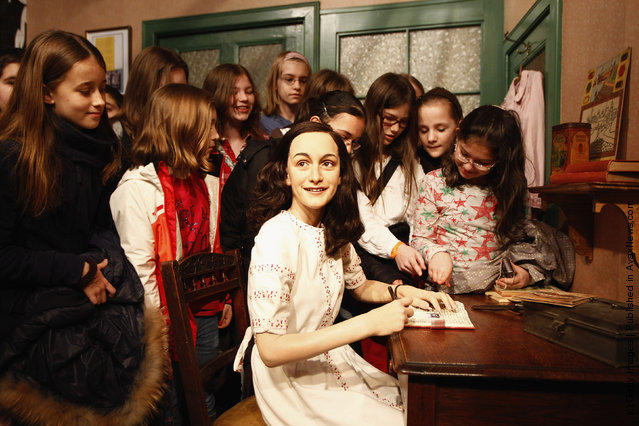
Childrens watch the wax figure of Anne Frank and their hideout reconstruction at Madame Tussauds in Berlin, Germany

“Annelies Marie “Anne” Frank (12 June 1929 – early March 1945) was one of the most renowned and most discussed Jewish victims of the Holocaust. Acknowledged for the quality of her writing, her diary has become one of the world's most widely read books, and has been the basis for several plays and films”. – Wikipedia

Photo: Childrens watch the wax figure of Anne Frank and their hideout reconstruction at Madame Tussauds on March 9, 2012 in Berlin, Germany. (Photo by Andreas Rentz/Getty Images)
Details
09 Mar 2012 11:59:00
South Korean environmentalists participates in a rally held to commemorate the Fukushima nuclear disaster on the eve of the one year anniversary of Japan's earthquake and tsunami

South Korean environmentalists participates in a rally held to commemorate the Fukushima nuclear disaster on the eve of the one year anniversary of Japan's earthquake and tsunami on March 10, 2012 in Seoul, South Korea. Currently four nuclear power plants are in operation in South Korea while the government plans to increase the number of reactors to 32 by the year 2021. (Photo by Chung Sung-Jun/Getty Images)
Details
12 Mar 2012 11:44:00