Loading...
Done
Aliia Nasyrova laying her hair on the couch to show her hair's length on March 5, 2017 in Riga, Latvia. (Photo by  Eduard Kolik/Barcroft Media)

Aliia Nasyrova laying her hair on the couch to show her hair's length on March 5, 2017 in Riga, Latvia. Real-life Rapunzel Aliia Nasyrova has hair so long that her husband admits he thinks of it as another member of the family. Aliia, 27, who lives in Riga, Latvia, took 20 years to grow out her hair, which measures 90 inches to the floor – and even has its own space in the marital bed. And while her massive mane attracts stares when out in public, her husband Ivan Balaban says he loves it and is proud of her for not cutting it. Weighing in at 4.5lbs (2kg), Aliia says her lengthy locks weigh as much as the family cat. (Photo by Eduard Kolik/Barcroft Media)
Details
18 Mar 2017 10:46:00
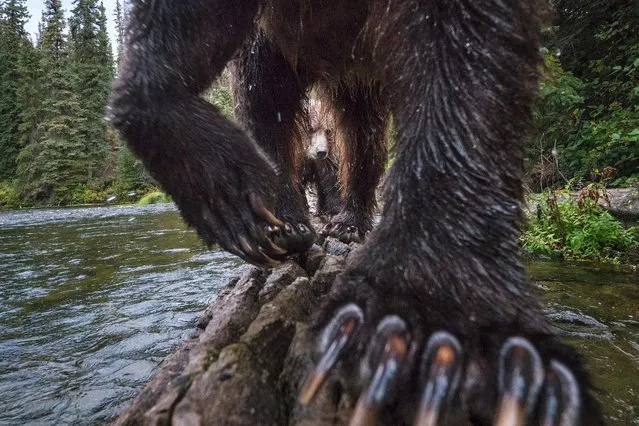
“The Salmon Catchers”. Terrestrial Wildlife. To capture this view of a mother grizzly bear and her cub, photographer Peter Mather set up a camera trap on a log that he knew the bears tended to traverse while fishing for salmon, in the Yukon River watershed in Canada. (Photo by Peter Mather/BigPicture Natural World Photography Competition 2017)

The fourth annual BigPicture Natural World Photography Competition aims to celebrate the diversity of life on Earth, and encourages people to protect and conserve it. Here: “The Salmon Catchers”. Terrestrial Wildlife. To capture this view of a mother grizzly bear and her cub, photographer Peter Mather set up a camera trap on a log that he knew the bears tended to traverse while fishing for salmon, in the Yukon River watershed in Canada. (Photo by Peter Mather/BigPicture Natural World Photography Competition 2017)
Details
02 Jul 2017 07:25:00
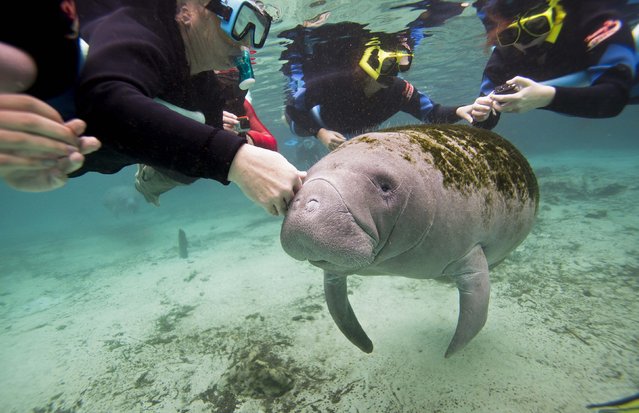
Snorkelers interact with a Florida Manatee inside of the Three Sisters Springs in Crystal River, Florida January 15, 2015. On winter days, Florida manatees flock by the hundreds to the balmy waters of Three Sisters Springs, drawing crowds of snorkelers and kayakers to the U.S. sanctuary, where people may swim with the endangered species. (Photo by Scott Audette/Reuters)

Snorkelers interact with a Florida Manatee inside of the Three Sisters Springs in Crystal River, Florida January 15, 2015. On winter days, Florida manatees flock by the hundreds to the balmy waters of Three Sisters Springs, drawing crowds of snorkelers and kayakers to the U.S. sanctuary, where people may swim with the endangered species. But as tolerant as the gentle, whiskered sea giants can be of the accidental kicks and splashes of delighted tourists, wild life regulators want to ban most canoes and paddle boards and create people-free zones to protect the wintering “sea cow”. Proposed limitations for this winter are awaiting approval by the U.S. Fish and Wildlife Service. (Photo by Scott Audette/Reuters)
Details
22 Jan 2015 13:34:00
“Two-Handed Saw, 2014”. “Most of the neighbors have switched to power tools to run their households, the buzz of chain saws and weed-whackers overpowering the quieter sounds of country life, but my aunts hold on to the two-handed saw that's decades old, the sickle and scythe that need to be sharpened and polished after each use, the old axe that's becoming heavier each year. Each of these objects is familiar, holding memories of their brother, who succumbed to cancer a few years ago, of days before my grandfather lost his vision in the 50's, of busier days and longer futures”, Sablin told. (Photo by Nadia Sablin)

In northwest Russia, in a small village called Alekhovshchina, Nadia Sablin's aunts spend the warmer months together in the family home and live as the family has always lived, chopping wood to heat the house and making their own clothes. Sablin's book of photographs, “Aunties: The Seven Summers of Alevtina and Ludmila”, is published by Duke University Press. Here: “Two-Handed Saw, 2014”. (Photo by Nadia Sablin)
Details
25 Feb 2016 12:12:00
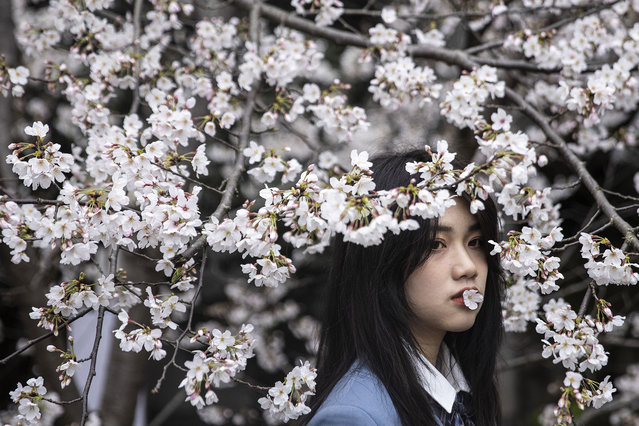
A girl holds a blossom in her mouth while posing for photos under cherry blossom trees at Wuhan University on March 11, 2021 in Wuhan, China. Tourists come to view cherry blossoms at the university during the spring. Wuhan University, first founded in 1893, is widely known as one of the most beautiful universities in China. Last year Wuhan University did not receive guests due to the pandemic lockdown. Currently the limit is 10,000 tourists a day. With no recorded cases of community transmission since May 2020, life for residents is gradually returning to normal. (Photo by Getty Images/China Stringer Network)

A girl holds a blossom in her mouth while posing for photos under cherry blossom trees at Wuhan University on March 11, 2021 in Wuhan, China. Tourists come to view cherry blossoms at the university during the spring. Wuhan University, first founded in 1893, is widely known as one of the most beautiful universities in China. (Photo by Getty Images/China Stringer Network)
Details
16 Mar 2021 09:45:00
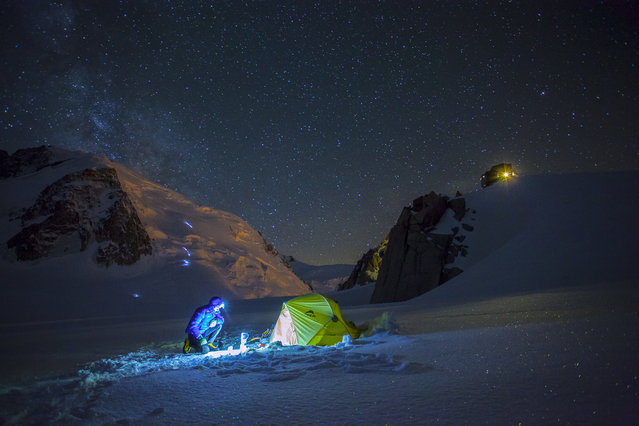
“A snapshot from mountaineer's life”. Have you ever wondered how does a mountaineer's day start? (Photo and caption by Kamil Tamiola/National Geographic Traveler Photo Contest)

“A snapshot from mountaineer's life”. Have you ever wondered how does a mountaineer's day start? I will give you a hint: you wake up at 3 am, set the stove, wake up your partner, pretend it is warm, quickly consume a high-calorie breakfast, watch your friends slowly ascending the icy slopes of your dream summit with their tiny head torches glimmering against perfectly blue ice, and hope for the good weather. One would ask: why all this trouble? The answer is easy: for the love of the adventure and the unknown. Location: Chamonix, Haute Savoye, France. (Photo and caption by Kamil Tamiola/National Geographic Traveler Photo Contest)

ATTENTION! All pictures are presented in high resolution. To see Hi-Res images – just TWICE click on any picture. In other words, click small picture – opens the BIG picture. Click BIG picture – opens VERY BIG picture.
Details
27 Jun 2013 12:47:00
A handout photo made available by the NASA shows the United Launch Alliance Delta IV Heavy rocket launches NASA's Parker Solar Probe to touch the Sun, from Launch Complex 37 at Cape Canaveral Air Force Station, Florida, USA, 12 August 2018. Parker Solar Probe is humanity’s first-ever mission into a part of the Sun’s atmosphere called the corona. Here it will directly explore solar processes that are key to understanding and forecasting space weather events that can impact life on Earth. (Photo by Bill Ingalls/EPA-EFE/NASA)

A handout photo made available by the NASA shows the United Launch Alliance Delta IV Heavy rocket launches NASA's Parker Solar Probe to touch the Sun, from Launch Complex 37 at Cape Canaveral Air Force Station, Florida, USA, 12 August 2018. Parker Solar Probe is humanity’s first-ever mission into a part of the Sun’s atmosphere called the corona. Here it will directly explore solar processes that are key to understanding and forecasting space weather events that can impact life on Earth. (Photo by Bill Ingalls/EPA-EFE/NASA)
Details
13 Aug 2018 07:26:00
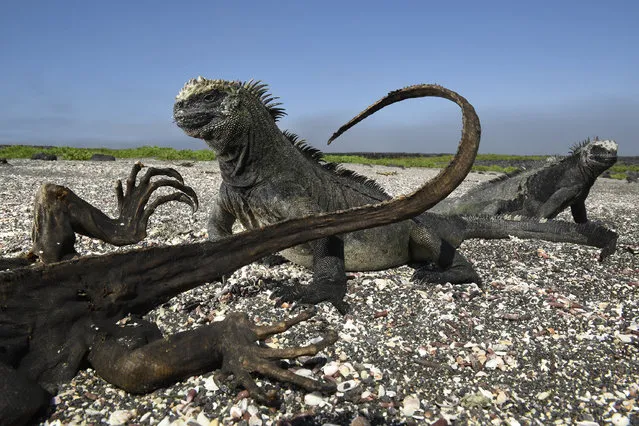
Galapagos – Rocking the Cradle: Four major ocean currents converge along the Galapagos archipelago, creating the conditions for an extraordinary diversity of animal life, April 25, 2016. The islands are home to at least 7,000 flora and fauna species, of which 97 percent of the reptiles, 80 percent of the land birds, 50 percent of the insects and 30 percent of the plants are endemic. The local ecosystem is highly sensitive to the changes in temperature, rainfall and ocean currents that characterize the climatic events known as El Niño and La Niña. These changes cause marked fluctuations in weather and food availability. Many scientists expect the frequency of El Niño and La Niña to increase as a result of climate change, making the Galapagos a possible early-warning location for its effects. (Photo by Thomas P. Peschak for National Geographic/World Press Photo)

Galapagos – Rocking the Cradle: Four major ocean currents converge along the Galapagos archipelago, creating the conditions for an extraordinary diversity of animal life, April 25, 2016. The islands are home to at least 7,000 flora and fauna species, of which 97 percent of the reptiles, 80 percent of the land birds, 50 percent of the insects and 30 percent of the plants are endemic. (Photo by Thomas P. Peschak for National Geographic/World Press Photo)
Details
16 Apr 2018 00:01:00