A person watches the sunrise from the Edge observation deck at Hudson Yards on the first day of spring on March 20, 2021 in New York City. (Photo by Noam Galai/Getty Images)
Models are seen backstage ahead of the Hakan Akkaya x Cinderella Bridal Capsule Collection at Tersane Istanbul on November 30, 2021 in Istanbul, Turkey. (Photo by Ferda Demir/Getty Images for Hakan Akkaya)
English television personality from Newcastle, known for being a cast member in the MTV reality series “Geordie Shore”, Chloe Ferry, 25, soaked up the sun in a thong latex bikini during her holiday in Portugal on May 28, 2021. (Photo by Backgrid USA)
A mahout rides on painted elephant as they march during a procession near the Grand Palace to pay their respects to Thailand's former queen Sirikit in Bangkok on November 27, 2025. (Photo by Chanakarn Laosarakham/AFP Photo)
Sergio Valverde Espinoza, a Catholic priest of the Cristo Rey church who modified a popular song called “Sopa de Caracol”, or Snail Soup in English, gestures during a Mass in San Jose, Costa Rica, Sunday, May 2, 2021. Valverde changed the song's lyrics to a message calling for the use of face masks and care during the pandemic. (Photo by Carlos Gonzalez/AP Photo)
Some artists want to convey some deep message through their art, while some are simply satisfied with shocking the audience. Roderique Arisiaman is the latter kind. Though his works do not play on the strings of our emotion, they can pique the interest with their flashy and sometimes humorous appearance. Many of his works have a zombie theme, and are surprisingly well done, especially the one where a man pushes his fingers through his cheek and into his eye. If given the chance, Roderique Arisiaman would probably do a great job of designing a poster for some zombie apocalypse movie. (Photo and caption by Roderique Arisiaman)
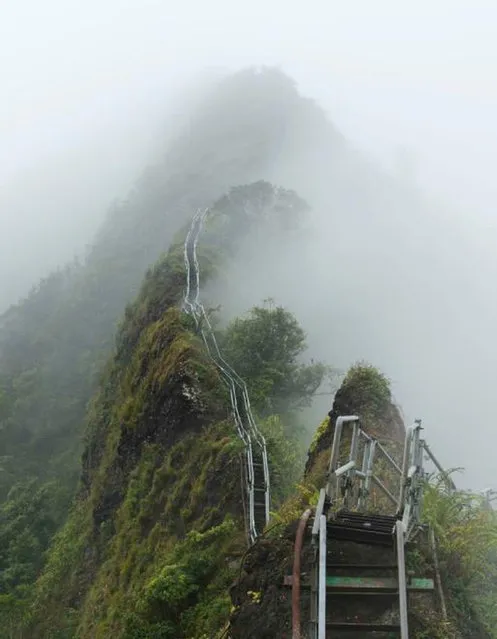
The Haʻikū Stairs, also known as the Stairway to Heaven or Haʻikū Ladder, is a steep hiking trail on the island of Oʻahu. The trail began as a wooden ladder spiked to the cliff on the south side of the Haʻikū Valley. It was installed in 1942 to enable antenna cables to be strung from one side of the cliffs above Haʻikū Valley to the other. A building to provide a continuous communication link between Wahiawā and Haʻikū Valley Naval Radio Station was constructed at the peak of Puʻukeahiakahoe, elevation about 2,800 feet (850 m). The antennae transmitted very low frequency radio signals from a 200,000-watt Alexanderson alternator in the center of Haʻikū valley. The signals could reach US Navy submarines as far away as Tokyo Bay while the submarines were submerged.