Loading...
Done
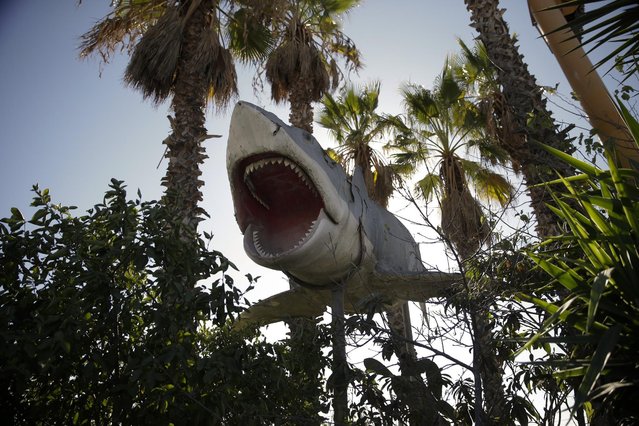
In this Wednesday, November 11, 2015 photo, one of the giant mechanical sharks that starred in the movie “Jaws” is seen at Aadlen Brothers Auto Wrecking, also known as U Pick Parts, in the Sun Valley section of Los Angeles. (Photo by Jae C. Hong/AP Photo)

In this Wednesday, November 11, 2015 photo, one of the giant mechanical sharks that starred in the movie “Jaws” is seen at Aadlen Brothers Auto Wrecking, also known as U Pick Parts, in the Sun Valley section of Los Angeles. It's not just a junkyard or even a really big junkyard, but a living, breathing monument to Los Angeles pop culture. But the family business is closing on New Year's Eve, and everything must go by then, the cars, the shark, the arches, even the giant car-crushing machine. (Photo by Jae C. Hong/AP Photo)
Details
25 Dec 2015 08:00:00
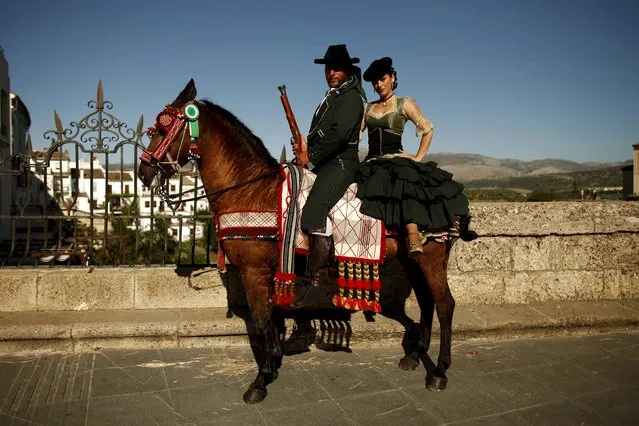
Francisco Javier Moreno (L), 35, and his wife Maria Auxiliadora Canca, 34, dressed as bandits pose for a photo with their horse as they participate in the third edition of “Ronda Romantica” (Romantic Ronda) in Ronda, southern Spain, May 16, 2015. (Photo by Jon Nazca/Reuters)

Francisco Javier Moreno (L), 35, and his wife Maria Auxiliadora Canca, 34, dressed as bandits pose for a photo with their horse as they participate in the third edition of “Ronda Romantica” (Romantic Ronda) in Ronda, southern Spain, May 16, 2015. Ronda Romantica is a cultural, historical and tourist event during the three days where thousands of people of Ronda and about fifty towns around of “Serrania de Ronda” (Ronda Mountain Ranges), dressed in traditional costumes, recreate the era of the bandits, drovers and romantic travelers in the nineteenth century. (Photo by Jon Nazca/Reuters)
Details
18 May 2015 11:32:00
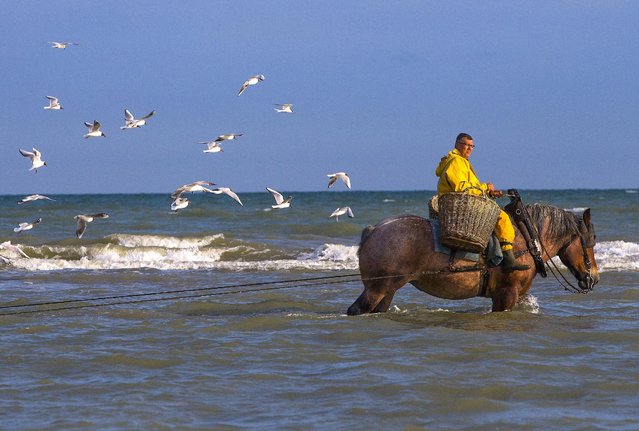
A Belgian shrimp fisherman rides a carthorse to haul a net out in the sea to catch shrimps during low tide at the coastal town of Oostduinkerke, Belgium July 3, 2015. (Photo by Yves Herman/Reuters)

A Belgian shrimp fisherman rides a carthorse to haul a net out in the sea to catch shrimps during low tide at the coastal town of Oostduinkerke, Belgium July 3, 2015. At the end of each fishing session, the fishermen and their mounts leave the water to empty the net's contents into two wicker baskets fixed on each side of the horse. This traditional method of catching shrimps along the North Sea coast, which dates back to some 500 years, attracts tourists every summer. In 2013, Unesco recognized shrimp fishing on horseback as an intangible cultural heritage. (Photo by Yves Herman/Reuters)
Details
04 Jul 2015 11:29:00
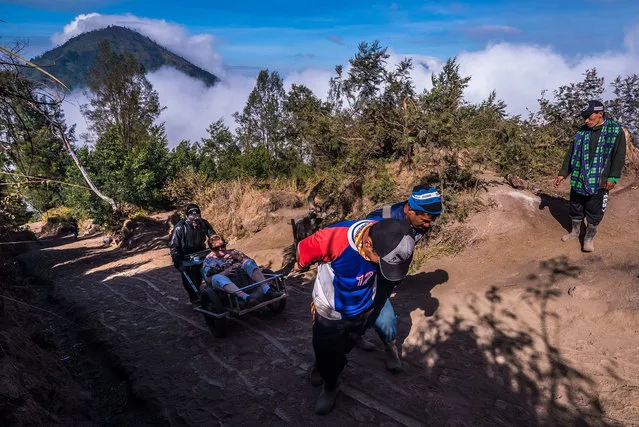
Miners pulling up lazy tourists to the rim of Kawah Ijen (Ijen Volcano), East Java, Indonesia on September 21, 2017. They will earn as much as they would bring down a load of sulfur. Nomadic Explorer, Cultural Lifestyle Photographer Claudio Sieber captured striking images of miners working at Ijen volcanic range in East Java, Indonesia. The sulphur miners risk their lives daily as they climb the active volcano carrying heavy loads, which they sell to sugar refineries. Shortly after midnight curious tourists are flocking in hundreds through the gate of Ijen's foothills to be right on time, driven by the images others took before them. Kawah Ijen is the one of the world's largest acidic volcanic crater lake; famous for its turquoise color as well as the unreal atmosphere it offers during darkness. A dusty path zigzags 3 kilometers up to the crater rim. This doesn't mean anything challenging; in particular, special sights have to be deserved anyway. The irritating smell of sulfur announces the near of the crater's existence. Arriving on the crater's rim the reward for the torture becomes visible. Blue fire darts its tongues through the fumes of sulfur dioxide. Somehow, the spectacle isn't as romantic as expected, since it is also the rough working space of approx. 150 sulfur miners who start their shift at 1 am. Lately, harvesting the abundance of devil's gold received international attention. This did obviously not really improve a miner's lifestyle; neither did it contribute to a better wage. (Photo by Claudio Sieber/Barcroft Images)

Miners pulling up lazy tourists to the rim of Kawah Ijen (Ijen Volcano), East Java, Indonesia on September 21, 2017. They will earn as much as they would bring down a load of sulfur. Nomadic Explorer, Cultural Lifestyle Photographer Claudio Sieber captured striking images of miners working at Ijen volcanic range in East Java, Indonesia. The sulphur miners risk their lives daily as they climb the active volcano carrying heavy loads, which they sell to sugar refineries. (Photo by Claudio Sieber/Barcroft Images)
Details
02 Oct 2017 08:31:00
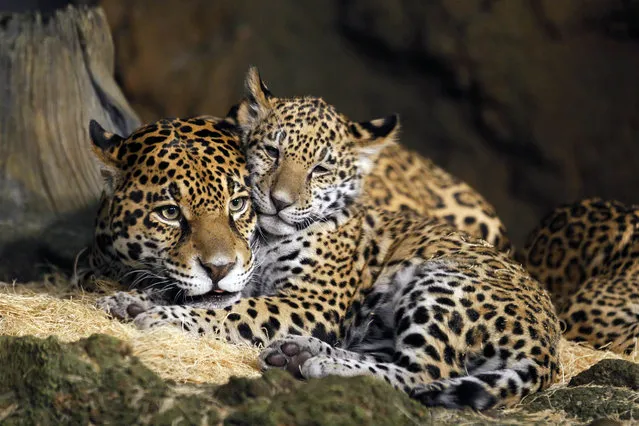
Stella the mother and her cub Zean rest together at The Milwaukee County Zoo  Zean and B'alam  are the two newest jaguar cubs with the mother Stella who are now on public exhibit, at four months old. B' alam (who has larger and darker spots as well as a square space on her forehead showing no spots) name means "Great and powerful king in Mayan.   Zean encompasses the Belize people living and working in Belize, with all cultures. She has smaller, almost greyish spots on her coat.  The names were revealaed at the Milwaukee County Zoo, Wednesday, March 13, 2013. Journal Sentinel photo by Rick Wood/RWOOD@JOURNALSENTINEL.COM

The first jaguar litter since 1975 was born at the Milwaukee County Zoo to Stella and Pat on November 13, 2013. The litter was on public display for the first time on March 13 when the jaguar baby's names were released. Belize schoolchildren named one Zean, which is the end of Belizean, and a public contest named the other B'alam, which means "great and powerful king" in Mayan. Photo: Stella the mother and her cub Zean rest together at The Milwaukee County Zoo. (Photo by Rick Wood)
Details
15 Mar 2013 07:51:00
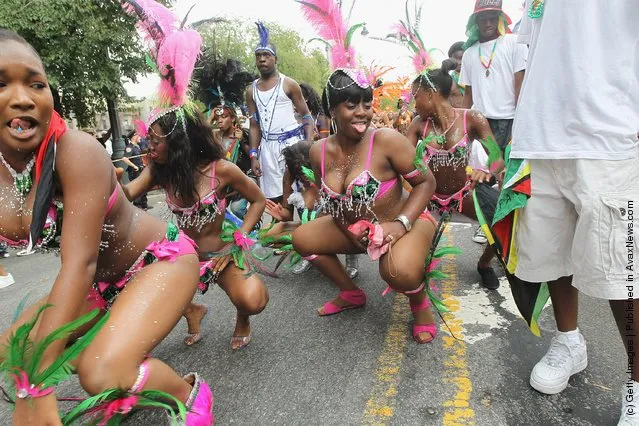
New Yorkers Celebrate At West Indian Day Parade

“The Labor Day Parade (or West Indian Carnival), is an annual celebration held on American Labor Day (the first Monday in September), in Crown Heights, Brooklyn, New York. Ms. Jessie Waddell and some of her West Indian friends started the Carnival in Harlem in the 1920s by staging costume parties in large enclosed places like the Savoy, Renaissance and Audubon Ballrooms due to the cold wintry weather of February. This is the usual time for the pre-Lenten celebrations held in most countries around the world. However, because of the very nature of Carnival, and the need to parade in costume to music, indoor confinement did not work well. The earliest known Carnival street parade was held on September 1, 1947. The Trinidad Carnival Pageant Committee was the founding force behind the parade, which was held in Harlem. The parade route was along Seventh Avenue, starting at 110th St.” – Wikipedia

Photo: A reveler looks on during the West Indian-American Day Parade September 5, 2011 in the Brooklyn borough of New York City. More than 2 million spectators were expected to attend the celebration of Caribbean culture. (Photo by Mario Tama/Getty Images)
Details
06 Sep 2011 11:18:00
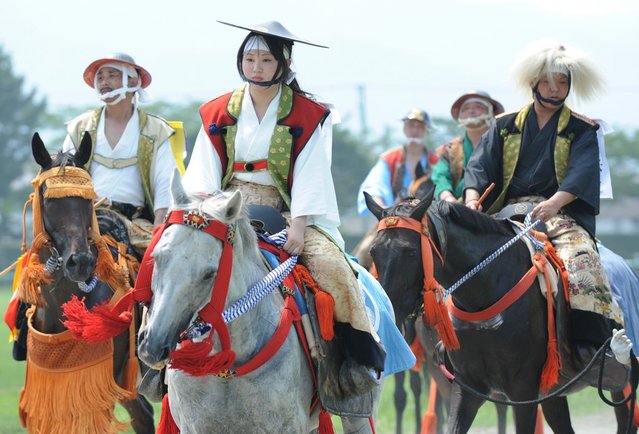
A young woman (C) clad in samurai costume leads other local poeple as she rides her horse during a parade at the annual Soma Nomaoi festival in Minamisoma, Fukushima Prefecture, on July 28, 2012.  The traditional full-scale festival kicked off for the first time after the accident of the Fukushima Dai-ichi Nuclear Power Plant following the massive earthquake and the tsunami on March 11, 2011. (Photo by Toru Yamanaka/AFP Photo)

Soma-Nomaoi is a festival that recreates a battle scene from more than 1,000 years ago. It is annually held for 4 days from July 22 to 25 in Haramachi City, Fukushima Prefecture, in the eastern part of Japan. In this historical event, 600 mounted samurai in traditional Japanese armor, with long swords at their side and ancestral flagstaffs streaming from their backs, ride across open fields. Soma-Nomaoi has been designated an Important Intangible Folk Cultural Property.

Photo: A young woman (C) clad in samurai costume leads other local poeple as she rides her horse during a parade at the annual Soma Nomaoi festival in Minamisoma, Fukushima Prefecture, on July 28, 2012. The traditional full-scale festival kicked off for the first time after the accident of the Fukushima Dai-ichi Nuclear Power Plant following the massive earthquake and the tsunami on March 11, 2011. (Photo by Toru Yamanaka/AFP Photo)
Details
02 Aug 2012 12:59:00
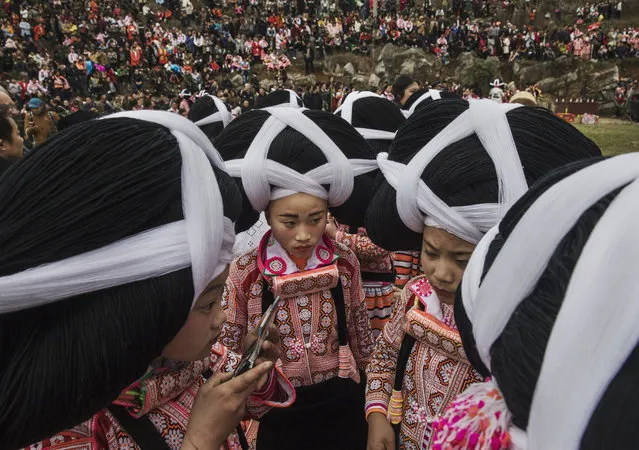
Girls of the Long Horn Miao ethnic minority group wear headdresses as they prepare gather for Tiaohua or Flower Festival as part of the Lunar New Year on February 6, 2017 in Longga village, Guizhou province, southern China. The Long Horn Miao are recognized for their declining practice of wrapping a blend of linen, wool, and the hair of their ancestors around animal horns or a wooden clip to make headdresses. Many young women say they now wear the headdresses only for special occasions and festivals, as the ornaments, which are attached by the horns to their real hair, have proved impractical for modern daily life in a fast changing world. China officially recognizes 56 different ethnic minorities, and statistics show over 7 million Chinese identifying themselves as Miao. But the small Long Horn Miao community counts only around 5000 people living in 12 villages, whose age-old traditions, language, and culture are fading. It is increasingly difficult in a modernizing China, as young people are drawn from remote rural villages to opportunities in bigger cities amongst wide-scale urbanization. Farming and labour remain the mainstays of life for the Long Horn Miao, leaving the area relatively poor in comparison with many parts of China. The government has invested significant amounts into local infrastructure and the tourism industry to try to bolster the local economy. (Photo by Kevin Frayer/Getty Images)

Girls of the Long Horn Miao ethnic minority group wear headdresses as they prepare gather for Tiaohua or Flower Festival as part of the Lunar New Year on February 6, 2017 in Longga village, Guizhou province, southern China. (Photo by Kevin Frayer/Getty Images)
Details
13 Feb 2017 00:01:00