Loading...
Done
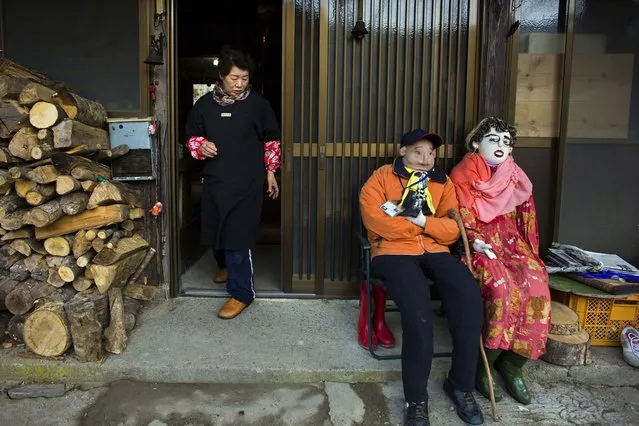
Tsukimi Ayano steps out of her house in the village of Nagoro on Shikoku Island in southern Japan February 24, 2015. (Photo by Thomas Peter/Reuters)

Tsukimi Ayano steps out of her house in the village of Nagoro on Shikoku Island in southern Japan February 24, 2015. Tsukimi Ayano made her first scarecrow 13 years ago to frighten off birds pecking at seeds in her garden. The life-sized straw doll resembled her father, so she made more. Today, the tiny village of Nagoro in southern Japan is teeming with Ayano's hand-sewn creations, frozen in time for a tableau that captures the motions of everyday life. (Photo by Thomas Peter/Reuters)
Details
17 Mar 2015 12:38:00
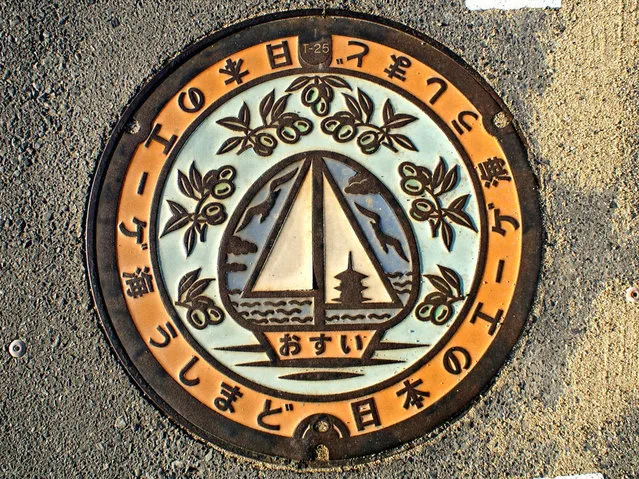
Japanese Manhole Covers Photos By S. Morita Part 2

Japan is a country full of art. Much of this is housed in museums and galleries, but others are right under our feet. We speak, of Japan’s peculiar obsession with manhole covers. Almost anywhere in the country you can find manhole covers with spectacular grounds, each more beautiful and complex than the previous. In recent years, S. Morita photographer has traveled around Japan and leave us this great gathering on the beautiful and artistic Japanese manhole covers.
Details
06 Apr 2014 12:03:00
For her series “Japanese Whispers”, Belgian photographer Zaza Bertrand headed inside the intimate world of rabuhos – Japanese love hotels. Love hotels became popular in Japan from the 1960s onwards, due to a lack of privacy in many family homes. There are now around 37,000 of these hotels in Japan, allowing short daytime “rests” or overnight stays. (Photo by Zaza Bertrand/The Guardian)

For her series “Japanese Whispers”, Belgian photographer Zaza Bertrand headed inside the intimate world of rabuhos – Japanese love hotels. Love hotels became popular in Japan from the 1960s onwards, due to a lack of privacy in many family homes. There are now around 37,000 of these hotels in Japan, allowing short daytime “rests” or overnight stays. (Photo by Zaza Bertrand/The Guardian)
Details
02 Dec 2016 11:30:00
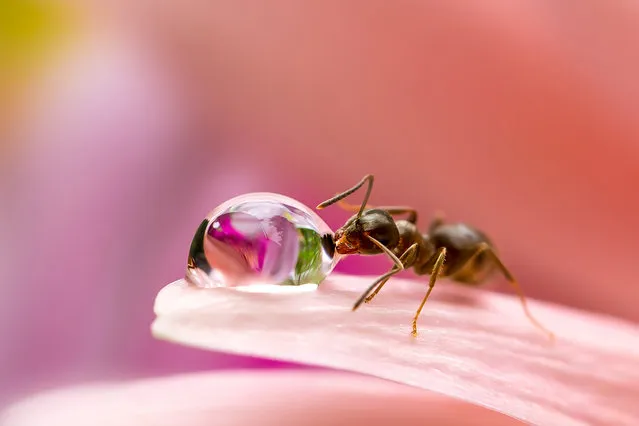
A macro view of an ant taking a sip from a water droplet on the edge of a flower in Obihiro, Japan. Animal-Lover Miki Asai has gone a step beyond feeding bread to the ducks – by syringe-feeding water to tiny ants. The office worker from Obihiro City, Japan, squirts droplets near the tiny insects and then uses a macro lens to capture quenching their thirst. The amateur photographer started capturing these images near her house in July 2013 after spotting an ant struggling in the rain. (Photo by Miki Asai/Barcroft Media)

A macro view of an ant taking a sip from a water droplet on the edge of a flower in Obihiro, Japan. Animal-Lover Miki Asai has gone a step beyond feeding bread to the ducks – by syringe-feeding water to tiny ants. The office worker from Obihiro City, Japan, squirts droplets near the tiny insects and then uses a macro lens to capture quenching their thirst. The amateur photographer started capturing these images near her house in July 2013 after spotting an ant struggling in the rain. (Photo by Miki Asai/Barcroft Media)
Details
09 Sep 2014 08:34:00


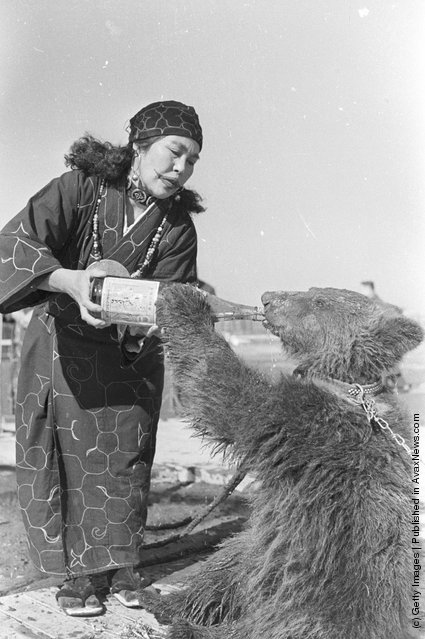
“The Ainu (アイヌ?), also called Aynu, Aino (アイノ), and in historical texts Ezo (蝦夷), are indigenous people or groups in Japan and Russia. Historically they spoke the Ainu language and related varieties and lived in Hokkaidō, the Kuril Islands, and much of Sakhalin. Most of those who identify themselves as Ainu still live in this same region, though the exact number of living Ainu is unknown. This is due to ethnic issues in Japan resulting in those with Ainu backgrounds hiding their identities and confusion over mixed heritages. In Japan, because of intermarriage over many years with Japanese, the concept of a 'pure Ainu' ethnic group is no longer feasible. Official estimates of the population are of around 25,000, while the unofficial number is upwards of 200,000 people”. – Wkipedia

Photo: A captive bear drinking from a large bottle held by an Ainu tribeswoman. (Photo by Evans/Three Lions/Getty Images). Circa 1955
Details
24 Mar 2011 14:01:00
A model presents a creation by Japanese lingerie brand Peach John from its Autumn/Winter 2016 collection during Tokyo Fashion Week in Tokyo, Japan, March 15, 2016. (Photo by Toru Hanai/Reuters)

A model presents a creation by Japanese lingerie brand Peach John from its Autumn/Winter 2016 collection during Tokyo Fashion Week in Tokyo, Japan, March 15, 2016. (Photo by Toru Hanai/Reuters)
Details
20 Mar 2016 11:55:00
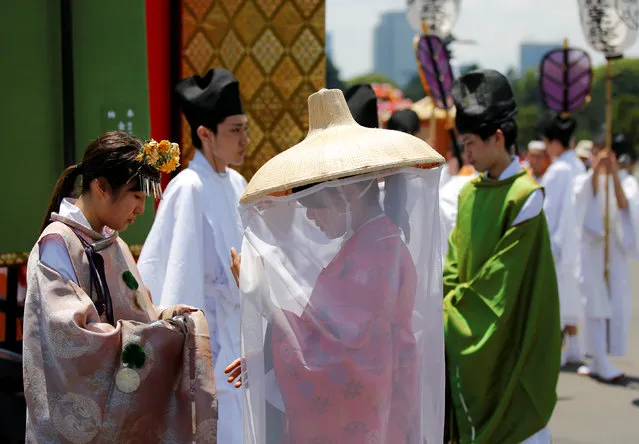
Participants dressed in ancient Japanese costumes take part in a parade at the Imperial Palace during the Sanno Festival in Tokyo, Japan June 10, 2016. (Photo by Toru Hanai/Reuters)

Participants dressed in ancient Japanese costumes take part in a parade at the Imperial Palace during the Sanno Festival in Tokyo, Japan June 10, 2016. (Photo by Toru Hanai/Reuters)
Details
11 Jun 2016 12:31:00
A participant in costume poses to a camera after a Halloween parade in Kawasaki, south of Tokyo, Japan October 30, 2016. (Photo by Kim Kyung-Hoon/Reuters)

A participant in costume poses to a camera after a Halloween parade in Kawasaki, south of Tokyo, Japan October 30, 2016. More than 130,000 spectators turned up to watch the parade, where about 2,600 participants dressed up in costumes, according to the organiser. ((Photo by Kim Kyung-Hoon/Reuters)
Details
31 Oct 2016 11:40:00