Loading...
Done


“Kimberly Noel “Kim” Kardashian (born October 21, 1980) is an American socialite, television personality, actress, model, and recording artist. She is the daughter of late attorney Robert Kardashian, and is known for a s*x tape with her former boyfriend Ray J as well as her E! reality series which she shares with her family, Keeping Up with the Kardashians. Kardashian's prominence has increased as of January 2011 with the premiere of Kourtney and Kim Take New York, the second spin-off of Keeping Up with the Kardashians (the first being Kourtney and Khloe Take Miami), debuting on E!, with the series following Kim and sister Kourtney Kardashian as they leave Los Angeles to open a third D-A-S-H store in New York City.

Kardashian has launched multiple fragrances, guest starred on numerous shows, competed on ABC's Dancing with the Stars, and has had roles in movies such as Disaster Movie and Deep in the Valley. In 2010, Kardashian, along with her sisters Kourtney and Khloe, released an autobiography, Kardashian Konfidential, and plan to launch their own fashion line”.

Photo: Socialite Kim Kardashian blows out her birthday cake candles at her birthday party at Les Deux on October 21, 2007 in Los Angeles, California. (Photo by Noel Vasquez/Getty Images). LOS ANGELES, CA – OCTOBER 21
Details
11 Mar 2011 14:39:00
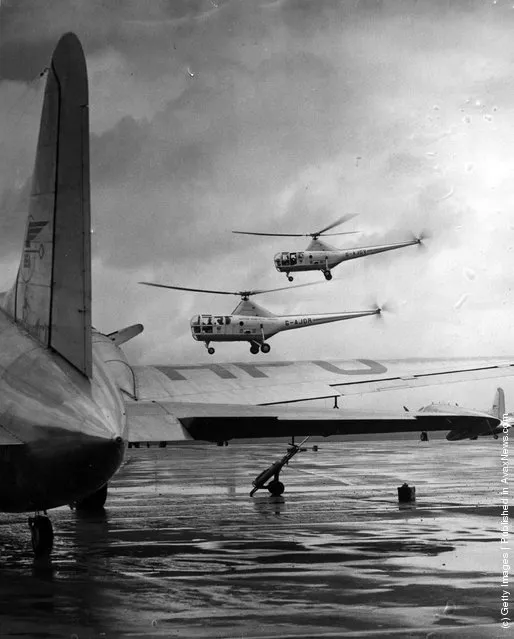
Sikorsky H-5 helicopters

“Igor Sikorsky (May 25, 1889 – October 26, 1972), born Igor Ivanovich Sikorsky was a Russian American pioneer of aviation in both helicopters and fixed-wing aircraft. He designed and flew the world's first multi-engine fixed-wing aircraft, the Russky Vityaz in 1913, and the first airliner, Ilya Muromets, in 1914. After immigrating to the United States in 1919, Sikorsky founded the Sikorsky Aircraft Corporation in 1923, and developed the first of Pan American Airways' ocean-conquering flying boats in the 1930s. In 1939 Sikorsky designed and flew the Vought-Sikorsky VS-300, the first viable American helicopter, which pioneered the rotor configuration used by most helicopters today. Sikorsky would modify the design into the Sikorsky R-4, which became the world's first mass-produced helicopter in 1942”. – Wikipedia

Photo: Westland Sikorsky H-5's, used by British European Airways Helicopters, which fly between London and Birmingham. The Sikorsky H-5, (aka R-5, S-51, HO3S-1, or Horse) (R-5 until 1948; company designation VS-327) is a helicopter built by Sikorsky Aircraft Corporation, formerly used by the United States Air Force, and its predecessor, the United States Army Air Forces, as well as the United States Navy and United States Coast Guard (with the designations HO2S and HO3S). (Photo by Harrison /Topical Press Agency/Getty Images). 22nd May 1951
Details
06 Sep 2011 10:18:00
Photographers: Helmut Newton

“Newton was born in Berlin, the son of Klara “Claire” (Marquis) and Max Neustädter, a button factory owner. His family was Jewish. Newton attended the Heinrich-von-Treitschke-Realgymnasium and the American School in Berlin. Interested in photography from the age of 12 when he purchased his first camera, he worked for the German photographer Yva (Elsie Neulander Simon) from 1936. The increasingly oppressive restrictions placed on Jews by the Nuremberg laws meant that his father lost control of the factory in which he manufactured buttons and buckles; he was briefly interned in a concentration camp on “Kristallnacht”, November 9, 1938, which finally compelled the family to leave Germany. Newton's parents fled to South America. He was issued with a passport just after turning 18, and left Germany on December 5, 1938. At Trieste he boarded the “Conte Rosso” (along with about 200 others escaping the Nazis) intending to journey to China. After arriving in Singapore he found he was able to remain there, first and briefly as a photographer for the Straits Times and then as a portrait photographer”. – Wikipedia

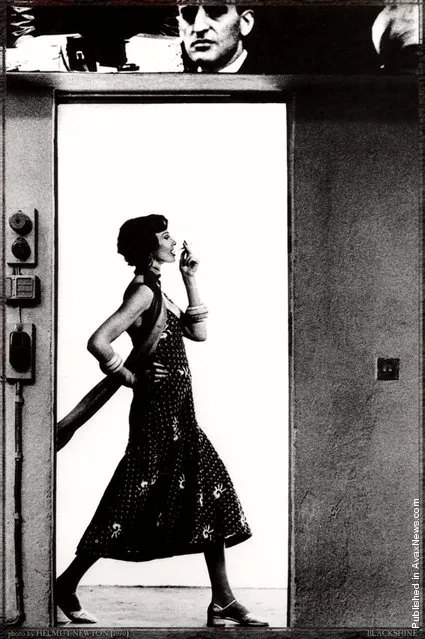
Photo: Sigourney Weaver by Helmut Newton, 1995.
Details
08 Apr 2012 13:49:00
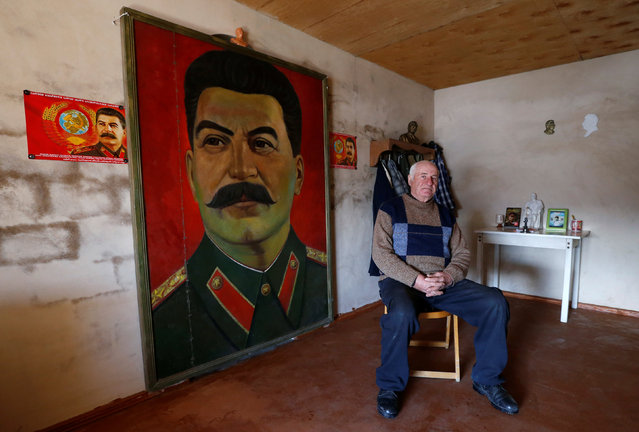
Retired builder Vasili Sidamonidze, 70, poses for a portrait at his home in Gori, Georgia, December 6, 2016. “Unfortunately, Stalin is not popular nowadays. Our people don't respect him. Only we, members of the (Communist) Party, respect him”, Sidamonidze said. “I always try to attend Stalin's birthday anniversaries in Gori. Unfortunately many people don't want to join us even if they live nearby. They look at us from their windows”. Stalin, who was born in Gori in 1878 and died in 1953, is largely reviled today in Georgia, which regained its independence during the 1991 collapse of the Soviet Union. Over the years, his memorials have been dismantled, most recently in 2010 when authorities removed a statue of the dictator from Gori's central square. But Stalin is still revered by a small group of mainly elderly supporters who stress his role in the industrialisation of the Soviet Union and in defeating Nazi Germany in World War Two. Each Dec. 21, a few dozen people mark his birthday by gathering outside a Gori museum dedicated to Stalin, where they make speeches and walk to the square where a 6-meter-high bronze statue of him once stood, calling for it to be reinstated. Opponents say it was a symbol of Moscow's still lingering shadow. In 2008, Russia fought a brief war with Georgia and recognised its breakaway regions of Abkhazia and South Ossetia as independent states. (Photo by David Mdzinarishvili/Reuters)

Retired builder Vasili Sidamonidze, 70, poses for a portrait at his home in Gori, Georgia, December 6, 2016. “Unfortunately, Stalin is not popular nowadays. Our people don't respect him. Only we, members of the (Communist) Party, respect him”, Sidamonidze said. “I always try to attend Stalin's birthday anniversaries in Gori. Unfortunately many people don't want to join us even if they live nearby. They look at us from their windows”. (Photo by David Mdzinarishvili/Reuters)
Details
17 Dec 2016 07:59:00
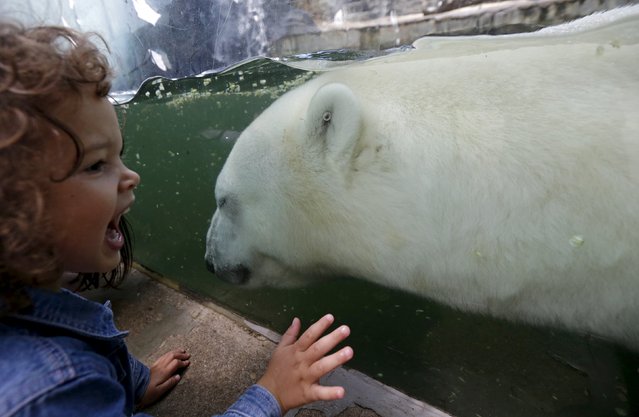
A child looks at a polar bear swimming under a water in its enclosure on a hot summer day at Prague Zoo, Czech Republic, July 30, 2015. (Photo by David W. Cerny/Reuters)

A child looks at a polar bear swimming under a water in its enclosure on a hot summer day at Prague Zoo, Czech Republic, July 30, 2015. (Photo by David W. Cerny/Reuters)
Details
31 Jul 2015 11:45:00
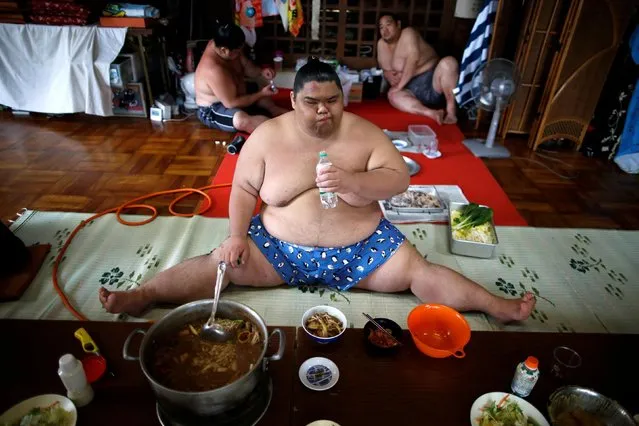
Sumo wrestler Kaiho eats a “chanko” meal in Nagoya, Japan on July 18, 2017. After ending practice at 10:30 a.m., the wrestlers mingle with fans, sign autographs and pose for photos before the first of their two daily meals. (Photo by Issei Kato/Reuters)

Sumo wrestler Kaiho eats a “chanko” meal in Nagoya, Japan on July 18, 2017. After ending practice at 10:30 a.m., the wrestlers mingle with fans, sign autographs and pose for photos before the first of their two daily meals. (Photo by Issei Kato/Reuters)
Details
20 Jul 2017 07:49:00
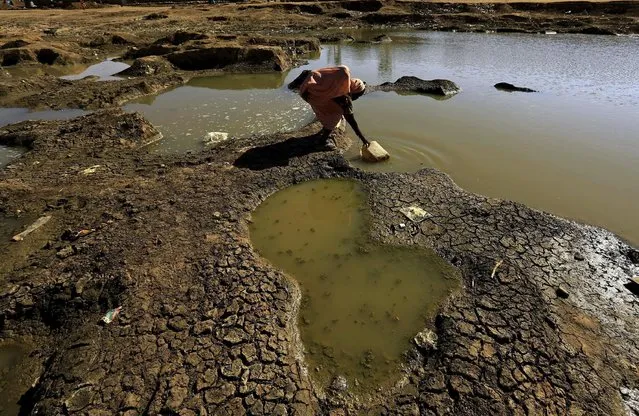
An internally displaced woman collects water from a pond to construct a mud-house at the Aboushok camp in El Fasher, North Darfur, Sudan, November 17, 2015. (Photo by Mohamed Nureldin Abdallah/Reuters)

An internally displaced woman collects water from a pond to construct a mud-house at the Aboushok camp in El Fasher, North Darfur, Sudan, November 17, 2015. The conflict in Sudan's Darfur region that erupted 12 years ago shows no sign of ending. But it hasn't stopped displaced youngsters, some of whom have spent their entire lives in refugee camps, from dreaming big. Twelve children aged 12 explain their hopes and dreams for the future; ambitions include becoming a doctor, an engineer and a teacher. (Photo by Mohamed Nureldin Abdallah/Reuters)
Details
13 Dec 2015 08:00:00
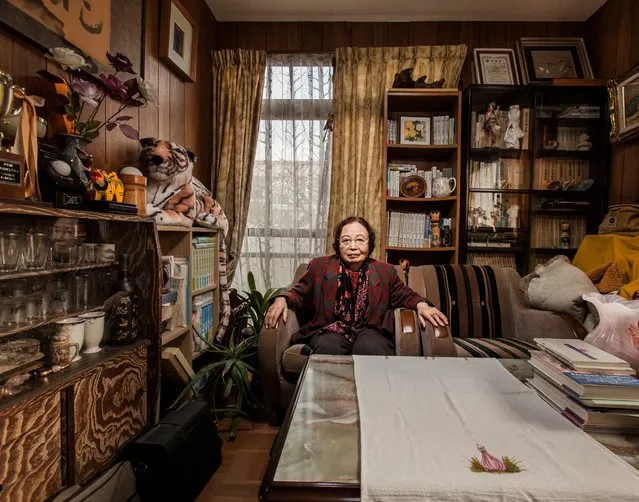
Takeoka Chisaka, Hiroshima, Japan. “One morning in August 1945, I was walking home from the night shift at a factory in Hiroshima. As I reached my door, there was a huge explosion. When I came to, my head was bleeding and I had been blasted 30m away”. (Photo and caption by Sasha Maslov)

Takeoka Chisaka, Hiroshima, Japan. “One morning in August 1945, I was walking home from the night shift at a factory in Hiroshima. As I reached my door, there was a huge explosion. When I came to, my head was bleeding and I had been blasted 30m away. The atomic bomb had detonated. When I found my mother, her eyes were badly burned. A doctor said they had to come out, but he didn’t have the proper tools so used a knife instead. It was hellish. I became a peace-worker after the war. In the 1960s, at a meeting at the UN, I met one of the people who created the atomic bomb. He apologised”. (Photo and caption by Sasha Maslov)
Details
11 May 2015 11:56:00