Loading...
Done
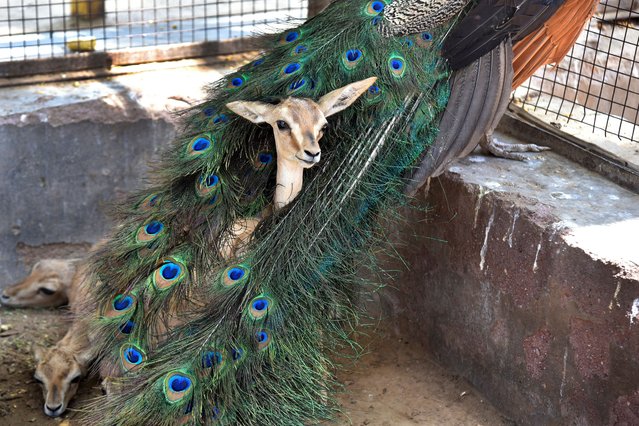
A Chinkara gazelle fawn rests in the plumage of a peacock at an animal rescue center on a hot summer day in Bikaner, Rajasthan, India, Thursday, May 23, 2024. (Photo by Dinesh Gupta/AP Photo)

A Chinkara gazelle fawn rests in the plumage of a peacock at an animal rescue center on a hot summer day in Bikaner, Rajasthan, India, Thursday, May 23, 2024. (Photo by Dinesh Gupta/AP Photo)
Details
02 Oct 2025 04:53:00
Runner-up; Hon Yen marine ecosystem. Phu Yen, Vietnam. Every year between May and August, the coral of this rich and diverse ecosystem becomes exposed at low tide. (Photo by Truong Hoai Vu/Royal Society of Biology Photography Competition)

Runner-up; Hon Yen marine ecosystem. Phu Yen, Vietnam. Every year between May and August, the coral of this rich and diverse ecosystem becomes exposed at low tide. (Photo by Truong Hoai Vu/Royal Society of Biology Photography Competition)
Details
31 Oct 2021 05:12:00
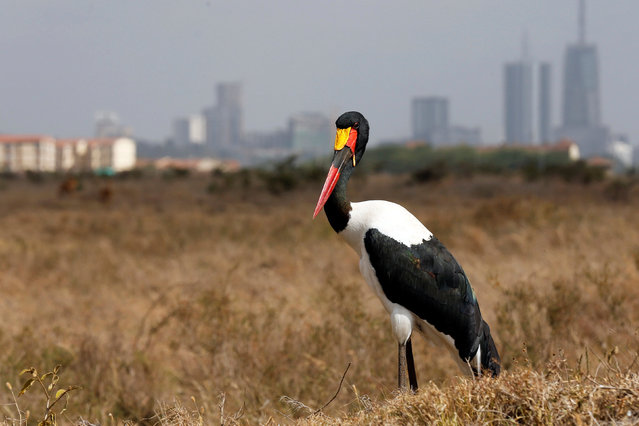
A saddle-billed stork stands in the grassland at the Nairobi National Park near Nairobi, Kenya January 23, 2017. (Photo by Thomas Mukoya/Reuters)

A saddle-billed stork stands in the grassland at the Nairobi National Park near Nairobi, Kenya January 23, 2017. (Photo by Thomas Mukoya/Reuters)
Details
29 Jan 2017 11:32:00
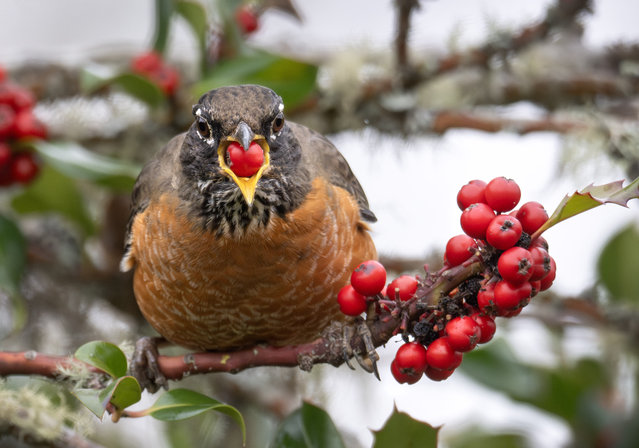
An American robin feeds on holly berries in a thicket near Elkton in southwestern Oregon on November 16, 2024. Many birds can safely consume holly berries, including blackbirds, redwings, and thrushes. There is an old wives tale that if you see a bird eating a berry, it is safe for humans to eat, but this is not true. Birds consume many plants that are poisonous to humans, holly berries included. (Photo by Robin Loznak/ZUMA Press Wire/Rex Features/Shutterstock)

An American robin feeds on holly berries in a thicket near Elkton in southwestern Oregon on November 16, 2024. Many birds can safely consume holly berries, including blackbirds, redwings, and thrushes. There is an old wives tale that if you see a bird eating a berry, it is safe for humans to eat, but this is not true. Birds consume many plants that are poisonous to humans, holly berries included. (Photo by Robin Loznak/ZUMA Press Wire/Rex Features/Shutterstock)
Details
01 Dec 2024 01:43:00
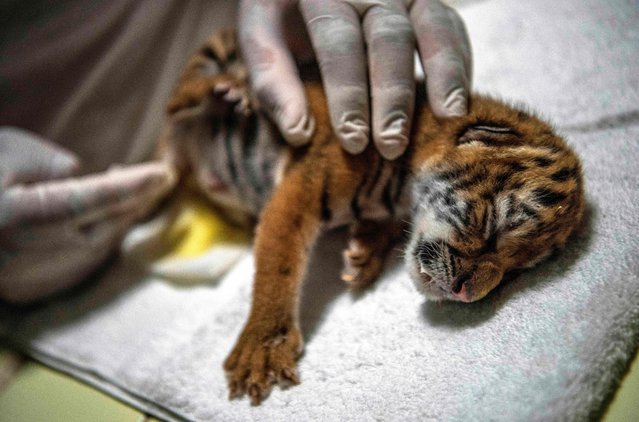
A three-day-old Bengal tiger calf is cared for after being fed at the National Zoo in Masaya on August 30, 2021. A female Bengal tiger calf was born in the National Zoo of Nicaragua, the fourth of this species in risk of extinction born in captivity in the country, and is under special care due to a limited breastfeeding capacity of the mother. (Photo by Inti Ocon/AFP Photo)

A three-day-old Bengal tiger calf is cared for after being fed at the National Zoo in Masaya on August 30, 2021. A female Bengal tiger calf was born in the National Zoo of Nicaragua, the fourth of this species in risk of extinction born in captivity in the country, and is under special care due to a limited breastfeeding capacity of the mother. (Photo by Inti Ocon/AFP Photo)
Details
05 Sep 2021 05:48:00
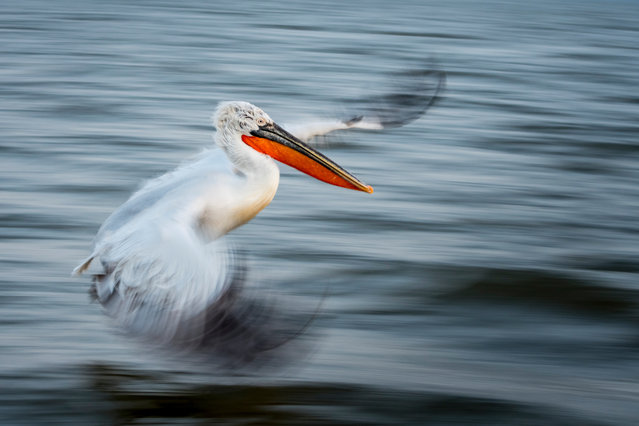
Overall winner: The Art of Flight by Alwin Hardenbol (University of Eastern Finland). A panning shot of a Dalmatian pelican in flight. The picture was taken on Lake Kerkini in Greece. (Photo by Alwin Hardenbol/2020 British Ecological Society Photography Competition)

Overall winner: The Art of Flight by Alwin Hardenbol (University of Eastern Finland). A panning shot of a Dalmatian pelican in flight. The picture was taken on Lake Kerkini in Greece. (Photo by Alwin Hardenbol/2020 British Ecological Society Photography Competition)
Details
01 Dec 2020 00:03:00
Fans react as Kansas City Chiefs wide receiver Xavier Worthy, right, signs autographs at the team's NFL football training camp Sunday, July 27, 2025, in St. Joseph, Mo. (Photo by Charlie Riedel/AP Photo)

Fans react as Kansas City Chiefs wide receiver Xavier Worthy, right, signs autographs at the team's NFL football training camp Sunday, July 27, 2025, in St. Joseph, Mo. (Photo by Charlie Riedel/AP Photo)
Details
07 Aug 2025 04:08:00
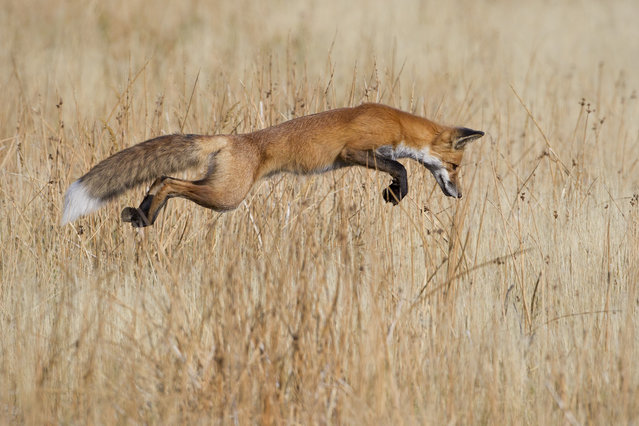
Canada: “Lucky pounce”. (Photo by Connor Stefanison/Wildlife Photographer of the Year 2013)

The winners of The London’s Natural History Museum's prestigious Wildlife Photographer of the Year for 2013 have finally been unveiled. Selected from almost 43,000 entries from 96 countries, the winners offer a glimpse of the stunning array of natural beauty on our planet. Photo: Canada: “Lucky pounce”. “Anticipating the pounce – that was the hardest part”, says Connor, who had come to Yellowstone National Park, Wyoming, USA, in search of wildlife as much as the spectacular landscape. He had found this fox, his first ever, on his last day in the park. It was so absorbed in hunting that Connor had plenty of time to get out of the car and settle behind a rock. It quartered the grassland, back and forth, and then started staring intently at a patch of ground, giving Connor just enough warning of the action to come. When it sprung up, Connor got his shot. And when it landed, the fox got his mouse. (Photo by Connor Stefanison/Wildlife Photographer of the Year 2013)
Details
17 Oct 2013 08:12:00