Loading...
Done
Rooftops of solar powered houses are pictured in Ota, 80 km northwest of Tokyo in this October 28, 2008 file photo. One by one, Japan is turning off the lights at the giant oil-fired power plants that propelled it to the ranks of the world's top industrialised nations. With nuclear power in the doldrums after the Fukushima disaster, it's solar energy that is becoming the alternative. (Photo by Yuriko Nakao/Reuters)

Rooftops of solar powered houses are pictured in Ota, 80 km northwest of Tokyo in this October 28, 2008 file photo. One by one, Japan is turning off the lights at the giant oil-fired power plants that propelled it to the ranks of the world's top industrialised nations. With nuclear power in the doldrums after the Fukushima disaster, it's solar energy that is becoming the alternative. Solar power is set to become profitable in Japan as early as this quarter, according to the Japan Renewable Energy Foundation (JREF), freeing it from the need for government subsidies and making it the last of the G7 economies where the technology has become economically viable. (Photo by Yuriko Nakao/Reuters)
Details
24 Nov 2015 08:04:00
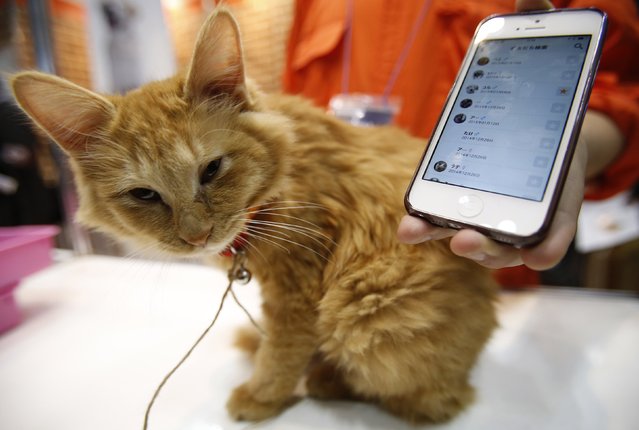
A cat wears a “Tsunagaru Col” gadget next to a smart phone displaying the connected app, at the Anicall Corp booth during the Wearable Device Technology Expo in Tokyo January 14, 2015. The gadget (“Tsunagaru” means connection) for animals tracks information about pets, such as the location and other animals the pet might be interacting with, with the purpose of providing “social networking” for animals. (Photo by Yuya Shino/Reuters)

A cat wears a “Tsunagaru Col” gadget next to a smart phone displaying the connected app, at the Anicall Corp booth during the Wearable Device Technology Expo in Tokyo January 14, 2015. The gadget (“Tsunagaru” means connection) for animals tracks information about pets, such as the location and other animals the pet might be interacting with, with the purpose of providing “social networking” for animals. The expo runs until January 16 as a part of Japan's largest electronic exhibition expected to attract around 77,000 visitors, according to organisers. (Photo by Yuya Shino/Reuters)
Details
16 Jan 2015 12:57:00
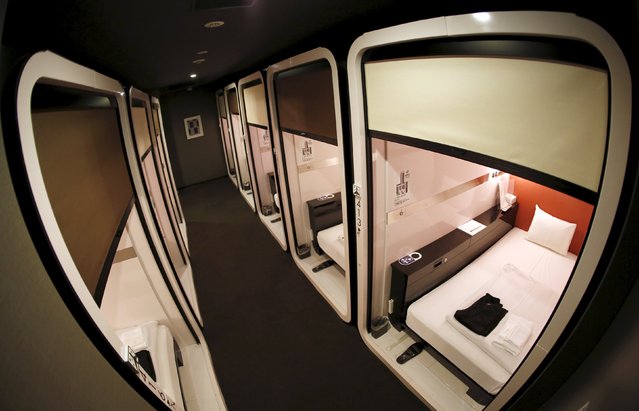
“Business-class” cabins are seen at First Cabin hotel, which was converted from an old office building, in Tokyo, July 3, 2015. Record tourists to Japan are stretching the ability of hotels to accommodate them in a sector constrained by high costs, forcing developers to think out of the box for means to quickly increase lodging options without breaking the bank. (Photo by Toru Hanai/Reuters)

“Business-class” cabins are seen at First Cabin hotel, which was converted from an old office building, in Tokyo, July 3, 2015. Record tourists to Japan are stretching the ability of hotels to accommodate them in a sector constrained by high costs, forcing developers to think out of the box for means to quickly increase lodging options without breaking the bank. (Photo by Toru Hanai/Reuters)
Details
31 Jul 2015 10:57:00
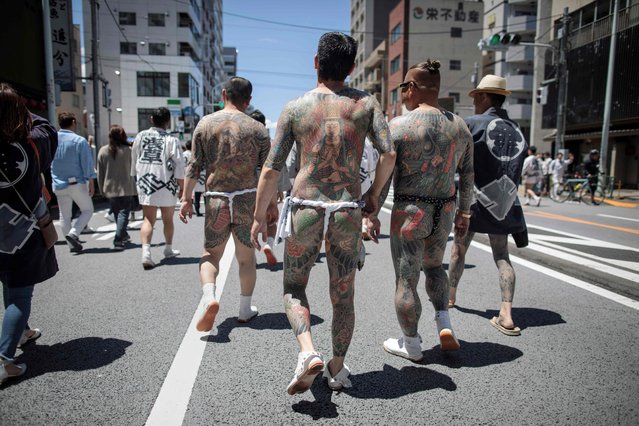
Participants with traditional Japanese tattoos (Irezumi), related to the Yakuza, walk through the Asakusa district during the annual Sanja Matsuri festival in Tokyo on May 20, 2018. Sanja Matsuri festival is a celebration for the three founders of Sensoji Temple in the Asakusa neighbourhood with nearly two million people visiting during the three-day event. (Photo by Behrouz Mehri/AFP Photo)

Participants with traditional Japanese tattoos (Irezumi), related to the Yakuza, walk through the Asakusa district during the annual Sanja Matsuri festival in Tokyo on May 20, 2018. Sanja Matsuri festival is a celebration for the three founders of Sensoji Temple in the Asakusa neighbourhood with nearly two million people visiting during the three-day event. (Photo by Behrouz Mehri/AFP Photo)
Details
17 Jul 2018 00:05:00
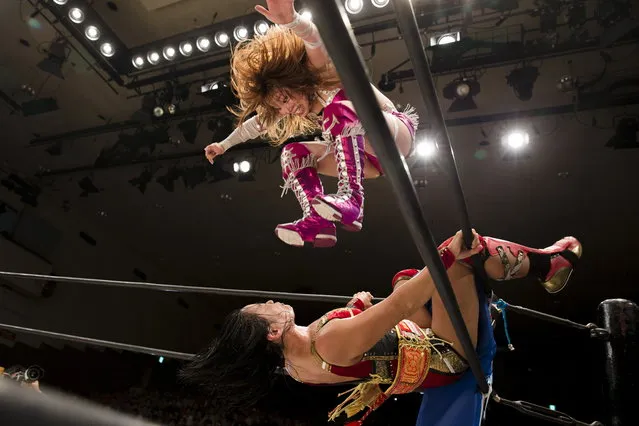
Wrestler Kairi Hojo jumps at her opponent Mieko satomura during their Stardom female professional wrestling show at Korakuen Hall in Tokyo, Japan, July 26, 2015. Professional women's wrestling in Japan means body slams, sweat, and garish costumes. But Japanese rules on hierarchy also come into play, with a culture of deference to veteran fighters. The brutal reality of the ring is masked by a strong fantasy element that feeds its popularity with fans, most of them men. (Photo by Thomas Peter/Reuters)

Wrestler Kairi Hojo jumps at her opponent Mieko satomura during their Stardom female professional wrestling show at Korakuen Hall in Tokyo, Japan, July 26, 2015. Professional women's wrestling in Japan means body slams, sweat, and garish costumes. But Japanese rules on hierarchy also come into play, with a culture of deference to veteran fighters. The brutal reality of the ring is masked by a strong fantasy element that feeds its popularity with fans, most of them men. (Photo by Thomas Peter/Reuters)
Details
14 Dec 2016 07:58:00
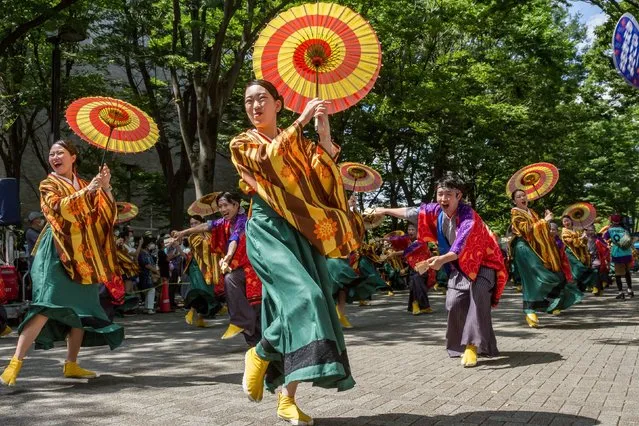
Dancers perform at the Harajuku Omotesando Super Yosakoi Dance festival in Shibuya, Tokyo on August 27, 2022. Super Yosakoi festival, is a two day festival that sees thousands of dancers, in hundreds of teams, energetically perform this unique Japanese dance style that combines traditional and more modern elements of movement and costume. (Photo by Damon Coulter/SOPA Images/Rex Features/Shutterstock)

Dancers perform at the Harajuku Omotesando Super Yosakoi Dance festival in Shibuya, Tokyo on August 27, 2022. Super Yosakoi festival, is a two day festival that sees thousands of dancers, in hundreds of teams, energetically perform this unique Japanese dance style that combines traditional and more modern elements of movement and costume. (Photo by Damon Coulter/SOPA Images/Rex Features/Shutterstock)
Details
07 Sep 2022 05:17:00
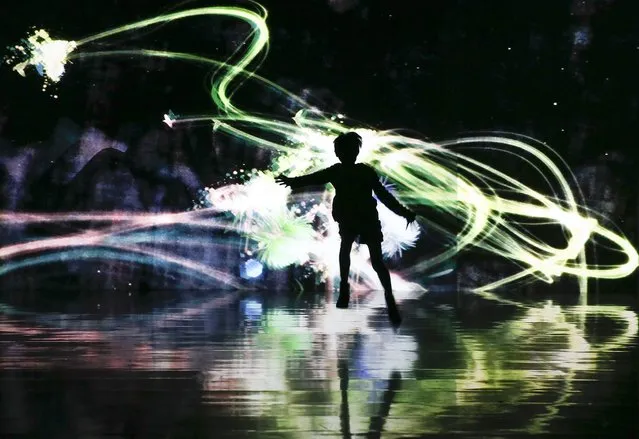
A girl dances in front of the digital art installation “Light in Dark” created by teamLab, a collaborative of Japanese digital artists, during a special exhibition of “Shake! Art Exhibition! and Learn and Play! teamLab Future Park” at National Museum of Emerging Science and Innovation (or Miraikan) in Tokyo, Japan, 19 January 2015. The exhibition is held through 01 March 2015. (Photo by Kimimasa Mayama/EPA)

A girl dances in front of the digital art installation “Light in Dark” created by teamLab, a collaborative of Japanese digital artists, during a special exhibition of “Shake! Art Exhibition! and Learn and Play! teamLab Future Park” at National Museum of Emerging Science and Innovation (or Miraikan) in Tokyo, Japan, 19 January 2015. The exhibition is held through 01 March 2015. (Photo by Kimimasa Mayama/EPA)
Details
06 Feb 2015 12:51:00
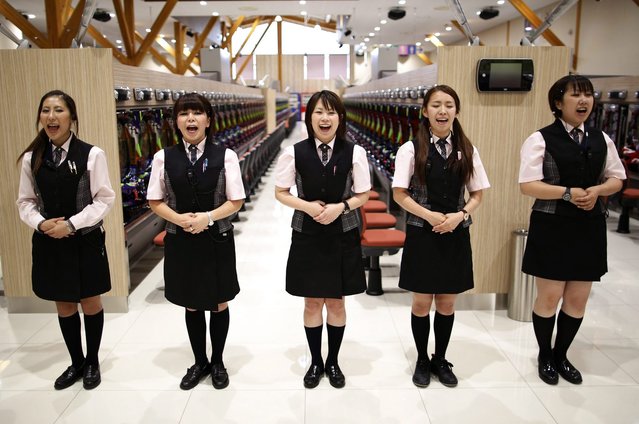
Dynam employees say a greeting message as they receive customer-care training ahead of the grand opening of the company's pachinko parlour in Fukaya, north of Tokyo July 29, 2014. (Photo by Issei Kato/Reuters)

Dynam employees say a greeting message as they receive customer-care training ahead of the grand opening of the company's pachinko parlour in Fukaya, north of Tokyo July 29, 2014. Japan's once-booming pachinko industry, grappling with a greying customer base and the threat of new competition from casinos, is adopting a softer touch and smoke-free zones to lure a new generation of players, particularly women. Pachinko, a modified version of pinball, is a fading national obsession, with about 12,000 parlours nation-wide and one in thirteen people playing the game. But that figure is declining as the population shrinks and younger people prefer games on their mobile phones. (Photo by Issei Kato/Reuters)
Details
25 Aug 2014 10:18:00