Loading...
Done
Moscow Metro

The is a rapid transit system serving Moscow and the neighbouring town of Krasnogorsk. Opened in 1935 with one 11-kilometre (6.8 mi) line and 13 stations, it was the first underground railway system in the Soviet Union. As of 2011, the Moscow Metro has 185 stations and its route length is 305.7 kilometres (190.0 mi). The system is mostly underground, with the deepest section 84 metres (276 ft) at the Park Pobedy station. The Moscow Metro is the world's second most heavily used rapid transit system after Tokyo's twin subway.
Details
13 Jun 2012 09:17:00
Snailpimp By Stefan Siverud

“Snailpimp” is a project by artist Stefan Siverud, who is having fun decorating living snails with the most varied designs, from the McDonald’s logo to the miniature lighthouse through Pac-Man, Ikea and Adidas. A funny and interesting project, achieved with non-toxic paints, which of course raises the question of the impact on these living animals. If some people ironize that these highly visible snails are less likely to be inadvertently stepped on by people, others point out that they are more easily spotted by predators… A project in line with the Inner City Snail artist Slinkachu.
Details
09 Jun 2015 12:18:00
A marine aims an RPG-7, a portable rocket- propelled grenade launcher, during military exercises conducted by the Russian Pacific Fleet' s naval infantry unit at the Bamburovo firing range on February 2, 2017. (Photo by Yuri Smityuk/TASS)

A marine aims an RPG-7, a portable rocket- propelled grenade launcher, during military exercises conducted by the Russian Pacific Fleet' s naval infantry unit at the Bamburovo firing range on February 2, 2017. The drills are a part of preparations for the Suvorov Attack and Sniper Line army competitions. (Photo by Yuri Smityuk/TASS)
Details
04 Feb 2017 01:00:00
Dorothy Bradley (left), photographed for LIFE magazine article on obesity, 1949. (Photo by Martha Holmes/Time & Life Pictures)

“The most serious health problem in the U.S. today is obesity.” Sounds familiar, doesn’t it? But that pronouncement about obesity’s primacy in the hierarchy of national health problems is not new. Rather, it’s the opening line to a remarkable article published 60 years ago in LIFE magazine. This photographs made by Martha Holmes to illustrate that March 1954 article, titled “The Plague of Overweight.” Photo: Dorothy Bradley (left), photographed for LIFE magazine article on obesity, 1949. (Photo by Martha Holmes/Time & Life Pictures)
Details
11 Apr 2013 11:42:00
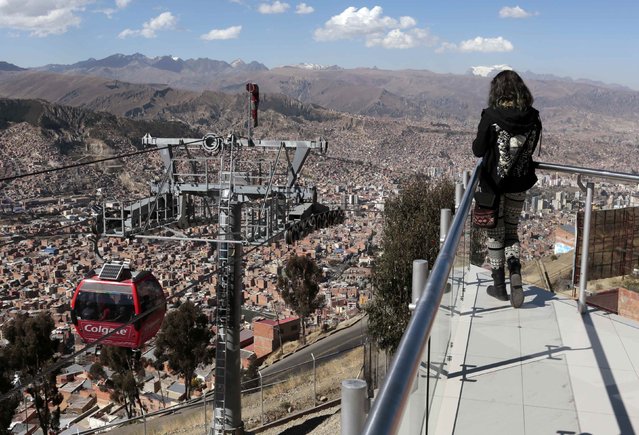
A woman looks at La Paz city from the Jacha Qhatu cable car station in El Alto, July 23, 2015. (Photo by David Mercado/Reuters)

A woman looks at La Paz city from the Jacha Qhatu cable car station in El Alto, July 23, 2015. Bolivia already has the largest urban cable car system in the world. Now the booming country is tripling the size of the network and will soon have nine lines whizzing above the administrative capital of La Paz. (Photo by David Mercado/Reuters)
Details
28 Jul 2015 12:50:00


“NASA's Pathfinder, Pathfinder Plus, Centurion and Helios Prototype were an evolutionary series of solar- and fuel-cell-system-powered unmanned aerial vehicles. AeroVironment, Inc. developed the vehicles under NASA's Environmental Research Aircraft and Sensor Technology (ERAST) program. They were built to develop the technologies that would allow long-term, high-altitude aircraft to serve as “atmospheric satellites”, to perform atmospheric research tasks as well as serve as communications platforms”. – Wikipedia

Photo: The solar-electric Helios Prototype flying wing is flies over the Hawaiian islands of Niihau and Lehua during the first solar-powered test flight July 14, 2001 from the U.S. Navy's Pacific Missile Range Facility on Kauai, HI. The 18-hour flight was a functional checkout of the aircraft's systems and performance in preparation for an attempt to reach sustained flight at 100,000 feet altitude later in the summer. (Photo Courtesy of NASA/Getty Images)
Details
14 Jul 2011 09:24:00


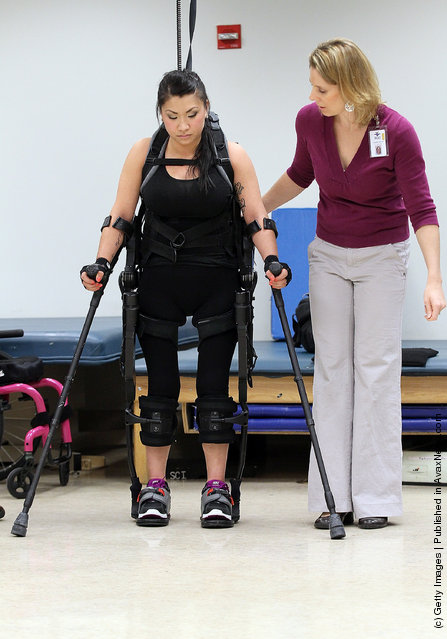
“eLEGS is a wearable, artificially intelligent, bionic device that enables people with paralysis to stand up and walk again. The exoskeleton is battery-powered and rechargeable, fitting comfortably and securely over clothing. Initially, eLEGS will be used under medical supervision for rehabilitation and training”. – BerkeleyBionics.com

Photo: Paralysis victim Stephanie Sablan (L) is helped by physical therapist Shonna Moran as she walks using eLEGS robotic legs at Santa Clara Valley Medical Center on May 25, 2011 in San Jose, California. Sablan, 24, was paralyzed from the waist down earlier this year when she was in a car accident and has begun using the newly developed eLEGS made by Berkeley Bionics. The robot-like battery powered eLEGS fit over clothing and enables people with paralysis to stand up and walk again. (Photo by Justin Sullivan/Getty Images)
Details
26 May 2011 09:56:00
A storm whips through a tented area occupied by Nepalese earthquake survivors as a mother grabs her infant child and runs to find shelter in Kathmandu, Nepal 23 May 2015. Nepalese, who lost their homes in earthquake and fear aftershocks, have been living in temporary shelter in open ground which they had to flee because of the heavy rain and powerful wind. (Photo by Narendra Shrestha/EPA)

A storm whips through a tented area occupied by Nepalese earthquake survivors as a mother grabs her infant child and runs to find shelter in Kathmandu, Nepal 23 May 2015. Nepalese, who lost their homes in earthquake and fear aftershocks, have been living in temporary shelter in open ground which they had to flee because of the heavy rain and powerful wind. (Photo by Narendra Shrestha/EPA)
Details
25 May 2015 10:00:00