Loading...
Done
A Polisario fighter sits on a rock at a forward base on the outskirts of Tifariti, Western Sahara, September 9, 2016. At a rocky outpost in Western Sahara, a new generation of soldiers who have never known war are mobilising as tensions resurface in one of Africa's oldest disputes after a quarter century of uneasy peace. Young Sahrawi troops man new desert posts for the Polisario Front, which for more than 40 years has sought independence for the vast desert region - first in a guerrilla war against Morocco and then politically since a ceasefire deal in 1991. Now a standoff with Morocco, which controls the majority of Western Sahara, is renewing pressure for a diplomatic solution to ensure foot soldiers don't return to fighting as the last generation of commanders once did. The standoff since August has brought Moroccan and Polisario forces within 200 metres of each other in a narrow strip of land near the Mauritanian border. Rich in phosphate, Western Sahara has been contested since 1975 when Spanish colonial powers left. Morocco claimed the territory and fought the 16-year war with Polisario. (Photo by Zohra Bensemra/Reuters)

A Polisario fighter sits on a rock at a forward base on the outskirts of Tifariti, Western Sahara, September 9, 2016. At a rocky outpost in Western Sahara, a new generation of soldiers who have never known war are mobilising as tensions resurface in one of Africa's oldest disputes after a quarter century of uneasy peace. (Photo by Zohra Bensemra/Reuters)
Details
04 Nov 2016 12:09:00
An Economic Freedom Fighters supporter shows a mock weapons during a demonstration in Pretoria on April 12, 2017 calling for South African President Jacob Zuma to resign. Tens of thousand demonstrators took part in the march to Union Buildings, the official seat of government, which was organised on Zuma's 75th birthday and came after nationwide rallies against the president last week. Zuma's recent sacking of respected finance minister Pravin Gordhan has fanned years of public anger over government corruption scandals, record unemployment and slowing economic growth. (Photo by Marco Longari/AFP Photo)

An Economic Freedom Fighters supporter shows a mock weapons during a demonstration in Pretoria on April 12, 2017 calling for South African President Jacob Zuma to resign. Tens of thousand demonstrators took part in the march to Union Buildings, the official seat of government, which was organised on Zuma's 75th birthday and came after nationwide rallies against the president last week. Zuma's recent sacking of respected finance minister Pravin Gordhan has fanned years of public anger over government corruption scandals, record unemployment and slowing economic growth. (Photo by Marco Longari/AFP Photo)
Details
13 Apr 2017 09:53:00
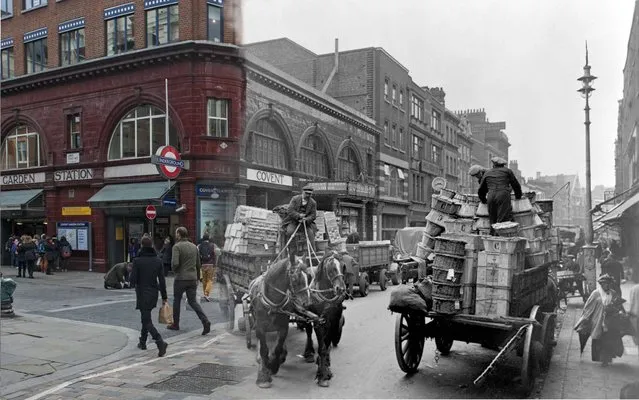
A street scene in London’s Covent Garden with the underground station and a horse and cart in the background in c.1930 and the same street in 2014. (Photo by Museum of London/Streetmuseum app)

“For most Londoners, the most common view they enjoy as they trudge to work is the back of another commuter's head. But now, thanks to the Streetmuseum app, anyone traipsing through the capital's streets can step back in time to see what London looked like in the 19th and 20th century compared with today – all in the same image”. – Joe Krishnan via The Independent. Photo: A street scene in London’s Covent Garden with the underground station and a horse and cart in the background in c.1930 and the same street in 2014. (Photo by Museum of London/Streetmuseum app)
Details
27 Feb 2014 06:48:00
Yoshkar-Ola, Matrosova Street (1995). He turned his lens upon Russians – particularly young people – in the newly liberated state. (Photo by Sergey Chilikov)

Russian pop art photographer Sergey Chilikov captures a nation liberated from the social oppression of late-era Soviet rule – at parties, in the streets, and bouncing high. His exhibition, Photoprovocations, will be at Photo London, 19-22 May. Here: Yoshkar-Ola, Matrosova Street (1995). (Photo by Sergey Chilikov)
Details
20 May 2016 13:10:00
Revelers look at a cellphone during the annual street block party know as “Explode Coracao” on the third day of Carnival on February 19, 2023 in Sao Paulo, Brazil. According to the São Paulo City Council, during Carnival week more than 500 street blocks (blocos de rua) are held and more than 15 million people are expected to participate in them. Created in 2017, Explode Coracao is one of the most popular street blocks and attracted 150,000 revelers in its last edition, before the pandemic, in 2020. (Photo by Alexandre Schneider/Getty Images)

Revelers look at a cellphone during the annual street block party know as “Explode Coracao” on the third day of Carnival on February 19, 2023 in Sao Paulo, Brazil. According to the São Paulo City Council, during Carnival week more than 500 street blocks (blocos de rua) are held and more than 15 million people are expected to participate in them. Created in 2017, Explode Coracao is one of the most popular street blocks and attracted 150,000 revelers in its last edition, before the pandemic, in 2020. (Photo by Alexandre Schneider/Getty Images)
Details
22 Feb 2023 04:58:00
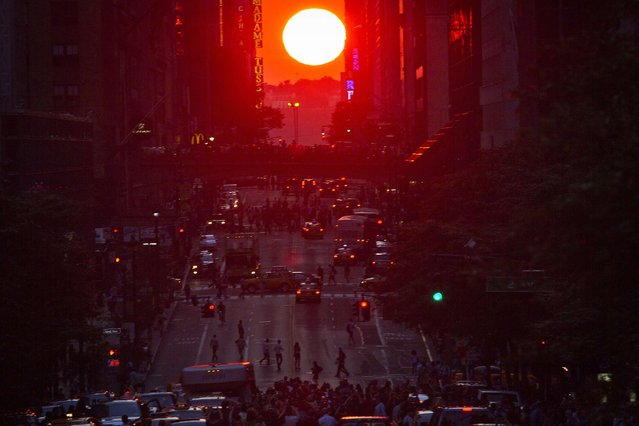
People crowd onto 42nd Street as they take photos of the “Manhattanhenge” phenomenon in the Manhattan borough of New York July 11, 2014. Manhattanhenge, coined by astrophysicist Neil deGrasse Tyson, occurs twice a year, when the setting sun aligns itself with the east-west grid of streets in Manhattan. (Photo by Carlo Allegri/Reuters)

People crowd onto 42nd Street as they take photos of the “Manhattanhenge” phenomenon in the Manhattan borough of New York July 11, 2014. Manhattanhenge, coined by astrophysicist Neil deGrasse Tyson, occurs twice a year, when the setting sun aligns itself with the east-west grid of streets in Manhattan. (Photo by Carlo Allegri/Reuters)
Details
15 Jul 2014 10:55:00
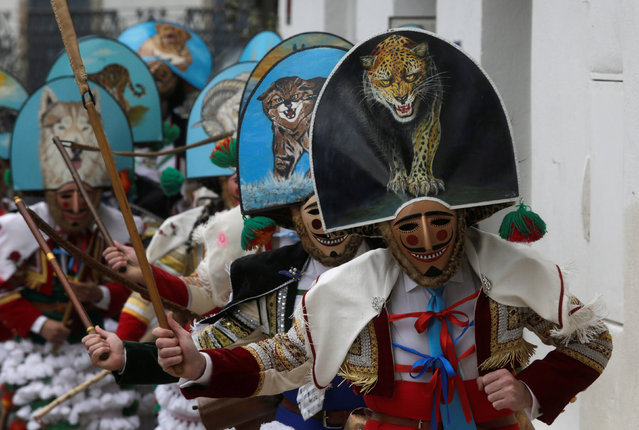
Carnival revellers dressed as “Peliqueiros” run along a street in the village of Laza, Spain February 26, 2017. “Peliqueiros”, or ancient tax collectors, pursued villagers through the streets ringing their cowbells and hitting villagers with their sticks. (Photo by Miguel Vidal/Reuters)

Carnival revellers dressed as “Peliqueiros” run along a street in the village of Laza, Spain February 26, 2017. “Peliqueiros”, or ancient tax collectors, pursued villagers through the streets ringing their cowbells and hitting villagers with their sticks. (Photo by Miguel Vidal/Reuters)
Details
28 Feb 2017 00:02:00
Costumed participants are reflected in a woman's sunglasses during the Summer Carnival Street Parade, which travels through the streets of the center of Rotterdam, the Netherlands, 27 July 2019. Twenty floats participated in the parade with dance acts and lots of music. (Photo by Marco De Swart/EPA/EFE/Rex Features/Shutterstock)

Costumed participants are reflected in a woman's sunglasses during the Summer Carnival Street Parade, which travels through the streets of the center of Rotterdam, the Netherlands, 27 July 2019. Twenty floats participated in the parade with dance acts and lots of music. (Photo by Marco De Swart/EPA/EFE/Rex Features/Shutterstock)
Details
29 Jul 2019 00:05:00