Loading...
Done
A man wearing a hazmat suit and a mask holds a sign reading “The end is near – call grandma” at Times Square on March 14, 2020 in New York City. The World Health Organization said March 13, 2020 it was not yet possible to say when the COVID-19 pandemic, which has killed more than 5,000 people worldwide, will peak. “It's impossible for us to say when this will peak globally”, Maria Van Kerkhove, who heads the WHO's emerging diseases unit, told a virtual press conference, adding that “we hope that it is sooner rather than later”. (Photo by Johannes Eisele/AFP Photo)

A man wearing a hazmat suit and a mask holds a sign reading “The end is near – call grandma” at Times Square on March 14, 2020 in New York City. The World Health Organization said March 13, 2020 it was not yet possible to say when the COVID-19 pandemic, which has killed more than 5,000 people worldwide, will peak. “It's impossible for us to say when this will peak globally”, Maria Van Kerkhove, who heads the WHO's emerging diseases unit, told a virtual press conference, adding that “we hope that it is sooner rather than later”. (Photo by Johannes Eisele/AFP Photo)
Details
16 Mar 2020 00:07:00
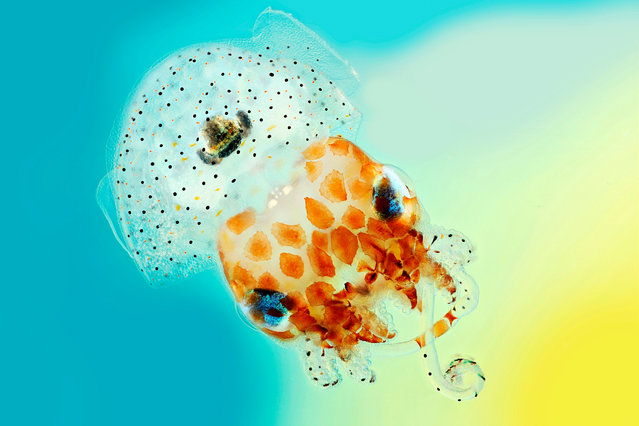
With its huge eyes, comical name and diminutive size, Mark R. Smith’s image of a baby Hawaiian bobtail squid can’t help but raise a smile. A curiously endearing creature, the cephalopod is just 1.5cm across, its mantle cavity bearing more than a passing resemblance to a rather natty shower cap. But it is also a beautiful example of symbiosis – nature’s version of “I’ll scratch your back if you scratch mine” – for on the underside of the squid is a light organ which houses bioluminescent bacteria. The squid offers the bacteria protection and food, while the bacteria emit a glow – a handy trait that the squid uses to offset its silhouette, helping it to evade predators in the depths below. Mark R. Smith’s entry combines several images of a Hawaiian bobtail squid with different focus lengths to create a final picture with greater depth of field than normal. (Photo by Mark R. Smith/Wellcome Images/Macroscopic Solutions)

With its huge eyes, comical name and diminutive size, Mark R. Smith’s image of a baby Hawaiian bobtail squid can’t help but raise a smile. A curiously endearing creature, the cephalopod is just 1.5cm across, its mantle cavity bearing more than a passing resemblance to a rather natty shower cap. But it is also a beautiful example of symbiosis – nature’s version of “I’ll scratch your back if you scratch mine” – for on the underside of the squid is a light organ which houses bioluminescent bacteria. The squid offers the bacteria protection and food, while the bacteria emit a glow – a handy trait that the squid uses to offset its silhouette, helping it to evade predators in the depths below. Mark R. Smith’s entry combines several images of a Hawaiian bobtail squid with different focus lengths to create a final picture with greater depth of field than normal. (Photo by Mark R. Smith/Wellcome Images/Macroscopic Solutions)
Details
08 Mar 2017 00:05:00
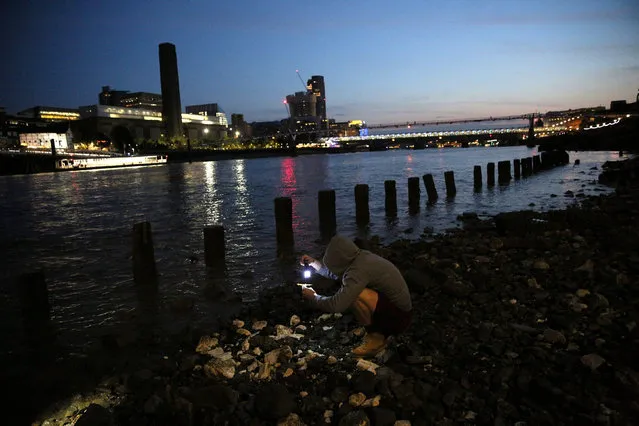
A mudlark uses a torch to look for items on the bank of the River Thames in London, Britain June 06, 2016. Mudlarking is believed to trace its origins to the 18th and 19th century, when scavengers searched the Thames' shores for items to sell. These days, history and archaeology fans are the ones hoping to find old relics such as coins, ceramics, artifacts or everyday items from across centuries. They wait for the low tide and then scour specific areas of exposed shores. "If you're in a field you could be out all day long, with the river you're restricted to about two or three hours," mudlark Nick Stevens said. While many just use the naked eye for their searches, others rely on metal detectors for which a permit from the Port of London Authority is needed. Digging also requires consent. (Photo by Neil Hall/Reuters)

A mudlark uses a torch to look for items on the bank of the River Thames in London, Britain June 06, 2016. Mudlarking is believed to trace its origins to the 18th and 19th century, when scavengers searched the Thames' shores for items to sell. These days, history and archaeology fans are the ones hoping to find old relics such as coins, ceramics, artifacts or everyday items from across centuries. their finds with the Portable Antiquities Scheme. Any item over 300 years old must be recorded. (Photo by Neil Hall/Reuters)
Details
27 Aug 2016 10:43:00
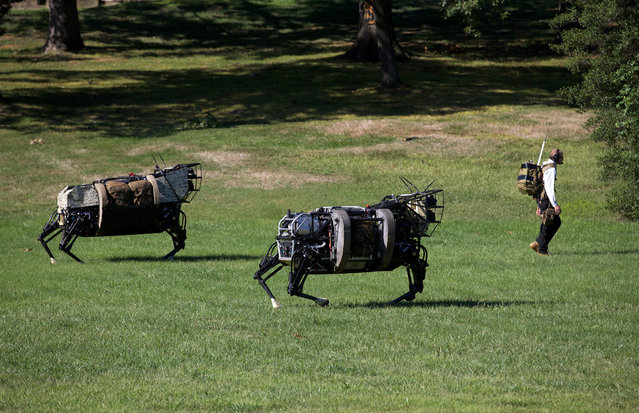
Two robotic legged squad support system (LS3) machines by the Defense Advanced Research Project Agency follow a technician during a demonstration at Joint Base Myer-Henderson Hall, Virginia, on September 10, 2012. (U.S. Marine Corps photo by Sgt. Mallory S. VanderSchans)

Two robotic legged squad support system (LS3) machines by the Defense Advanced Research Project Agency follow a technician during a demonstration at Joint Base Myer-Henderson Hall, Virginia, on September 10, 2012. (U.S. Marine Corps photo by Sgt. Mallory S. VanderSchans via The Atlantic)
Details
20 Oct 2012 10:30:00
Nicaraguan army members carry a participant playing the role of a victim during a national multi-hazard drill organized by the National System for Prevention, Mitigation and Attention to Disasters (SINAPRED), in the 30 de Mayo neighborhood in Managua, Nicaragua, September 26, 2016. (Photo by Oswaldo Rivas/Reuters)

Nicaraguan army members carry a participant playing the role of a victim during a national multi-hazard drill organized by the National System for Prevention, Mitigation and Attention to Disasters (SINAPRED), in the 30 de Mayo neighborhood in Managua, Nicaragua, September 26, 2016. (Photo by Oswaldo Rivas/Reuters)
Details
27 Sep 2016 09:20:00
Masked up revellers hit the town in Sheffield, United Kingdom on October 10, 2020 before the Prime Minister introduces a three-tier lockdown system that will see hospitality venues shut in virus hotspots. (Photo by London News Pictures/The Sun)

Masked up revellers hit the town in Sheffield, United Kingdom on October 10, 2020 before the Prime Minister introduces a three-tier lockdown system that will see hospitality venues shut in virus hotspots. (Photo by London News Pictures/The Sun)
Details
12 Oct 2020 00:07:00
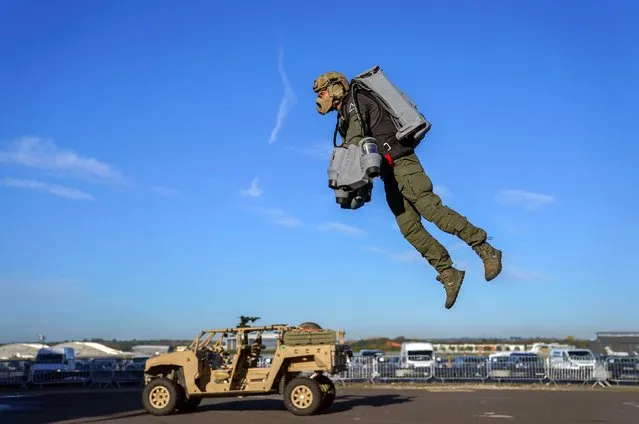
“Jet Man” Richard Browning demonstrating Gravity, a human jet suit system, at the opening of the Army's Personnel Conference held at Farnborough International Conference Centre, Farnborough, Hampshire on Tuesday, November 2, 2021. (Photo by Steve Parsons/PA Images via Getty Images)

“Jet Man” Richard Browning demonstrating Gravity, a human jet suit system, at the opening of the Army's Personnel Conference held at Farnborough International Conference Centre, Farnborough, Hampshire on Tuesday, November 2, 2021. (Photo by Steve Parsons/PA Images via Getty Images)
Details
04 Nov 2021 08:42:00
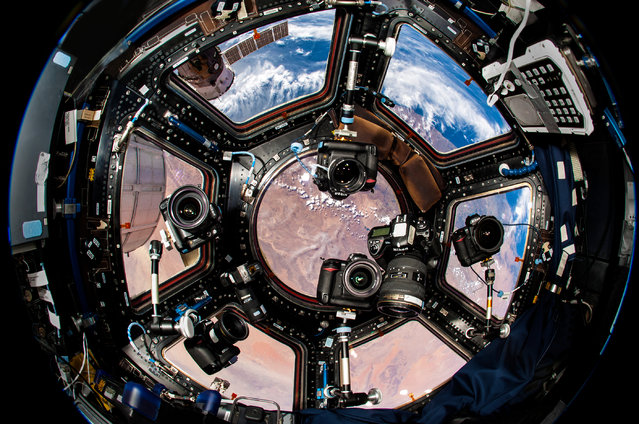
Astronaut Donald R. Pettit would often rig an array of as many as six cameras in the cupola windows and set them all to fire continuously for events such as sunsets, which only last around seven seconds on the ISS. (Photo by Donald R. Pettit)

Astronaut Donald R. Pettit would often rig an array of as many as six cameras in the cupola windows and set them all to fire continuously for events such as sunsets, which only last around seven seconds on the ISS. (Photo by Donald R. Pettit)
Details
05 Sep 2016 11:34:00