Loading...
Done
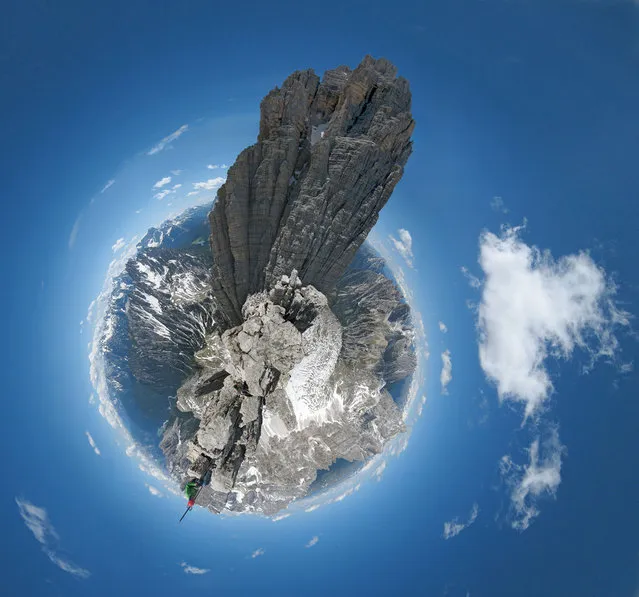
“Taken at the tiny summit of Cima Piccola in the the Tre Cima group in the Dolomites, Italy. The large peak is Cima Grande Some remote peaks have a summit register, and my climbing partner Steve can be seen signing this in the bottom of the picture”. (“Little Planets” Project. Photo and comment by Dan Arkle)

These are the amazing panoramic photographs that look like little planets. They were taken by photographer Dan Arkle, 34, from Sheffield, UK. He said: “On a sharp summit, you feel literally on top of the world, with dramatic views in all directions, including straight down. I tried using conventional photography to capture this feeling, but even with a wide angle lens I couldnt get all the view in the image”. Here: “Taken at the tiny summit of Cima Piccola in the the Tre Cima group in the Dolomites, Italy. The large peak is Cima Grande Some remote peaks have a summit register, and my climbing partner Steve can be seen signing this in the bottom of the picture”. (“Little Planets” Project. Photo and comment by Dan Arkle)
Details
06 Jun 2015 09:52:00
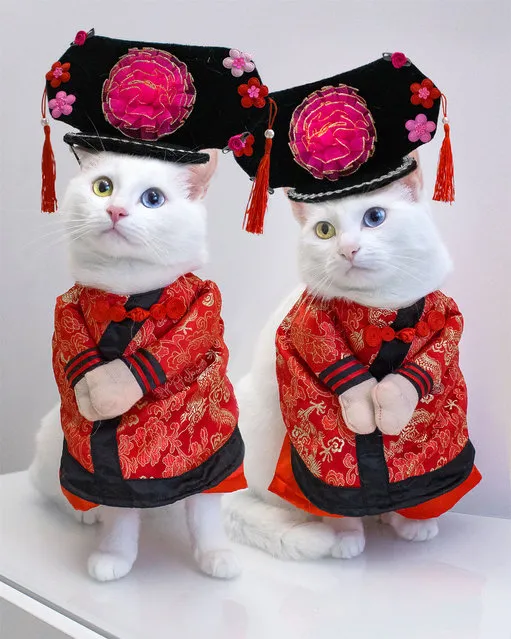
These adorable cats – which are twins – showcase their contrasting blue and green eyes. The fascinating pair, Iriss and Abyss, live with their owner Pavel Dyagilev, 34, in St. Petersburg, Russia. The cats have a condition called heterochromia iridis, which causes each eye to vary in color. Dyagilev said: “When I found an ad on social media that two kittens were seeking a new home, I never imagined that I'd end up with two. But I looked through the pictures of kittens and saw two twins always together on the photos. And my heart melted”. (Photo by @sis.twins/Caters News Agency)

These adorable cats – which are twins – showcase their contrasting blue and green eyes. The cats have a condition called heterochromia iridis, which causes each eye to vary in color. (Photo by @sis.twins/Caters News Agency)
Details
14 Aug 2019 00:03:00
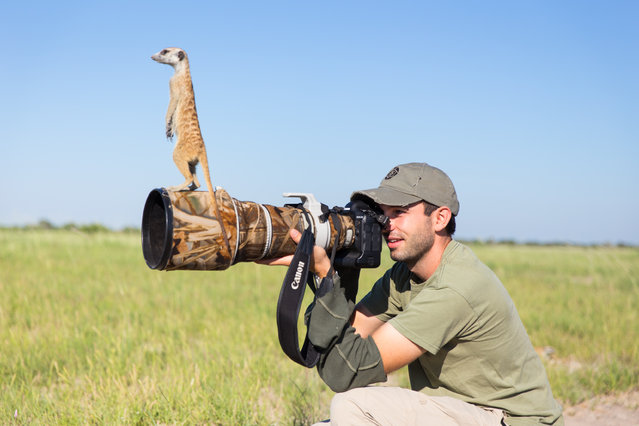
Will Burrard-Lucas takes a photo while a Meerkat perches on his lens on January 2014 in Makgadikgadi, Botswana. These adorable Meerkats used a photographer as a look out post before trying their hand at taking pictures. The beautiful images were caught by wildlife photographer Will Burrard-Lucas after he spent six days with the quirky new families in the Makgadikgadi region of Botswana. Will has photographed Meerkats in the past and was delighted when he realised he would be shooting new arrivals. (Photo by Will Burrard-Lucas/Barcroft Media)

Will Burrard-Lucas takes a photo while a Meerkat perches on his lens on January 2014 in Makgadikgadi, Botswana. These adorable Meerkats used a photographer as a look out post before trying their hand at taking pictures. The beautiful images were caught by wildlife photographer Will Burrard-Lucas after he spent six days with the quirky new families in the Makgadikgadi region of Botswana. Will has photographed Meerkats in the past and was delighted when he realised he would be shooting new arrivals. (Photo by Will Burrard-Lucas/Barcroft Media)

P.S. All pictures are presented in high resolution. To see Hi-Res images – just TWICE click on any picture. In other words, click small picture – opens the BIG picture. Click BIG picture – opens VERY BIG picture (if available; this principle works anywhere on the site AvaxNews)
Details
13 Apr 2014 08:42:00
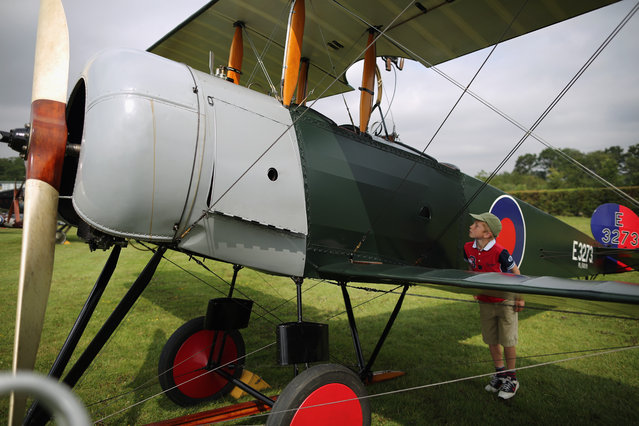
Aviation enthusiast Patrick Wilson 8, from Wetherby looks at  an Avro 504 k at “The Shuttlesworth Collection” at Old Warden on July 21, 2014 in Biggleswade, England. Of the 55,000 planes that were manufactured by the Royal Army Corps (RAC) during WWI, only around 20 remain in airworthy condition. (Photo by Dan Kitwood/Getty Images)

Aviation enthusiast Patrick Wilson 8, from Wetherby looks at an Avro 504 k at “The Shuttlesworth Collection” at Old Warden on July 21, 2014 in Biggleswade, England. Of the 55,000 planes that were manufactured by the Royal Army Corps (RAC) during WWI, only around 20 remain in airworthy condition. Six of these belong to The Shuttleworth Collection at Old Warden, Bedfordshire, making it the most complete collection of original airworthy WWI aircraft in the world. Amongst the collection is the SE5a. The SE5a is a single seater fighter aircraft. It is an original biplane designed by the Royal Aircraft Factory, with its engine built by Wolseley Motors Ltd, and it was issued to 84 Squadron in November 1918. The National Archive in Kew has recently verified that the plane saw action in France with 84 Squadron the day before Armistice, November 10, 1918. (Photo by Dan Kitwood/Getty Images)
Details
23 Jul 2014 10:00:00
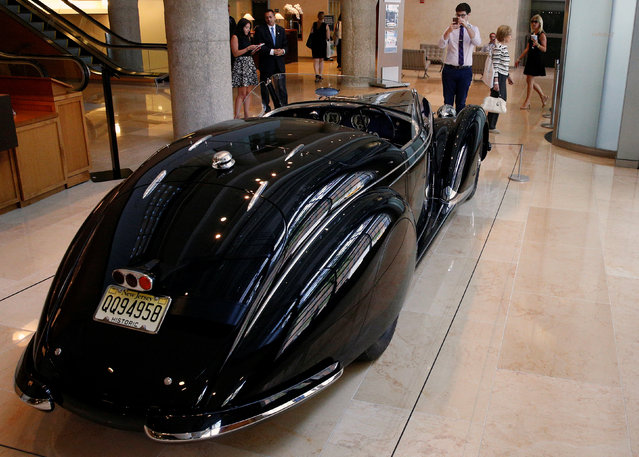
People look at a 1939 Alfa Romeo 8C 2900B Lungo Touring Spider displayed at Sotheby's in New York City, New York, U.S. July 21, 2016. The car, unveiled in a pre-publicity showing in New York on Thursday, is expected to sell for more than US$15 million – and could set a record for the most money ever paid for a pre-war auto at auction. “This is a personal favourite of mine, the 1939 Alfa Romeo is one of the grandest pre-war cars ever built”, said Ian Kelleher, managing director, RM Sotheby's US West Coast division. “You can achieve speeds in excess of 100 miles an hour in this car. (Photo by Brendan McDermid/Reuters)

People look at a 1939 Alfa Romeo 8C 2900B Lungo Touring Spider displayed at Sotheby's in New York City, New York, U.S. July 21, 2016. The car, unveiled in a pre-publicity showing in New York on Thursday, is expected to sell for more than US$15 million – and could set a record for the most money ever paid for a pre-war auto at auction. (Photo by Brendan McDermid/Reuters)
Details
22 Jul 2016 12:22:00
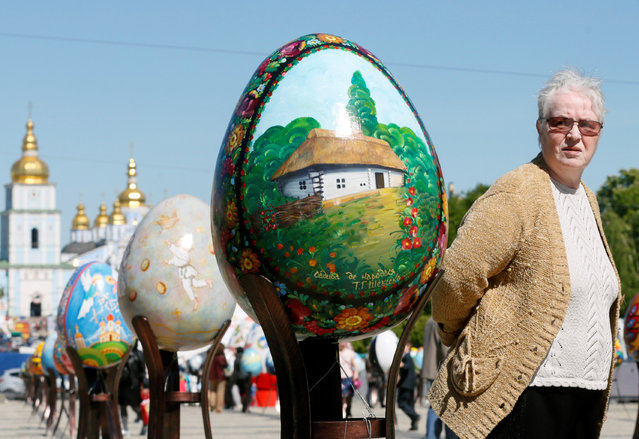
A woman looks at traditional Ukrainian Easter eggs “Pysanka”, installed as part of the upcoming celebrations of Easter, in central Kiev, Ukraine, April 29, 2016. A pysanka is a Ukrainian Easter egg, decorated with traditional Ukrainian folk designs using a wax-resist (batik) method. The word pysanka comes from the verb pysaty, “to write”, as the designs are not painted on, but written with beeswax. Many other eastern European ethnic groups decorate eggs using wax resist for Easter. These include the Belarusians, Bulgarians, Croats, Czechs, Hungarians, Lithuanians, Poles, Romanians, Serbs, Slovaks, Slovenes and Sorbs. (Photo by Valentyn Ogirenko/Reuters)

A woman looks at traditional Ukrainian Easter eggs “Pysanka”, installed as part of the upcoming celebrations of Easter, in central Kiev, Ukraine, April 29, 2016. A pysanka is a Ukrainian Easter egg, decorated with traditional Ukrainian folk designs using a wax-resist (batik) method. The word pysanka comes from the verb pysaty, “to write”, as the designs are not painted on, but written with beeswax. Many other eastern European ethnic groups decorate eggs using wax resist for Easter. These include the Belarusians, Bulgarians, Croats, Czechs, Hungarians, Lithuanians, Poles, Romanians, Serbs, Slovaks, Slovenes and Sorbs. (Photo by Valentyn Ogirenko/Reuters)
Details
30 Apr 2016 09:00:00
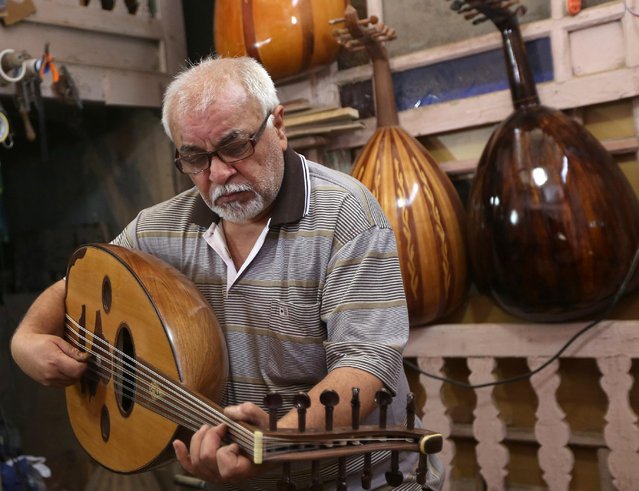
In this photo taken Saturday, June 20, 2015, Mahmoud Abdulnabi tries out an oud, an Arabic instrument related to the lute, at his workshop in Baghdad, Iraq. “The oud is different than other musical instruments”, said Abdulnabi, who has crafted ouds played by some of Iraq's best known musicians, many of whom look down from headshots on the walls. “If you feel joyful, it can play your joy. If the circumstances are sad it can play your sorrow and... help to empty whatever is in your chest”. (Photo by Hadi Mizban/AP Photo)

In this photo taken Saturday, June 20, 2015, Mahmoud Abdulnabi tries out an oud, an Arabic instrument related to the lute, at his workshop in Baghdad, Iraq. “The oud is different than other musical instruments”, said Abdulnabi, who has crafted ouds played by some of Iraq's best known musicians, many of whom look down from headshots on the walls. “If you feel joyful, it can play your joy. If the circumstances are sad it can play your sorrow and... help to empty whatever is in your chest”. (Photo by Hadi Mizban/AP Photo)
Details
05 Jul 2015 10:32:00
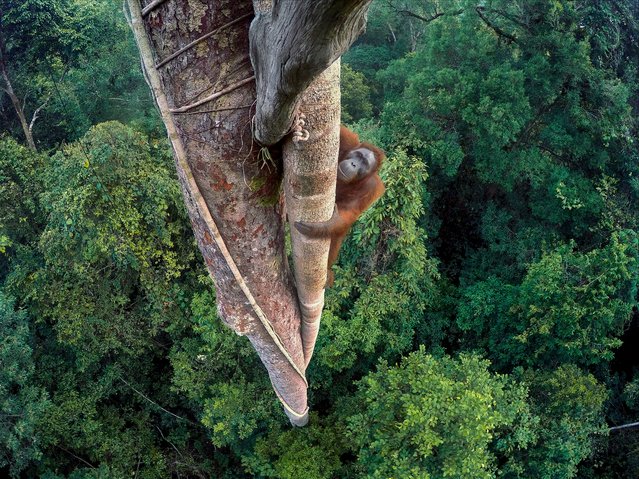
“Entwined Lives”. Tim Laman, US Winner, Wildlife photographer of the year. A young male orangutan makes the 30-metre climb up the thickest root of the strangler fig high above the canopy in Gunung Palung national park, one of the few protected orangutan strongholds in Indonesian Borneo. Laman had to do three days of climbing to position several GoPro cameras that he could trigger remotely. This shot was the one he had long visualised, looking down on the orangutan within its forest home. (Photo by Tim Laman/2016 Wildlife Photographer of the Year)

“Entwined Lives”. Tim Laman, US Winner, Wildlife photographer of the year. A young male orangutan makes the 30-metre climb up the thickest root of the strangler fig high above the canopy in Gunung Palung national park, one of the few protected orangutan strongholds in Indonesian Borneo. Laman had to do three days of climbing to position several GoPro cameras that he could trigger remotely. This shot was the one he had long visualised, looking down on the orangutan within its forest home. (Photo by Tim Laman/2016 Wildlife Photographer of the Year)
Details
19 Oct 2016 12:08:00