Loading...
Done
“Cub”. In the colony of penguins in South Georgia. (Photo and caption by Ondrej Zaruba/National Geographic Traveler Photo Contest)

“Cub”. In the colony of penguins in South Georgia. (Photo and caption by Ondrej Zaruba/National Geographic Traveler Photo Contest)

ATTENTION! All pictures are presented in high resolution. To see Hi-Res images – just TWICE click on any picture. In other words, click small picture – opens the BIG picture. Click BIG picture – opens VERY BIG picture.
Details
28 Jun 2013 12:32:00
Gers, traditional Mongolian tents, are seen on a hill in an area known as a ger district in Ulan Bator June 26, 2013. (Photo by Carlos Barria/Reuters)

Gers, traditional Mongolian tents, are seen on a hill in an area known as a ger district in Ulan Bator June 26, 2013. Approximately 60 percent of the population of Ulan Bator live in settlements known as ger districts and in many cases residents have limited access to basic services such as water and sanitation. According to a 2010 National Population Center census, every year between thirty and forty thousand people migrate from the countryside to the capital Ulan Bator. Ger districts in the city have been expanding rapidly in recent years. Mongolia is the world's least densely populated country, with 2.8 million people spread across an area around three times the size of France. (Photo by Carlos Barria/Reuters)
Details
11 Aug 2013 11:45:00
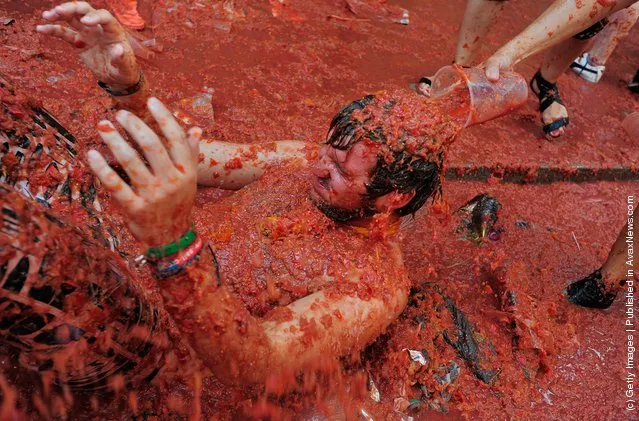
The World's Biggest Tomato Fight At Tomatina Festival 2011

A reveller is covered in tomato pulp and juice while participating in the annual Tomatina festival on August 31, 2011 in Bunol, Spain. An estimated 35,000 people threw 120 tons of ripe tomatoes in the world's biggest tomato fight held annually in this Spanish Mediterranean town. (Photo by Denis Doyle/Getty Images)
Details
01 Sep 2011 11:38:00
A man rides a bike on a submerged road alongside a boat at Demra area in Dhaka on July 24, 2020. As many as 20 districts including the latest additions Chandpur, Brahmanbaria, and Naogaon have so far been hit with the worsening flood situation across Bangladesh and many more areas might be inundated if the situation does not improve soon, said Flood Forecasting and Warning Centre (FFWC). (Photo by Sultan Mahmud Mukut/SOPA Images/LightRocket via Getty Images)

A man rides a bike on a submerged road alongside a boat at Demra area in Dhaka on July 24, 2020. As many as 20 districts including the latest additions Chandpur, Brahmanbaria, and Naogaon have so far been hit with the worsening flood situation across Bangladesh and many more areas might be inundated if the situation does not improve soon, said Flood Forecasting and Warning Centre (FFWC). (Photo by Sultan Mahmud Mukut/SOPA Images/LightRocket via Getty Images)
Details
20 Aug 2020 00:01:00
Masai women dressed in traditional clothes wear surgical masks as they wait for a ceremony marking World Elephant Day in the Amboseli National Park, Kenya, August 12, 2020. (Photo by Baz Ratner/Reuters)

Masai women dressed in traditional clothes wear surgical masks as they wait for a ceremony marking World Elephant Day in the Amboseli National Park, Kenya, August 12, 2020. (Photo by Baz Ratner/Reuters)
Details
23 Aug 2020 00:01:00
Galveston resident Charlotte, 12, photographs her two-year-old beagle Sunny who reacts to high wind ahead of Hurricane Laura in Galveston, Texas, U.S., August 26, 2020. (Photo by Adrees Latif/Reuters)

Galveston resident Charlotte, 12, photographs her two-year-old beagle Sunny who reacts to high wind ahead of Hurricane Laura in Galveston, Texas, U.S., August 26, 2020. (Photo by Adrees Latif/Reuters)
Details
31 Aug 2020 00:01:00
A dhobi, or a washerman washes cloths on the banks of the River Gomti in Lucknow, India, Saturday, September 12, 2020. Dhobis are traditional laundry workers who wash clothes by hand and dry them in the sun, an occupation which has been in existence for generations. Most cities in India have a Dhobi Ghat, or washermen's area, where the city's pile of clothes is laundered. This practice is still popular in India, despite of modern technology. Around 1,000 families work in Lucknow's Dhobi Ghat. However, in light of the novel coronavirus, their wages have decreased drastically. With each family earning around US$100-200 per month. (Photo by Rajesh Kumar Singh/AP Photo)

A dhobi, or a washerman washes cloths on the banks of the River Gomti in Lucknow, India, Saturday, September 12, 2020. Dhobis are traditional laundry workers who wash clothes by hand and dry them in the sun, an occupation which has been in existence for generations. Most cities in India have a Dhobi Ghat, or washermen's area, where the city's pile of clothes is laundered. This practice is still popular in India, despite of modern technology. Around 1,000 families work in Lucknow's Dhobi Ghat. However, in light of the novel coronavirus, their wages have decreased drastically. With each family earning around US$100-200 per month. (Photo by Rajesh Kumar Singh/AP Photo)
Details
25 Sep 2020 00:03:00
An Indian villager wearing a face mask as a precaution against the coronavirus sells his ware at market in Jammu, India, Friday, October 9, 2020. (Photo by Channi Anand/AP Photo)

An Indian villager wearing a face mask as a precaution against the coronavirus sells his ware at market in Jammu, India, Friday, October 9, 2020. (Photo by Channi Anand/AP Photo)
Details
14 Oct 2020 00:05:00