Loading...
Done
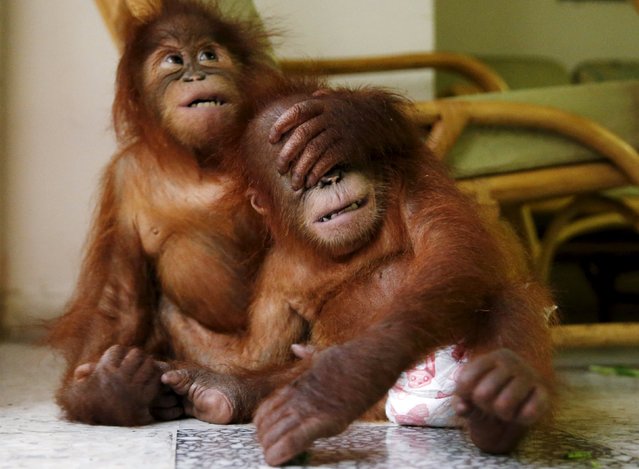
Two baby orangutans play with each other at the wildlife department in Kuala Lumpur, Malayasia, October 19, 2015. The Malaysian wildlife department in July seized two baby Sumatran orangutans, found in duffel bags, from traffickers who were attempting to sell them to buyers in Malaysia. According to local media, the orangutans will be returned to Medan, Indonesia on Tuesday. The illegal wildlife trade is estimated to be $8 billion a year worldwide, according to TRAFFIC, a wildlife trade monitoring network. (Photo by Olivia Harris/Reuters)

Two baby orangutans play with each other at the wildlife department in Kuala Lumpur, Malayasia, October 19, 2015. The Malaysian wildlife department in July seized two baby Sumatran orangutans, found in duffel bags, from traffickers who were attempting to sell them to buyers in Malaysia. According to local media, the orangutans will be returned to Medan, Indonesia on Tuesday. The illegal wildlife trade is estimated to be $8 billion a year worldwide, according to TRAFFIC, a wildlife trade monitoring network. (Photo by Olivia Harris/Reuters)
Details
24 Dec 2015 08:06:00
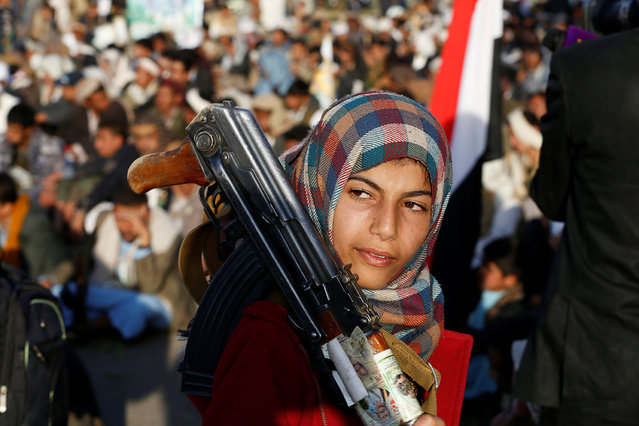
A girl carries a rifle as she attends a rally by followers of the Shi'ite Houthi movement commemorating the death of Imam Zaid bin Ali in Sanaa, Yemen October 26, 2016. (Photo by Khaled Abdullah/Reuters)

A girl carries a rifle as she attends a rally by followers of the Shi'ite Houthi movement commemorating the death of Imam Zaid bin Ali in Sanaa, Yemen October 26, 2016. (Photo by Khaled Abdullah/Reuters)
Details
22 Nov 2016 10:50:00
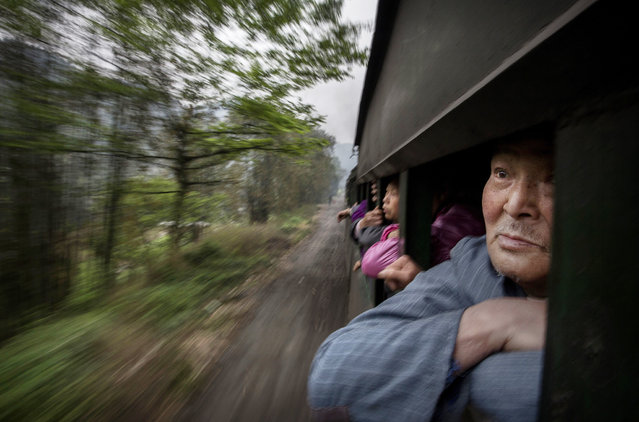
Local villagers ride a local coal powered steam train on March 27, 2015 at a station in the town of Shixi , Sichuan Province, in Southern China. While China boasts the world's most extensive high-speed rail infrastructure. (Photo by Kevin Frayer/Getty Images)

Local villagers ride a local coal powered steam train on March 27, 2015 at a station in the town of Shixi , Sichuan Province, in Southern China. While China boasts the world's most extensive high-speed rail infrastructure with over 16,000 kilometers of track, the Shixi-Bagou railway is still a primary connection for local villagers between towns and is kept alive by tourist cars carrying passengers for ten times the price. The rail line came into service in the late 1950s and the train was initially used to transport coal from a now-shuttered mine before passenger carriages were added. (Photo by Kevin Frayer/Getty Images)
Details
12 May 2015 12:00:00
People walk past the Sleepwalker, a sculpture along the High Line in New York, US on May 10, 2016. The hyperrealistic work by Brooklyn artist Tony Matelli is part of the linear park’s Wanderlust exhibition. (Photo by Xinhua/Barcroft Images)

People walk past the Sleepwalker, a sculpture along the High Line in New York, US on May 10, 2016. The hyperrealistic work by Brooklyn artist Tony Matelli is part of the linear park’s Wanderlust exhibition. (Photo by Xinhua/Barcroft Images)
Details
11 May 2016 11:49:00
Freshmen in Zhengzhou Institute of Aeronautical Industry Management head bottles of mineral water for upright stand during military training on September 17, 2015 in Zhengzhou, Henan Province of China. More than 6,800 freshmen in the school are required to take part in the military training. (Photo by ChinaFotoPress/ChinaFotoPress via Getty Images)

Freshmen in Zhengzhou Institute of Aeronautical Industry Management head bottles of mineral water for upright stand during military training on September 17, 2015 in Zhengzhou, Henan Province of China. More than 6,800 freshmen in the school are required to take part in the military training. (Photo by ChinaFotoPress/ChinaFotoPress via Getty Images)
Details
02 Oct 2015 08:02:00
Takeoka Chisaka, Hiroshima, Japan. “One morning in August 1945, I was walking home from the night shift at a factory in Hiroshima. As I reached my door, there was a huge explosion. When I came to, my head was bleeding and I had been blasted 30m away”. (Photo and caption by Sasha Maslov)

Takeoka Chisaka, Hiroshima, Japan. “One morning in August 1945, I was walking home from the night shift at a factory in Hiroshima. As I reached my door, there was a huge explosion. When I came to, my head was bleeding and I had been blasted 30m away. The atomic bomb had detonated. When I found my mother, her eyes were badly burned. A doctor said they had to come out, but he didn’t have the proper tools so used a knife instead. It was hellish. I became a peace-worker after the war. In the 1960s, at a meeting at the UN, I met one of the people who created the atomic bomb. He apologised”. (Photo and caption by Sasha Maslov)
Details
11 May 2015 11:56:00
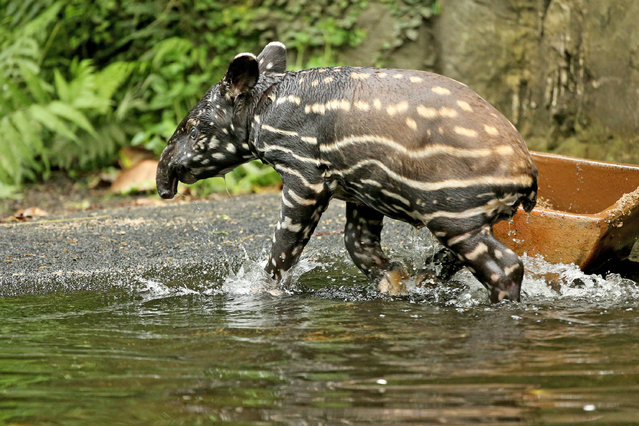
The nearly four-week-old Tapir cub bathes on June 28, 2016 in Gondwanaland at the zoo in Leipzig, Saxony. (Photo by Jan Woitas/DPA)

The nearly four-week-old Tapir cub bathes on June 28, 2016 in Gondwanaland at the zoo in Leipzig, Saxony. (Photo by Jan Woitas/DPA)
Details
03 Jul 2016 10:36:00
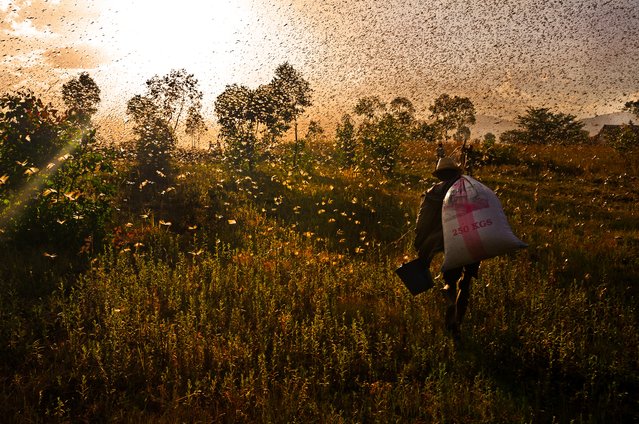
“Locusts & Men”. Oppression, interaction, collaboration. In the life cycle of nature nothing is lost, but the coexistence of different species is sometimes difficult. In Madagascar periodically returns the archaic antagonism between man and the migratory locust, in a circle of life where the two species are looking for space and food for their survival. Photo location: Madagascar, 2013. (Photo and caption by Michele Martinelli/National Geographic Photo Contest)

“Locusts & Men”. Oppression, interaction, collaboration. In the life cycle of nature nothing is lost, but the coexistence of different species is sometimes difficult. In Madagascar periodically returns the archaic antagonism between man and the migratory locust, in a circle of life where the two species are looking for space and food for their survival. At the end of the day a man walks home carrying on his shoulders the heavy bag which contains the locusts captured during the day. The insects provide nutritious meals for the man and his family. Photo location: Madagascar, 2013. (Photo and caption by Michele Martinelli/National Geographic Photo Contest)

ATTENTION! All pictures are presented in high resolution. To see Hi-Res images – just TWICE click on any picture. In other words, click small picture – opens the BIG picture. Click BIG picture – opens VERY BIG picture.
Details
03 Dec 2013 10:59:00