Loading...
Done
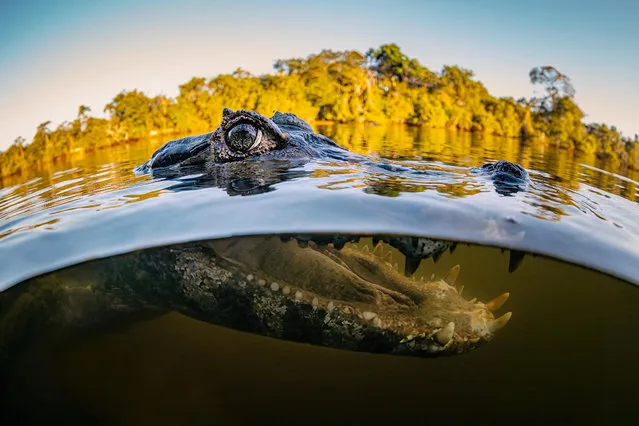
A caiman in the Pantanal region of Brazil in 2021. They are used to seeing humans, allowing the photographer, Leighton Lum, a close-up shot. (Photo by Leighton Lum/Caters News Agency)

A caiman in the Pantanal region of Brazil in 2021. They are used to seeing humans, allowing the photographer, Leighton Lum, a close-up shot. (Photo by Leighton Lum/Caters News Agency)
Details
02 Sep 2021 02:14:00
In this photograph taken on August 20, 2022 a woman dances with a child alongside the Garonne river in Toulouse, southern France. (Photo by Charly Triballeau/AFP Photo)

In this photograph taken on August 20, 2022 a woman dances with a child alongside the Garonne river in Toulouse, southern France. (Photo by Charly Triballeau/AFP Photo)
Details
08 Oct 2022 03:00:00
A woman poses for a picture during Lunar New Year's Eve on Yaowarat Road in Bangkok's Chinatown, Thailand, February 9, 2024. (Photo by Jorge Silva/Reuters)

A woman poses for a picture during Lunar New Year's Eve on Yaowarat Road in Bangkok's Chinatown, Thailand, February 9, 2024. (Photo by Jorge Silva/Reuters)
Details
19 Feb 2024 08:41:00
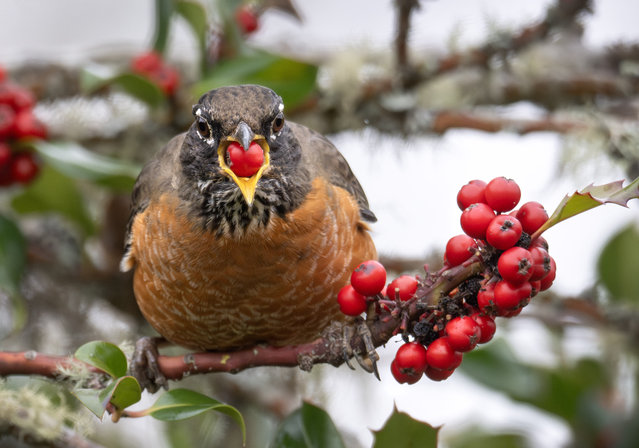
An American robin feeds on holly berries in a thicket near Elkton in southwestern Oregon on November 16, 2024. Many birds can safely consume holly berries, including blackbirds, redwings, and thrushes. There is an old wives tale that if you see a bird eating a berry, it is safe for humans to eat, but this is not true. Birds consume many plants that are poisonous to humans, holly berries included. (Photo by Robin Loznak/ZUMA Press Wire/Rex Features/Shutterstock)

An American robin feeds on holly berries in a thicket near Elkton in southwestern Oregon on November 16, 2024. Many birds can safely consume holly berries, including blackbirds, redwings, and thrushes. There is an old wives tale that if you see a bird eating a berry, it is safe for humans to eat, but this is not true. Birds consume many plants that are poisonous to humans, holly berries included. (Photo by Robin Loznak/ZUMA Press Wire/Rex Features/Shutterstock)

Details
01 Dec 2024 01:43:00
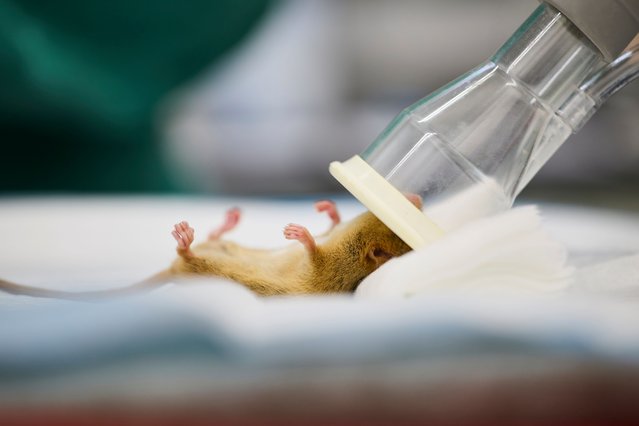
This hazel dormouse is being given a once-over by a disease risk team at ZSL London Zoo, UK in May 2025, as part of reintroduction programme. (Photo by David Levene/The Guardian)

This hazel dormouse is being given a once-over by a disease risk team at ZSL London Zoo, UK in May 2025, as part of reintroduction programme. (Photo by David Levene/The Guardian)
Details
01 Jun 2025 02:56:00
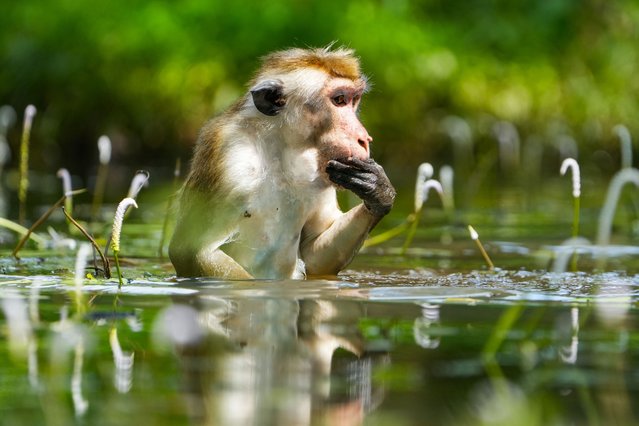
A toque macaque is eating flowers in the water at the pilgrimage site in Polonnaruwa, Sri Lanka, on January 13, 2024. The toque macaque (Macaca sinica), a reddish-brown-colored Old World monkey, is endemic to Sri Lanka, where it is known as the rilewa or rilawa. It is named for the whorl of hair at the crown of its head, which resembles a brimless toque cap. (Photo by Thilina Kaluthotage/NurPhoto/Rex Features/Shutterstock)

A toque macaque is eating flowers in the water at the pilgrimage site in Polonnaruwa, Sri Lanka, on January 13, 2024. The toque macaque (Macaca sinica), a reddish-brown-colored Old World monkey, is endemic to Sri Lanka, where it is known as the rilewa or rilawa. It is named for the whorl of hair at the crown of its head, which resembles a brimless toque cap. (Photo by Thilina Kaluthotage/NurPhoto/Rex Features/Shutterstock)
Details
10 Feb 2024 09:30:00
A workman smooths out the gravel near the base of British artist Alex Chinneck' latest sculpture “A bullet from a shooting star” on the Greenwich Peninsula in London on September 17, 2015. The 35-metre tall, upside-down electricity pylon overlooks the Canary Wharf financial district. (Photo by Leon Neal/AFP Photo)

A workman smooths out the gravel near the base of British artist Alex Chinneck' latest sculpture “A bullet from a shooting star” on the Greenwich Peninsula in London on September 17, 2015. The 35-metre tall, upside-down electricity pylon overlooks the Canary Wharf financial district. (Photo by Leon Neal/AFP Photo)
Details
19 Sep 2015 13:02:00
These Eurasian Otters seem ready for any danger as they all stand up on thier hind legs alert to any threats near to the English river bank. Amateur photographer and retired MOD worker Tony Moir, 57, spotted the otters whilst looking for kingfishers to photograph near the river Trent in East Yorkshire, UK. He was able to take just a couple of pictures before the excited animals spotted the photographer and ran away. (Photo by Tony Moir/Solent News)

These Eurasian Otters seem ready for any danger as they all stand up on thier hind legs alert to any threats near to the English river bank. Amateur photographer and retired MOD worker Tony Moir, 57, spotted the otters whilst looking for kingfishers to photograph near the river Trent in East Yorkshire, UK. He was able to take just a couple of pictures before the excited animals spotted the photographer and ran away. (Photo by Tony Moir/Solent News)
Details
23 Jul 2017 07:35:00