Loading...
Done
“The sustainable development goals cannot be met unless waste management is addressed as a priority”, says UK waste management charity Waste Aid. “E-waste is one of the fastest growing categories of the 7-10bn tonnes of waste produced globally every year”, adds director Mike Webster. “In our view, decent waste management is a basic right and we want governments around the world take this issue much more seriously – in 2012 only 0.2% of international aid went on improving solid waste management – it’s just not enough”. (Photo by Kai Loeffelbein/laif Agentur)

Sustainable development goal target 12.5 is to reduce waste. But with a planet increasingly dependent on technology, is that even possible? As of today, over 30m tonnes of electronic waste has been thrown out so far this year, according to the World Counts. Most e-waste is sent to landfills in Asia and Africa where it is recycled by hand, exposing the people who do it to environmental hazards. Kai Loeffelbein’s photographs of e-waste recycling in Guiyu, southern China show what happens to discarded computers. (Photo by Kai Loeffelbein/laif Agentur)
Details
19 Oct 2016 12:14:00
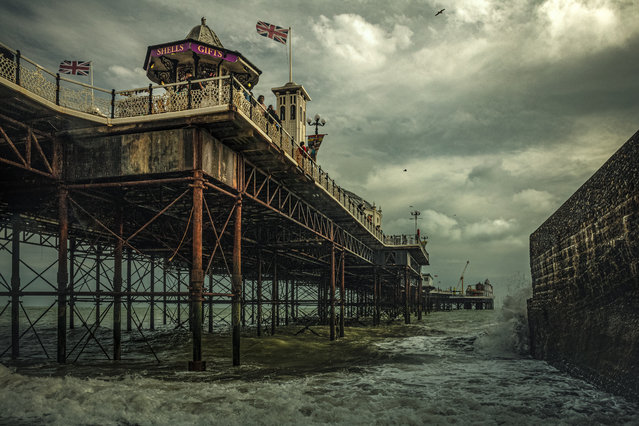
Overall Winner: The Brighton Palace Pier. “Standing in the full force of weather and time: the Brighton Palace Pier. My wife and I have been visiting Brighton for a few years now and I always strive to capture this lovely historic seaside town with a sense of the atmosphere and cinematic interpretation that it instills in me”. (Photo by Michael Marsh/Historic Photographer of the Year 2020)

The winners of the Historic Photographer of the Year Awards 2020 from triphistoric.com celebrate the places and cultural sites around the world that offer a window to the history that exists all around us. This year, restricted by Covid, photographers were called on to scour their photographic archive to share their imagery of those places that dominate our past. Here: The Brighton Palace Pier. (Photo by Michael Marsh/Historic Photographer of the Year 2020)
Details
27 Nov 2020 00:03:00
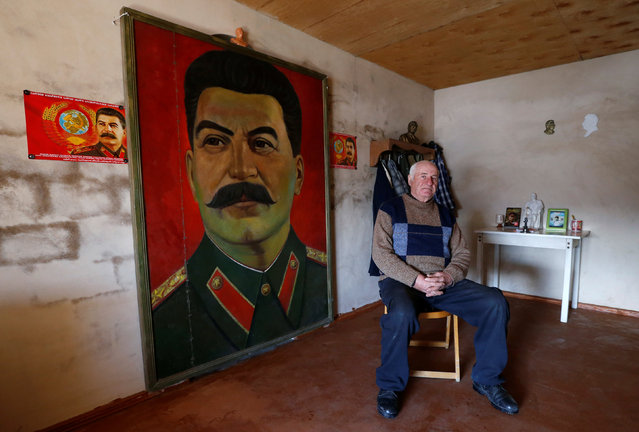
Retired builder Vasili Sidamonidze, 70, poses for a portrait at his home in Gori, Georgia, December 6, 2016. “Unfortunately, Stalin is not popular nowadays. Our people don't respect him. Only we, members of the (Communist) Party, respect him”, Sidamonidze said. “I always try to attend Stalin's birthday anniversaries in Gori. Unfortunately many people don't want to join us even if they live nearby. They look at us from their windows”. Stalin, who was born in Gori in 1878 and died in 1953, is largely reviled today in Georgia, which regained its independence during the 1991 collapse of the Soviet Union. Over the years, his memorials have been dismantled, most recently in 2010 when authorities removed a statue of the dictator from Gori's central square. But Stalin is still revered by a small group of mainly elderly supporters who stress his role in the industrialisation of the Soviet Union and in defeating Nazi Germany in World War Two. Each Dec. 21, a few dozen people mark his birthday by gathering outside a Gori museum dedicated to Stalin, where they make speeches and walk to the square where a 6-meter-high bronze statue of him once stood, calling for it to be reinstated. Opponents say it was a symbol of Moscow's still lingering shadow. In 2008, Russia fought a brief war with Georgia and recognised its breakaway regions of Abkhazia and South Ossetia as independent states. (Photo by David Mdzinarishvili/Reuters)

Retired builder Vasili Sidamonidze, 70, poses for a portrait at his home in Gori, Georgia, December 6, 2016. “Unfortunately, Stalin is not popular nowadays. Our people don't respect him. Only we, members of the (Communist) Party, respect him”, Sidamonidze said. “I always try to attend Stalin's birthday anniversaries in Gori. Unfortunately many people don't want to join us even if they live nearby. They look at us from their windows”. (Photo by David Mdzinarishvili/Reuters)
Details
17 Dec 2016 07:59:00
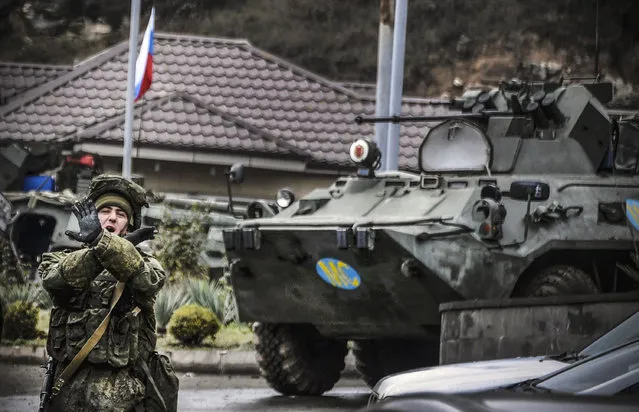
A Russian peacekeeper shouts “No pictures!” at a checkpoint outside the city of Stepanakert on November 13, 2020, during a ceasefire in the military conflict between Armenia and Azerbaijan over the breakaway region of Nagorno-Karabakh. Russian began deploying 2,000 peacekeepers to Nagorno-Karabakh on November 10 after Armenia and Azerbaijan agreed a peace deal to end weeks of fierce fighting over the disputed region. The Moscow-brokered agreement came after a string of Azerbaijani victories in its fight to retake the ethnic Armenian enclave. It sparked celebrations in Azerbaijan but fury in Armenia, where protesters took to the streets to denounce their leaders for losses in the territory, which broke from Azerbaijan's control during a war in the early 1990s. (Photo by Alexander Nemenov/AFP Photo)

A Russian peacekeeper shouts “No pictures!” at a checkpoint outside the city of Stepanakert on November 13, 2020, during a ceasefire in the military conflict between Armenia and Azerbaijan over the breakaway region of Nagorno-Karabakh. Russian began deploying 2,000 peacekeepers to Nagorno-Karabakh on November 10 after Armenia and Azerbaijan agreed a peace deal to end weeks of fierce fighting over the disputed region. (Photo by Alexander Nemenov/AFP Photo)
Details
15 Nov 2020 00:07:00
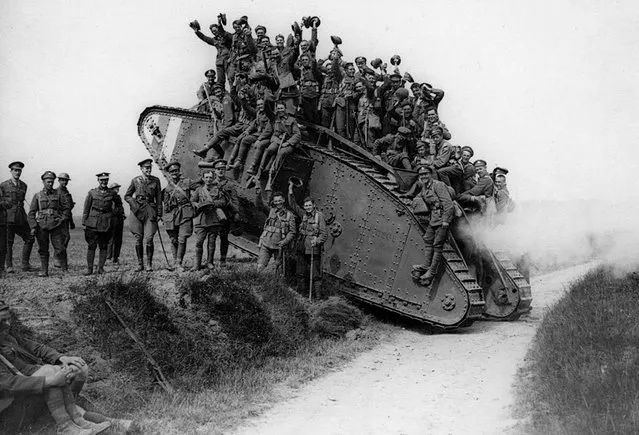
These black-and-white photos are taken from the new book “Armoured Warfare in the First World War 1916 – 1918” by Anthony Tucker-Jones and published by Pen & Sword Military. “Interestingly the British, French and Germans took completely different approaches with varying results”. The British military produced “Little Willie” in Autumn 1915 weighing 18 tonnes, which had a crew of two plus four gunners. “Inspired by a tracked artillery tractor “Little Willie” was referred to as a water tank – hence the name tank – to ensure secrecy”, said Anthony. “This led to the strange looking Mark I with its peculiar rhomboid shape, designed to cross trenches with guns in sponsons on either side. The Germans saw the tank as unchivalrous and were slow to grasp its utility. They favoured the Stormtrooper (specialist soldiers used to infiltrate enemy trenches) and artillery, not the tank”, said Anthony. “However, they didn’t hesitate to make use of captured British tanks. Although the tank helped secure victory and German soldiers dubbed it “Germany’s Downfall” the country was ultimately brought to its knees by the Allies blockade”. Here: British troops hitch a ride on a Mark IV after the massed tank fleet spearheading attack at Cambrai on November 20, 1917. (Photo by Anthony Tucker-Jones/Mediadrumworld.com)

These black-and-white photos are taken from the new book “Armoured Warfare in the First World War 1916 – 1918” by Anthony Tucker-Jones and published by Pen & Sword Military. Here: British troops hitch a ride on a Mark IV after the massed tank fleet spearheading attack at Cambrai on November 20, 1917. (Photo by Anthony Tucker-Jones/Mediadrumworld.com)
Details
23 Feb 2017 00:02:00
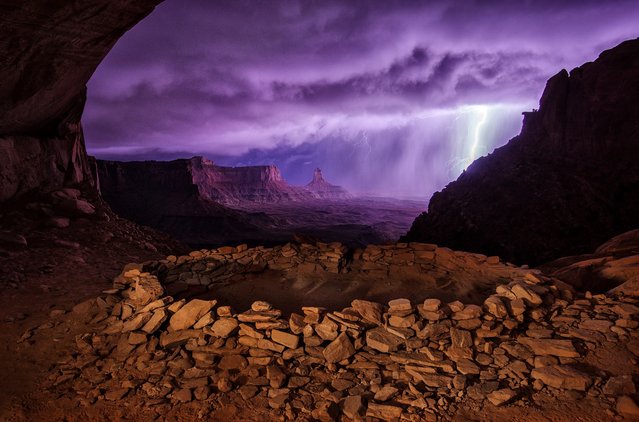
Second Place Winner: “Thunderstorm at False Kiva”. I hiked out to these ruins at night hoping to photograph them with the Milky Way, but instead a thunderstorm rolled through, creating this dramatic image. – Max Seigal. (Photo and caption by Max Seigal/National Geographic Traveler Photo Contest)

Second Place Winner: “Thunderstorm at False Kiva”. I hiked out to these ruins at night hoping to photograph them with the Milky Way, but instead a thunderstorm rolled through, creating this dramatic image. – Max Seigal. National Geographic Traveler Director of Photography Dan Westergren, one of this year's judges, shares his thoughts on the second place winner: “This photo combines two different scenes into one: the small kiva in a cliff dwelling and the grand vista of Canyonlands National Park across the valley. I really like the two different color palettes – warm inside and purple outside. This two-for-one scene was caused by the lightning storm outside the dwelling, which lit up the landscape like it was a huge electronic flash. Looking at this picture I can imagine what a wonderful sight it must have been for the ancient people who lived here. It doesn't seem too amazing now in our modern world, but might have been mind-blowing for the prehistoric residents”. Location: Utah. (Photo and caption by Max Seigal/National Geographic Traveler Photo Contest)
Details
02 Aug 2013 06:16:00
“Mr Big Dipper”, Nicholas Roemmelt (Denmark). A stargazer observes the constellation of the Big Dipper perfectly aligned with the window of the entrance to a large glacier cave in Engadin, Switzerland. This is a panorama of two pictures, and each is a stack of another two pictures: one for the stars and another one for the foreground, but with no composing or time blending. (Photo by Nicholas Roemmelt/National Maritime Museum/The Guardian)

“Mr Big Dipper”, Nicholas Roemmelt (Denmark). A stargazer observes the constellation of the Big Dipper perfectly aligned with the window of the entrance to a large glacier cave in Engadin, Switzerland. This is a panorama of two pictures, and each is a stack of another two pictures: one for the stars and another one for the foreground, but with no composing or time blending. (Photo by Nicholas Roemmelt/National Maritime Museum/The Guardian)
Details
27 Jul 2017 06:50:00


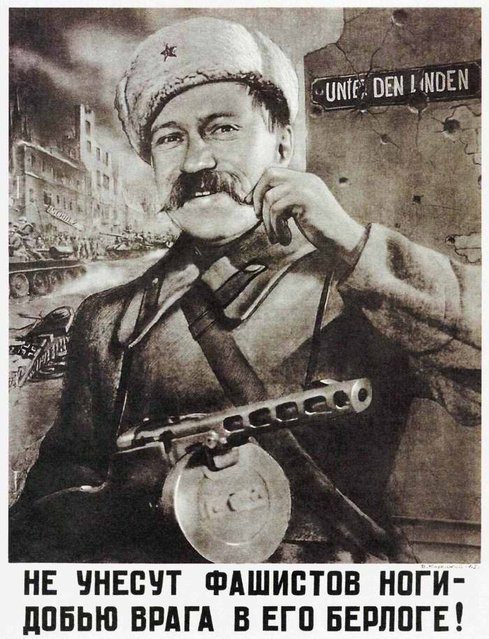
Nazis won't run away - I'll finish them in their lair! - Viktor Koretsky (1945)
Details
17 Aug 2013 10:23:00