Loading...
Done
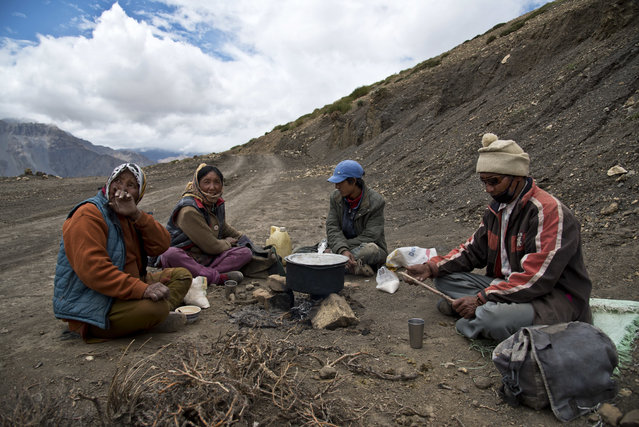
In this August 17, 2016, photo, from left to right, Chhering Chodom, 60, Tashi Yangzom, 50, Lobsang Chhering, 27, and Dorje Tandup, 58, drink milk tea on the side of the road. For centuries, the sleepy valley nestled in the Indian Himalayas remained a hidden Buddhist enclave forbidden to outsiders. Enduring the harsh year-round conditions of the high mountain desert, the people of Spiti Valley lived by a simple communal code – share the Earth's bounty, be hospitable to neighbors, and eschew greed and temptation at all turns. That's all starting to change, for better or worse. Since India began allowing its own citizens as well as outsiders to visit the valley in the early 1990s, tourism and trade have boomed. And the marks of modernization, such as solar panels, asphalt roads and concrete buildings, have begun to appear around some of the villages that dot the remote landscape at altitudes above 4,000 meters (13,000 feet). (Photo by Thomas Cytrynowicz/AP Photo)

In this August 17, 2016, photo, from left to right, Chhering Chodom, 60, Tashi Yangzom, 50, Lobsang Chhering, 27, and Dorje Tandup, 58, drink milk tea on the side of the road. For centuries, the sleepy valley nestled in the Indian Himalayas remained a hidden Buddhist enclave forbidden to outsiders. Enduring the harsh year-round conditions of the high mountain desert, the people of Spiti Valley lived by a simple communal code – share the Earth's bounty, be hospitable to neighbors, and eschew greed and temptation at all turns. That's all starting to change, for better or worse. (Photo by Thomas Cytrynowicz/AP Photo)
Details
15 Sep 2016 09:22:00
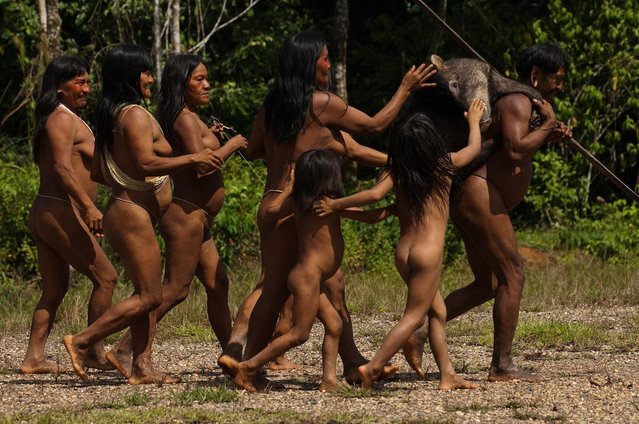
Spectacular images offering insight into the lives of the Huaorani people in the Ecuadorian Amazon have been revealed showing how they use traditional methods to hunt monkeys for food. The stunning pictures were taken by conservation photographer Pete Oxford from Torquay, Devon in the Ecuadorian Amazon. “The Huaorani Indians are a forest people highly in tune with their environment. Many are now totally acculturated since the 1950s by missionaries”, said Pete. “Today they face radical change to their culture to the proximity of oil exploration within their territory and the Yasuni National Park and Biosphere Reserve, they are vastly changed. Some still live very traditionally and for this shoot, through my Huaorani friend, a direct relative of those photographed he wanted to depict them as close to their original culture as possible. They still largely hunt with blow pipes and spears eating a lot of monkeys and peccaries”. The Huaorani are also known as the Waorani, Waodani or the Waos and are native Amerindians. Their lands are located between the Curaray and Napo rivers and speak the Huaorani language. Pete says that during his visit he was welcomed into the group and hopes that ancient cultures can be saved. Here: The tribe were seen celebrating after a hunter returned to camp with a wild pig. (Photo by Pete Oxford/Mediadrumworld.com)

Spectacular images offering insight into the lives of the Huaorani people in the Ecuadorian Amazon have been revealed showing how they use traditional methods to hunt monkeys for food. The stunning pictures were taken by conservation photographer Pete Oxford from Torquay, Devon in the Ecuadorian Amazon. Here: The tribe were seen celebrating after a hunter returned to camp with a wild pig. (Photo by Pete Oxford/Mediadrumworld.com)
Details
20 Jan 2017 07:58:00
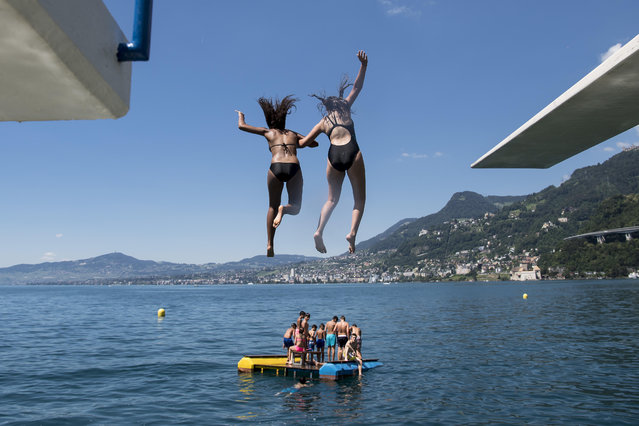
In this July 9, 2016 file photo, girls jump from a diving platform into the Geneva Lake and enjoy sunny and warm weather, in Villeneuve, Switzerland. After nearly 90 years, women can legally swim topless in Geneva’s lake and Rhone River without running the risk of a fine. Geneva’s regional council has voted to modify a 1929 ordinance that banned women from swimming topless in the city’s main natural waterways, though the change doesn’t apply to public swimming pools or swimming totally naked. Nicolas Bolle, an official with Geneva’s security department, on Thursday, April 6, 2017 confirmed the council’s action a day earlier. (Photo by Jean-Christophe Bott/Keystone via AP Photo)

In this July 9, 2016 file photo, girls jump from a diving platform into the Geneva Lake and enjoy sunny and warm weather, in Villeneuve, Switzerland. After nearly 90 years, women can legally swim topless in Geneva’s lake and Rhone River without running the risk of a fine. Geneva’s regional council has voted to modify a 1929 ordinance that banned women from swimming topless in the city’s main natural waterways, though the change doesn’t apply to public swimming pools or swimming totally naked. Nicolas Bolle, an official with Geneva’s security department, on Thursday, April 6, 2017 confirmed the council’s action a day earlier. (Photo by Jean-Christophe Bott/Keystone via AP Photo)
Details
08 Apr 2017 09:39:00
In this Thursday, March 28, 2019, photo, a “golden giant burger” is served at a restaurant of Hotel Grand Hyatt Tokyo in Tokyo. The $900 wagyu (Japanese-produced beef) burger was unveiled to commemorate the era change. What’s in a name? Quite a lot if you’re a Japanese citizen awaiting the official announcement Monday, April 1, 2019 of what the soon-to-be-installed new emperor’s next era will be called. It’s a proclamation that has happened only twice in nearly a century, and the new name will follow Emperor Naruhito, after his May 1 investiture, for the duration of his rule, attaching itself to much of what happens in Japan. (Photo by Kyodo News via AP Photo)

In this Thursday, March 28, 2019, photo, a “golden giant burger” is served at a restaurant of Hotel Grand Hyatt Tokyo in Tokyo. The $900 wagyu (Japanese-produced beef) burger was unveiled to commemorate the era change. What’s in a name? Quite a lot if you’re a Japanese citizen awaiting the official announcement Monday, April 1, 2019 of what the soon-to-be-installed new emperor’s next era will be called. It’s a proclamation that has happened only twice in nearly a century, and the new name will follow Emperor Naruhito, after his May 1 investiture, for the duration of his rule, attaching itself to much of what happens in Japan. (Photo by Kyodo News via AP Photo)
Details
02 Apr 2019 00:05:00
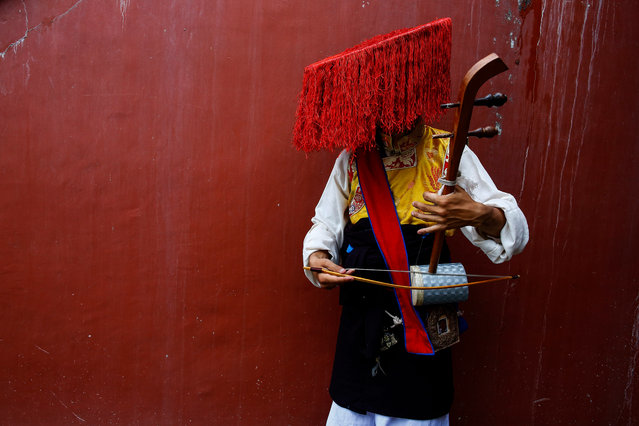
A Tibetan artists wearing a traditional costume waits before their performance during the 82nd pre-birthday celebration of Tibetan spiritual leader Dalai Lama at a Monastery in Kathmandu, Nepal, 05 July 2017. More than 1,000 monks and other Tibetans gathered at the Monastery compound to celebrate their spiritual leader's birthday. The Nepalese government has banned all kinds of Tibetan activities against the Chinese rule in Tibet so Tibetans have been changing the venue of the Dalai Lama's birthday celebration. The Dalai Lama will turn 82 on 06 July 2017. (Photo by Narendra Shrestha/EPA)

A Tibetan artists wearing a traditional costume waits before their performance during the 82nd pre-birthday celebration of Tibetan spiritual leader Dalai Lama at a Monastery in Kathmandu, Nepal, 05 July 2017. More than 1,000 monks and other Tibetans gathered at the Monastery compound to celebrate their spiritual leader's birthday. The Nepalese government has banned all kinds of Tibetan activities against the Chinese rule in Tibet so Tibetans have been changing the venue of the Dalai Lama's birthday celebration. The Dalai Lama will turn 82 on 06 July 2017. (Photo by Narendra Shrestha/EPA)
Details
10 Aug 2017 08:33:00
A model wears a creation from the Triya summer collection during Fashion Rio in Rio de Janeiro, Brazil, Friday, April 19, 2013. (Photo by Felipe Dana/AP Photo)

Felipe Dana discovered photography at age 15 when he started working as an assistant for event and commercial photographers. At the close of 2009, he decided to focus his career solely on photojournalism. Dana has focused his work on documenting the consequences of social changes in slums due to upcoming major sports events scheduled for 2014 and 2016 in Rio de Janeiro, where he currently lives and works as a staff photographer for The Associated Press. Photo: A model wears a creation from the Triya summer collection during Fashion Rio in Rio de Janeiro, Brazil, Friday, April 19, 2013. (Photo by Felipe Dana/AP Photo)
Details
15 May 2014 07:29:00
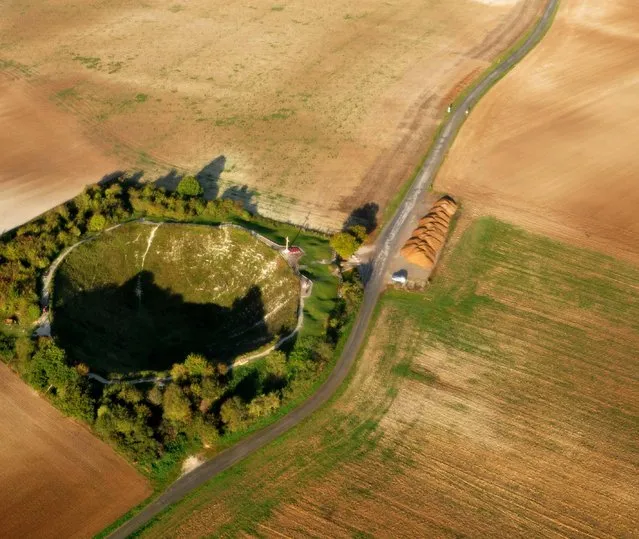
Lochnagar Crater Somme In France

It is amazing how much the humanity can change the face of the earth. Not only can it create huge craters, which look a lot like craters from meteors, they leave a big enough impact that it can be seen from space. Though this crater, caused by a massive explosion on 1 July 1916, looks large, being 90 feet deep and 300 feet across; it is nowhere big enough to be viewed for space. A common misconception is that the Great Wall of China can be seen from space. In reality, however, it is impossible. Not only is it of the same color as the earth near it, it is also not that wide. Deforestation, on the other hand, can be clearly seen from space. Also, at night, all the lights that the large cities produce are also very visible.
Details
17 Nov 2014 12:48:00
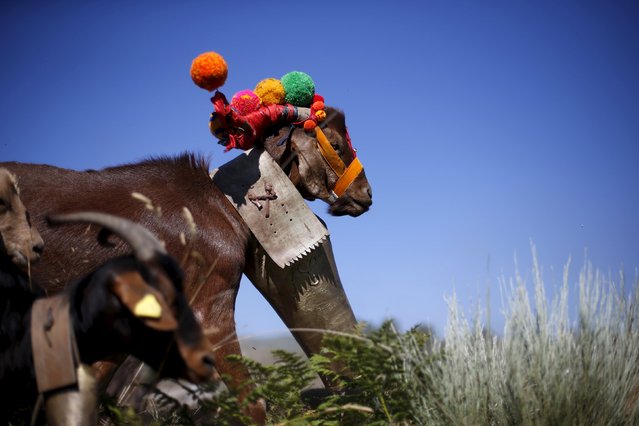
Sheep walk as they are herded to summer pastures in Serra da Estrela, near Seia, Portugal June 27, 2015. (Photo by Rafael Marchante/Reuters)

Sheep walk as they are herded to summer pastures in Serra da Estrela, near Seia, Portugal June 27, 2015. In late June, shepherds young and old in the Seia region of central Portugal start guiding sheep, goats and cattle to the Serra da Estrela, the country’s highest mountains, in search of better pastures. There they stay until the end of September. Modern-day shepherds may have mobile phones to keep in touch with family and friends, but their lifestyle has changed little for centuries. The sound of cowbells and the bark of longhaired mastiffs starts early in the morning as the animals – often decorated with traditional woollen balls on their horns – are herded up steep, narrow paths. (Photo by Rafael Marchante/Reuters)
Details
14 Jul 2015 13:48:00