Loading...
Done
Shortlisted: The Life: A narrow strip, Río Tinto, Huelva, Spain. A narrow strip of road divides ochre-coloured and fresh waters. Trees wait on the fresh side of the road opposite the toxic waters of a nearby mine reservoir. (Photo by Roberto Bueno/CIWEM Environmental Photographer of the Year 2021)

Shortlisted: The Life: A narrow strip, Río Tinto, Huelva, Spain. A narrow strip of road divides ochre-coloured and fresh waters. Trees wait on the fresh side of the road opposite the toxic waters of a nearby mine reservoir. (Photo by Roberto Bueno/CIWEM Environmental Photographer of the Year 2021)
Details
10 Nov 2021 08:04:00
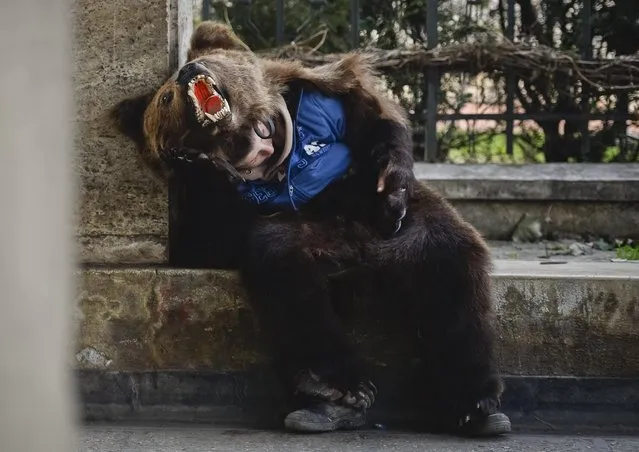
Florin Bors, aged 8 from Bacau, northern Romania, wearing a bear fur takes a break from performing a holiday season ritual in Bucharest, Romania, Tuesday, December 16, 2014. In pre-Christian rural traditions, dancers wearing colored costumes or animal furs, touring house to house in villages singing and dancing to ward off evil. (Photo by Octav Ganea/AP Photo/Mediafax)

Florin Bors, aged 8 from Bacau, northern Romania, wearing a bear fur takes a break from performing a holiday season ritual in Bucharest, Romania, Tuesday, December 16, 2014. In pre-Christian rural traditions, dancers wearing colored costumes or animal furs, touring house to house in villages singing and dancing to ward off evil. In recent years following the economic downturn in Romania, a European Union member since 2007, the tradition has moved to Romania's cities where dancers travel to perform the ritual for money. (Photo by Octav Ganea/AP Photo/Mediafax)
Details
20 Dec 2014 12:07:00
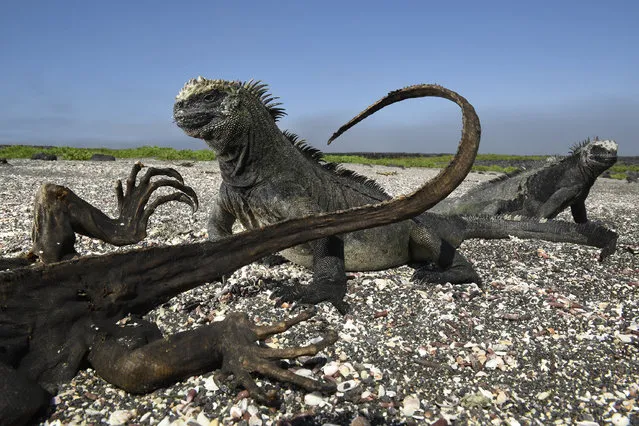
Galapagos – Rocking the Cradle: Four major ocean currents converge along the Galapagos archipelago, creating the conditions for an extraordinary diversity of animal life, April 25, 2016. The islands are home to at least 7,000 flora and fauna species, of which 97 percent of the reptiles, 80 percent of the land birds, 50 percent of the insects and 30 percent of the plants are endemic. The local ecosystem is highly sensitive to the changes in temperature, rainfall and ocean currents that characterize the climatic events known as El Niño and La Niña. These changes cause marked fluctuations in weather and food availability. Many scientists expect the frequency of El Niño and La Niña to increase as a result of climate change, making the Galapagos a possible early-warning location for its effects. (Photo by Thomas P. Peschak for National Geographic/World Press Photo)

Galapagos – Rocking the Cradle: Four major ocean currents converge along the Galapagos archipelago, creating the conditions for an extraordinary diversity of animal life, April 25, 2016. The islands are home to at least 7,000 flora and fauna species, of which 97 percent of the reptiles, 80 percent of the land birds, 50 percent of the insects and 30 percent of the plants are endemic. (Photo by Thomas P. Peschak for National Geographic/World Press Photo)
Details
16 Apr 2018 00:01:00
 A couple embrace during the start of the San Fermin festival in Pamplona, Spain July 6, 2016. (Photo by Vincent West/Reuters)

A couple embrace during the start of the San Fermin festival in Pamplona, Spain July 6, 2016. Revelers from around the world kick off the festival with a messy party in the Pamplona town square, one day before the first of eight days of the running of the bulls. (Photo by Vincent West/Reuters)
Details
07 Jul 2016 11:59:00
The Berenson robot strolls among visitors during the exhibition “Persona : Oddly Human” at the Quai Branly museum in Paris, France, February 23, 2016. The Berenson robot, developed in France in 2011, is the brainchild of anthropologist Denis Vidal and robotics engineer Philippe Gaussier. Its programming allows it to record reactions of museum visitors to certain pieces of art and then use the data to develop its own unique taste, which allows “Berenson” to judge whether or not it likes a certain work of art within an exhibition. (Photo by Philippe Wojazer/Reuters)

The Berenson robot strolls among visitors during the exhibition “Persona : Oddly Human” at the Quai Branly museum in Paris, France, February 23, 2016. The Berenson robot, developed in France in 2011, is the brainchild of anthropologist Denis Vidal and robotics engineer Philippe Gaussier. Its programming allows it to record reactions of museum visitors to certain pieces of art and then use the data to develop its own unique taste, which allows “Berenson” to judge whether or not it likes a certain work of art within an exhibition. (Photo by Philippe Wojazer/Reuters)
Details
25 Feb 2016 12:26:00
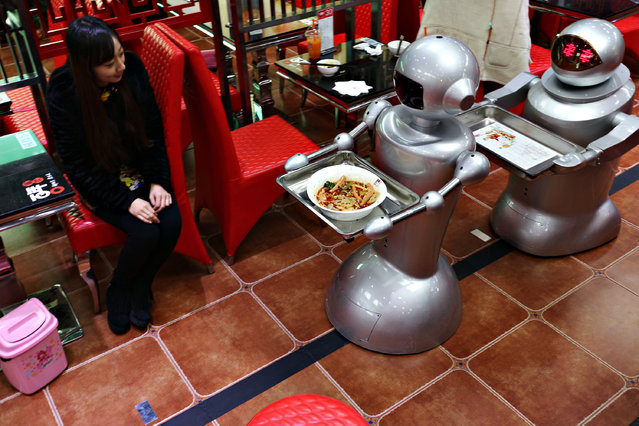
Two 70 thousand RMB (about 11,310 USD) robots carry dishes and offer service for customers at a robot themed restaurant at Chunxi Road in Chengdu, China, December 11, 2014. The restaurant has 10 robots to serve as waiters. Each robot can carry simple dishes and offer simple greetings. (Photo by ChinaFotoPress/ChinaFotoPress via Getty Images)

Two 70 thousand RMB (about 11,310 USD) robots carry dishes and offer service for customers at a robot themed restaurant at Chunxi Road in Chengdu, China, December 11, 2014. The restaurant has 10 robots to serve as waiters. Each robot can carry simple dishes and offer simple greetings. (Photo by ChinaFotoPress/ChinaFotoPress via Getty Images)
Details
13 Dec 2014 13:01:00
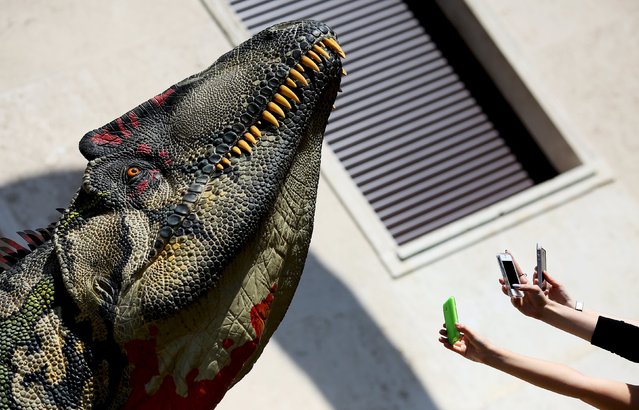
People take pictures with their mobile phone of a scale model of a dinosaur displayed in front of La Sapienza University headquarters in Rome April 10, 2015. The realistic reproductions of dinosaurs are part of the “Dinosaurs in the flesh, science and art bring to life the rulers of a lost world” exhibition. (Photo by Alessandro Bianchi/Reuters)

People take pictures with their mobile phone of a scale model of a dinosaur displayed in front of La Sapienza University headquarters in Rome April 10, 2015. The realistic reproductions of dinosaurs are part of the “Dinosaurs in the flesh, science and art bring to life the rulers of a lost world” exhibition. (Photo by Alessandro Bianchi/Reuters)
Details
11 Apr 2015 10:47:00
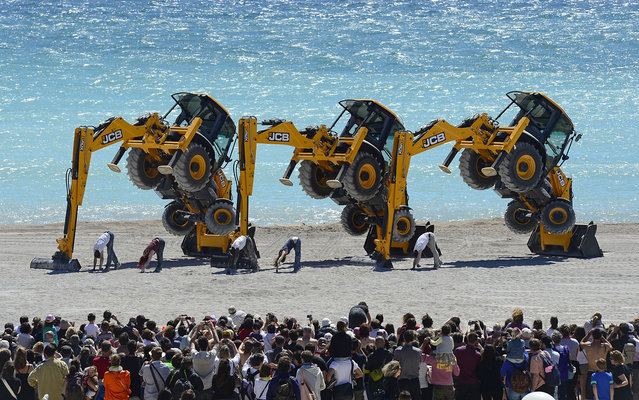
Dancers from the British theater company Motionhouse perform a show with excavators entitled “Traction” on the Prado beach in Marseille, France, on May 10, 2013. (Photo by Boris Horvat/AFP Photo)

Dancers from the British theater company Motionhouse perform a show with excavators entitled “Traction” on the Prado beach in Marseille, France, on May 10, 2013. (Photo by Boris Horvat/AFP Photo)
Details
11 May 2013 12:36:00