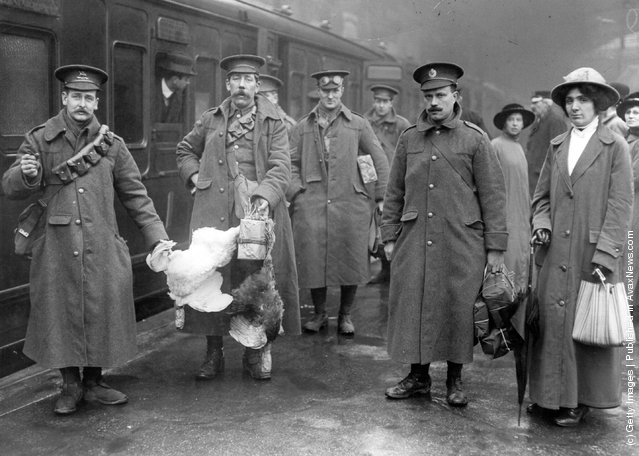
Soldiers, including two recruits who have brought some chickens, at Victoria prepare to board the train for the battle front. (Photo by Hulton Archive/Getty Images)
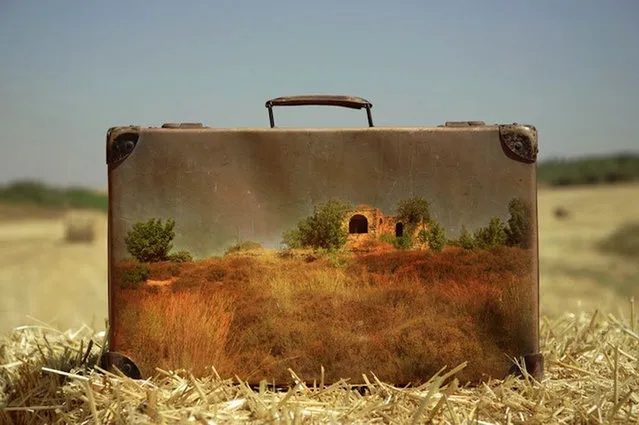
Memory Suitcases is a thought-provoking series by Israeli artist Yuval Yairi that uses old, worn suitcases as canvases for nostalgic landscapes. Like scenes out of one's memory, the propped up traveling cases feature a range of sepia-toned settings. The series presents the objects as though they are relics of a civilization from yesteryear, each with their own story to tell.
There's something both heartbreaking and sentimental about the images. It appears to tell a number of stories of leaving one lifestyle for another. The suitcases hold within them a picture show of memories from a life-altering journey. Like a number of his other works, Memory Suitcases "mimics the natural process of memory."
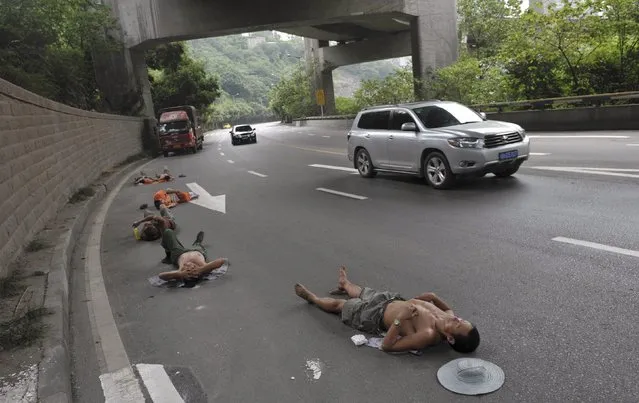
A section of multi-vehicle accident on Interstate 75 is shown in Detroit, Thursday, January 31, 2013. Snow squalls and slippery roads led to a series of accidents that left at least three people dead and 20 injured on a mile-long stretch of southbound I-75. More than two dozen vehicles, including tractor-trailers, were involved in the pileups. (Photo by Paul Sancya/AP Photo)
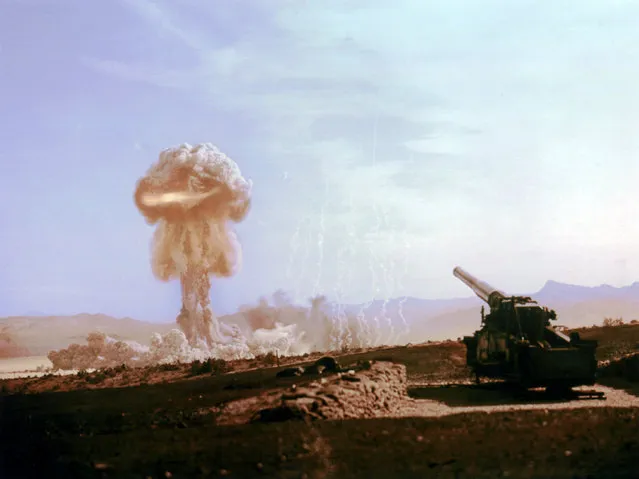
“A fter the former Soviet Union conducted its first nuclear test in August 1949, the US reevaluated its postwar defense policies. With the US monopoly on atomic weapons broken, military and political leaders chose to diversify the American stockpile by developing thermonuclear and tactical nuclear weapons. One of the more interesting concepts to come out of this period was atomic artillery, which was successfully tested at the Nevada Proving Grounds (now the Nevada Test Site) in May 1953”. – Alan Carr. Photo: Atomic Annie at work during the Upshot-Knothole test series, 1953. (Photo by Los Alamos National Laboratory/US Army)
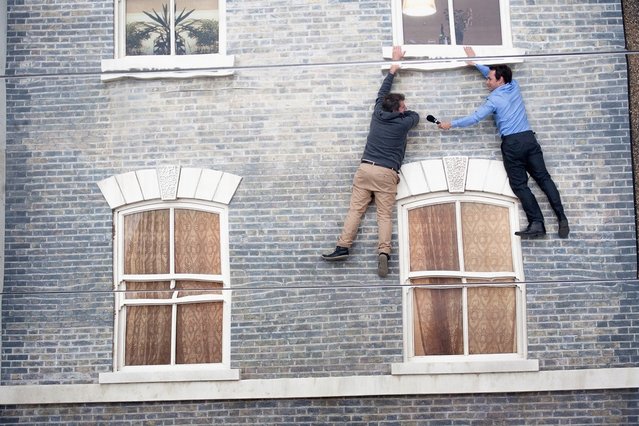
People appear dangling as a large-scale installation art piece by Leandro Erlich, named “Dalston House”, in London, England. Part of the “Beyond Barbican” summer series of events, the interactive installation is a full facade of a late nineteenth-century Victorian terraced house built on the ground with a large mirror above it to reflect people as to appear dangling from the structure. (Photo by Dan Dennison)
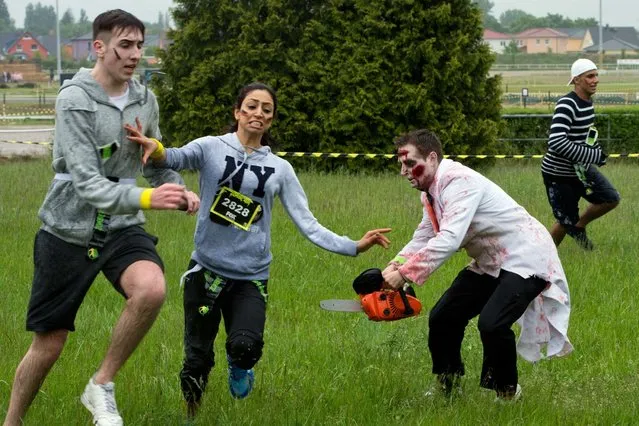
Participants costumed as zombies try to catch hobby runners during the so-called Zombie-Run at the harness racing track Karlshorst in Berlin, Germany, 18 May 2014. The runners carry small flags in their belts which they have to get safely across the finishing line while the zombies try to steal them. The sporting event is based on the US television series “The Walking Dead”. (Photo by Soeren Stache/DPA)