Loading...
Done
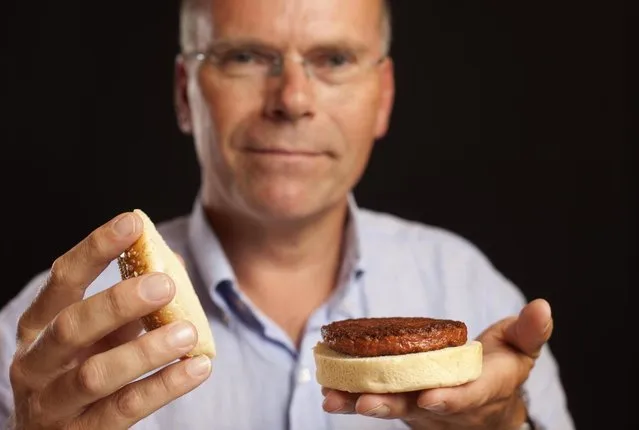
In this handout image provided by Ogilvy, a burger made from cultured beef, which has been developed by Professor Mark Post of Maastricht University in the Netherlands (pictured) is shown to the media during a press conference on August 5, 2013 in London, England. Cultured Beef could help solve the coming food crisis and combat climate change with commercial production of Cultured Beef beginning within ten to twenty years. (Photo by David Parry via Getty Images)

In this handout image provided by Ogilvy, a burger made from cultured beef, which has been developed by Professor Mark Post of Maastricht University in the Netherlands (pictured) is shown to the media during a press conference on August 5, 2013 in London, England. The in-vitro burger, cultured from cattle stem cells, the first example of what its creator says could provide an answer to global food shortages and help combat climate change, was fried in a pan and tasted by two volunteers. The burger is the result of years of research by Dutch scientist Mark Post, a vascular biologist at the University of Maastricht, who is working to show how meat grown in petri dishes might one day be a true alternative to meat from livestock.The meat in the burger has been made by knitting together around 20,000 strands of protein that has been cultured from cattle stem cells in Post's lab. (Photo by David Parry)
Details
06 Aug 2013 08:48:00


“The Trabant is a car that was produced by former East German auto maker VEB Sachsenring Automobilwerke Zwickau in Zwickau, Sachsen. It was the most common vehicle in East Germany, and was also exported to countries both inside and outside the communist bloc. The main selling points was that it had room for four adults and luggage in a compact, light and durable shell and that it was fast (when introduced) and durable. With its mediocre performance, smoky two-stroke engine, and production shortages, the Trabant is often cited as an example of the disadvantages of centralized planning; on the other hand, it is regarded with derisive affection as a symbol of the failed former East Germany and of the fall of communism (in former West Germany, as many East Germans streamed into West Berlin and West Germany in their Trabants after the opening of the Berlin Wall in 1989). It was in production without any significant changes for nearly 30 years with 3,096,099 Trabants produced in total”. – Wikipedia

Photo: Enthusiasts weared in uniforms of the former eastern german army trive in a military Trabant car as fans and owners of East German-era Trabant cars gather at the 2011 International Trabantfahrer Treffen (International Trabant Drivers Meeting) on June 26, 2011 in Zwickau, Germany. The Trabant, also known as the Trabi, was among the main cars produced in communist East Germany and built by VEB Sachsenring Automobilwerke in Zwickau for 30 years until 1989. Today the car has cult status for many followers and one company, IndiKar, is even seeking to revive the brand in a modern, electric version. (Photo by Carsten Koall/Getty Images)
Details
27 Jun 2011 12:21:00
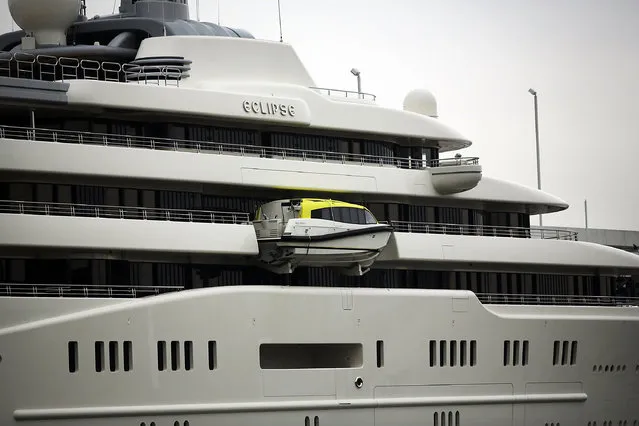
The Eclipse, reported to be the largest private yacht in the world, is viewed docked at a pier in New York on February 19, 2013 in New York City. The boat, which measures 557ft in length and is estimated to cost 1.5 billion US dollars, is owned by Russian billionaire Roman Abramovich and arrived into New York on Wednesday.  (Photo by Spencer Platt)

“Eclipse is a luxury motor yacht constructed by Blohm + Voss in Hamburg, Germany. Its exterior and interior were designed by Terence Disdale Design and its naval architect was Francis Design. The yacht was delivered to Russian businessman Roman Abramovich on 9 December 2010”. – Wikipedia

Photo: The Eclipse, reported to be the largest private yacht in the world, is viewed docked at a pier in New York on February 19, 2013 in New York City. The boat, which measures 557ft in length and is estimated to cost 1.5 billion US dollars, is owned by Russian billionaire Roman Abramovich and arrived into New York on Wednesday. (Photo by Spencer Platt)
Details
20 Feb 2013 09:00:00
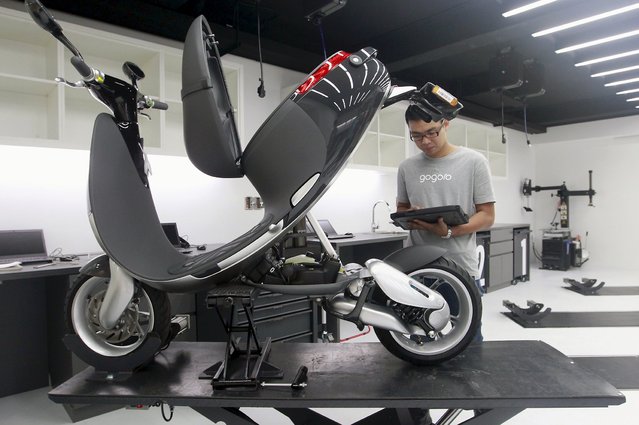
A mechanic examines a Gogoro Smartscooter which is connected to a tablet, in its shop in Taipei, Taiwan, July 6, 2015. (Photo by Pichi Chuang/Reuters)

A mechanic examines a Gogoro Smartscooter which is connected to a tablet, in its shop in Taipei, Taiwan, July 6, 2015. Companies such as electric motor scooter firm Gogoro could hold the key to Taiwan's economic growth. In just three years, the start-up raised $150 million to develop the smartphone-synched bike, and a charging network for it. Gogoro's success in creating a home-grown, innovative product is precisely what Taiwan's government wants to foster as it seeks to reduce the export-driven economy's reliance on the island's world-class tech manufacturing sector. (Photo by Pichi Chuang/Reuters)
Details
13 Jul 2015 11:13:00
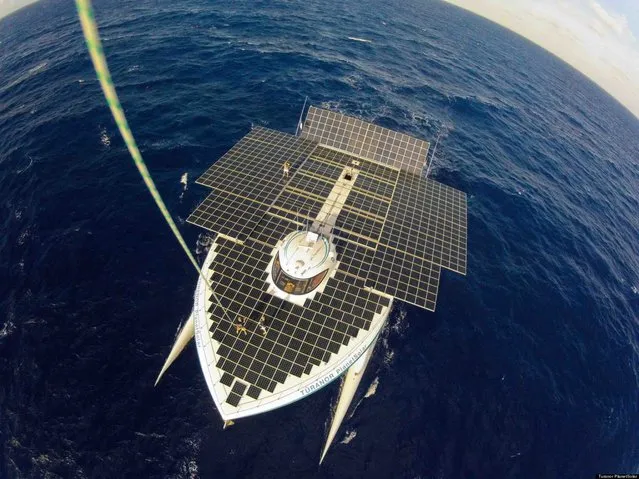
Turanor PlanetSolar

MS Tûranor PlanetSolar, known under the project name PlanetSolar, is the largest solar-powered boat in the world The vessel was designed by LOMOcean Design, built by Knierim Yachtbau in Kiel, Germany, and launched on 31 March 2010. In May 2012, it became the first ever solar electric vehicle to circumnavigate the globe. The 31-meter boat is covered in over 500 square meters of solar panels rated 93 kW, which in turn connect to one of the two electric motors in each hull. There are 8.5 tons of lithium-ion batteries in the ship's two hulls. The boat's shape allows it to reach speeds of up to 14 knots. The hull was model tested in wind tunnels and was tank tested to determine its hydrodynamics and aerodynamics. The boat has been designed to be used as a luxury yacht after the record attempt is finished.
Details
30 Oct 2013 09:06:00
Michael Grant, 28, “Philly Jesus”, carries a 12 foot cross 8 miles through this blighted area of North Philadelphia towards LOVE Park in Center City as part of a Christmas walk to spread the true message of the holiday in Philadelphia, Pennsylvania December 20, 2014. As many as a half dozen others joined him for numerous miles as he trekked southward down Broad Street.  Some shouted “Praise Jesus!” and “Thank you for doing this!” at the sight. (Photo by Mark Makela/Reuters)

Michael Grant, 28, “Philly Jesus”, carries a 12 foot cross 8 miles through this blighted area of North Philadelphia towards LOVE Park in Center City as part of a Christmas walk to spread the true message of the holiday in Philadelphia, Pennsylvania December 20, 2014. As many as a half dozen others joined him for numerous miles as he trekked southward down Broad Street. Some shouted “Praise Jesus!” and “Thank you for doing this!” at the sight. Nearly everyday for the last 8 months, Grant has dressed as Jesus Christ, and walked the streets of Philadelphia to share the Christian gospel by example. He quickly acquired the nickname of “Philly Jesus”, which he has gone by ever since. (Photo by Mark Makela/Reuters)
Details
24 Dec 2014 14:13:00
Girls, who are part of Afghan Mobile Mini Circus for Children (MMCC), participate in a juggling competition in Kabul, Afghanistan August 12, 2015. (Photo by Ahmad Masood/Reuters)

Girls, who are part of Afghan Mobile Mini Circus for Children (MMCC), participate in a juggling competition in Kabul, Afghanistan August 12, 2015. The MMCC, founded by David Mason from Denmark, teaches cooperation and creativity to children scarred by years of war in Afghanistan. Despite the dangers, the project has grown so popular that it now runs centres in ten provinces and has hundreds of regular students. The circus makes visits to internally displaced persons' camps, schools, orphanages, and holds annual festivals. The children are taught the skills of juggling clubs, walking on stilts and acrobatics. (Photo by Ahmad Masood/Reuters)
Details
01 Sep 2015 12:47:00
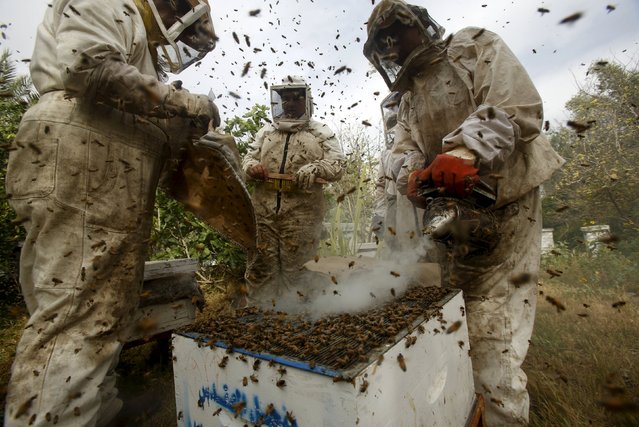
A Palestinian beekeeper uses smoke to calm bees in the process of collecting honey at a farm in Rafah, in the southern Gaza Strip April 11, 2016. (Photo by Suhaib Salem/Reuters)

A Palestinian beekeeper uses smoke to calm bees in the process of collecting honey at a farm in Rafah, in the southern Gaza Strip April 11, 2016. Rateb Samour sees 250 patients a day, whose complaints range from hair loss to cerebral palsy and cancer. He is not a doctor and has never worked in a hospital. Samour inherited the skill of bee-sting therapy from his father. From 2003 the agricultural engineer dedicated all his time to study and develop the alternative-medicine treatment of apitherapy, which uses bee-related products from honey, propolis – or bee glue used to build hives – to venom. (Photo by Suhaib Salem/Reuters)
Details
13 Apr 2016 09:14:00