Loading...
Done
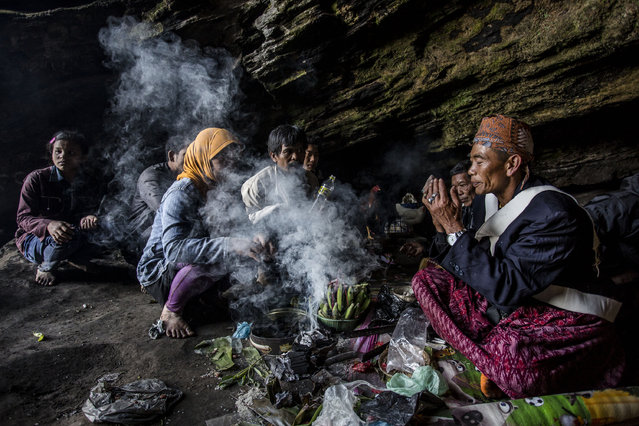
A Tenggerese shaman praying for worshippers at Widodaren cave during the Tenggerese Hindu Yadnya Kasada festival on July 31, 2015 in Probolinggo, East Java, Indonesia. The festival is the main festival of the Tenggerese people and lasts about a month. On the fourteenth day, the Tenggerese make the journey to Mount Bromo to make offerings of rice, fruits, vegetables, flowers and livestock to the mountain gods by throwing them into the volcano's caldera. (Photo by Ulet Ifansasti/Getty Images)

A Tenggerese shaman praying for worshippers at Widodaren cave during the Tenggerese Hindu Yadnya Kasada festival on July 31, 2015 in Probolinggo, East Java, Indonesia. The festival is the main festival of the Tenggerese people and lasts about a month. On the fourteenth day, the Tenggerese make the journey to Mount Bromo to make offerings of rice, fruits, vegetables, flowers and livestock to the mountain gods by throwing them into the volcano's caldera. The origin of the festival lies in the 15th century when a princess named Roro Anteng started the principality of Tengger with her husband Joko Seger, and the childless couple asked the mountain Gods for help in bearing children. The legend says the Gods granted them 24 children but on the provision that the 25th must be tossed into the volcano in sacrifice. The 25th child, Kesuma, was finally sacrificed in this way after initial refusal, and the tradition of throwing sacrifices into the caldera to appease the mountain Gods continues today. (Photo by Ulet Ifansasti/Getty Images)
Details
01 Aug 2015 12:07:00
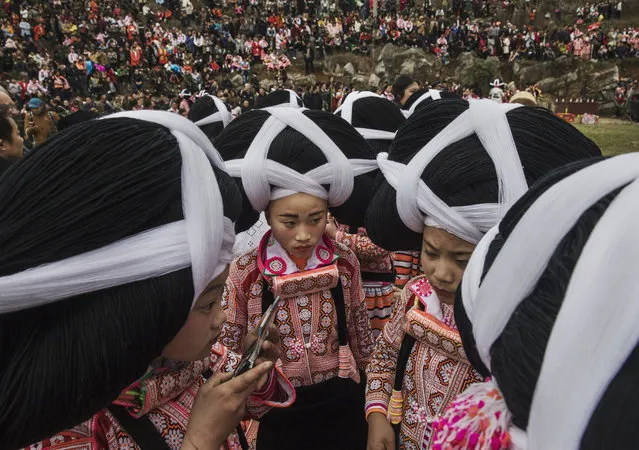
Girls of the Long Horn Miao ethnic minority group wear headdresses as they prepare gather for Tiaohua or Flower Festival as part of the Lunar New Year on February 6, 2017 in Longga village, Guizhou province, southern China. The Long Horn Miao are recognized for their declining practice of wrapping a blend of linen, wool, and the hair of their ancestors around animal horns or a wooden clip to make headdresses. Many young women say they now wear the headdresses only for special occasions and festivals, as the ornaments, which are attached by the horns to their real hair, have proved impractical for modern daily life in a fast changing world. China officially recognizes 56 different ethnic minorities, and statistics show over 7 million Chinese identifying themselves as Miao. But the small Long Horn Miao community counts only around 5000 people living in 12 villages, whose age-old traditions, language, and culture are fading. It is increasingly difficult in a modernizing China, as young people are drawn from remote rural villages to opportunities in bigger cities amongst wide-scale urbanization. Farming and labour remain the mainstays of life for the Long Horn Miao, leaving the area relatively poor in comparison with many parts of China. The government has invested significant amounts into local infrastructure and the tourism industry to try to bolster the local economy. (Photo by Kevin Frayer/Getty Images)

Girls of the Long Horn Miao ethnic minority group wear headdresses as they prepare gather for Tiaohua or Flower Festival as part of the Lunar New Year on February 6, 2017 in Longga village, Guizhou province, southern China. (Photo by Kevin Frayer/Getty Images)
Details
13 Feb 2017 00:01:00
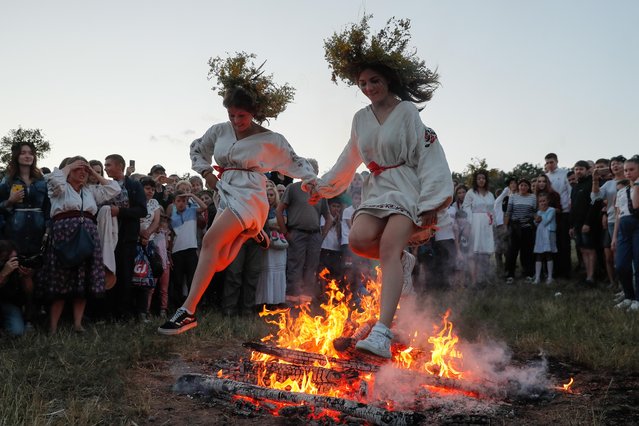
Ukrainians jump over a bonfire in Kiev, Ukraine, 06 July 2019, as they celebrate the traditional pagan holiday of Ivana Kupala. Ivana Kupala is celebrated, during the summer solstice, on the shortest night of the year, marking the beginning of summer and is celebrated in Ukraine, Belarus, Poland and Russia. People sing and dance around bonfires, play games and perform traditional rituals. Young people jump over bonfires in order to test their bravery. Couples holding hands jump over the flames to test their love. If the couple does not succeed it is predicted to split up. Traditionally, children and young unmarried women wear wreaths of wild flowers on their heads to symbolize purity. (Photo by Sergey Dolzhenko/EPA/EFE)

Ukrainians jump over a bonfire in Kiev, Ukraine, 06 July 2019, as they celebrate the traditional pagan holiday of Ivana Kupala. Ivana Kupala is celebrated, during the summer solstice, on the shortest night of the year, marking the beginning of summer and is celebrated in Ukraine, Belarus, Poland and Russia. People sing and dance around bonfires, play games and perform traditional rituals. Young people jump over bonfires in order to test their bravery. Couples holding hands jump over the flames to test their love. If the couple does not succeed it is predicted to split up. Traditionally, children and young unmarried women wear wreaths of wild flowers on their heads to symbolize purity. (Photo by Sergey Dolzhenko/EPA/EFE)
Details
13 Jan 2020 00:05:00
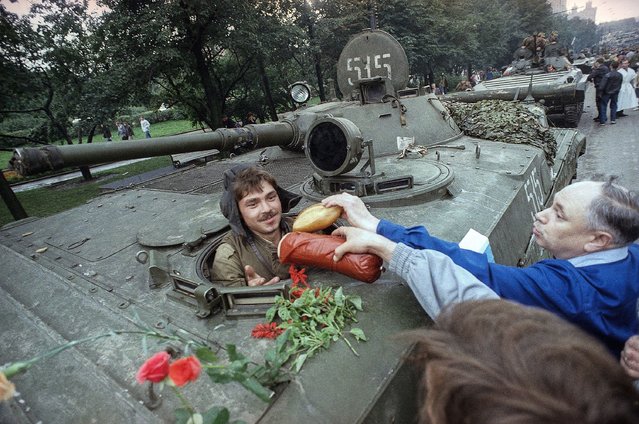
In this Wednesday, August 21, 1991 file photo, appreciative muscovites hand bread, sausages and flowers to a Soviet tank's driver who helped stop the failed hardline coup in Moscow, Russia. When a group of top Communist officials ousted Soviet leader Mikhail Gorbachev 30 years ago and flooded Moscow with tanks, the world held its breath, fearing a rollback on liberal reforms and a return to the Cold War confrontation. But the August 1991 coup collapsed in just three days, precipitating the breakup of the Soviet Union that plotters said they were trying to prevent. (Photo by Czarek Sokolowski/AP Photo/File)

In this Wednesday, August 21, 1991 file photo, appreciative muscovites hand bread, sausages and flowers to a Soviet tank's driver who helped stop the failed hardline coup in Moscow, Russia. When a group of top Communist officials ousted Soviet leader Mikhail Gorbachev 30 years ago and flooded Moscow with tanks, the world held its breath, fearing a rollback on liberal reforms and a return to the Cold War confrontation. But the August 1991 coup collapsed in just three days, precipitating the breakup of the Soviet Union that plotters said they were trying to prevent. (Photo by Czarek Sokolowski/AP Photo/File)
Details
23 Aug 2021 03:45:00
Scanning electron micrograph (SEM) of an Arabidopsis thaliana flower, also commonly known as thale cress. Some of the anthers are open, revealing pollen grains ready for dispersal. Arabidopsis was the first plant to have its entire genome sequenced and is widely used as a model organism in molecular and plant biology. Horizontal width of image is 1200 microns. Magnification 100x. (Photo by Stefan Eberhard/Wellcome Images)

Beautiful, strange and occasionally alarming pictures from the shortlist for this year’s Wellcome image awards – which celebrate the very best in science photography and imaging – from an x-ray of a bat to a micrograph of a kidney stone. The exhibition opens on 12 March at three science centres and the Museum of Science and Industry in Manchester. Photo: Scanning electron micrograph (SEM) of an Arabidopsis thaliana flower, also commonly known as thale cress. Some of the anthers are open, revealing pollen grains ready for dispersal. Arabidopsis was the first plant to have its entire genome sequenced and is widely used as a model organism in molecular and plant biology. Horizontal width of image is 1200 microns. Magnification 100x. (Photo by Stefan Eberhard/Wellcome Images)
Details
11 Mar 2014 05:58:00
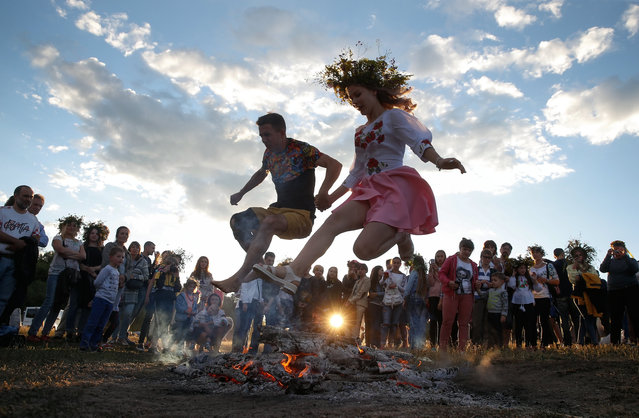
Ukrainians jump over a fire in Kiev, Ukraine, 06 July 2017, as they celebrate the traditional pagan holiday of Ivana Kupala. Ivana Kupala is celebrated, during the summer solstice, on the shortest night of the year, marking the beginning of summer and is celebrated in Ukraine, Belarus, Poland and Russia on the night of 06 July. People sing and dance around bonfires, play games and perform traditional rituals. Young people jump over bonfires in order to test their bravery. Couples holding hands jump over the flames to test their love. If the couple does not succeed it is predicted to split up. Traditionally, children and young unmarried women wear wreaths of wild flowers on their heads to symbolize purity. (Photo by Sergey Dolzhenko/EPA)

Ukrainians jump over a fire in Kiev, Ukraine, 06 July 2017, as they celebrate the traditional pagan holiday of Ivana Kupala. Ivana Kupala is celebrated, during the summer solstice, on the shortest night of the year, marking the beginning of summer and is celebrated in Ukraine, Belarus, Poland and Russia on the night of 06 July. People sing and dance around bonfires, play games and perform traditional rituals. Young people jump over bonfires in order to test their bravery. Couples holding hands jump over the flames to test their love. If the couple does not succeed it is predicted to split up. Traditionally, children and young unmarried women wear wreaths of wild flowers on their heads to symbolize purity. (Photo by Sergey Dolzhenko/EPA)
Details
08 Jul 2017 09:05:00


“Sektor gaza” (Russian: Сектор газа) was a Russian rock band formed on 5 December 1987 in the city of Voronezh, Russia. Despite only semi-officially existing (due to obscene lyrics), the group remains popular in Russia today. The group name was taken from an eponymous industrial district of Voronezh (itself named for high levels of environmental contamination). Their music style could be defined as Russian punk, integrated with elements of different musical genres such as rock, rap, and Russian folk. On 4 July 2000, group leader Yuri “Hoy” Klinskih complained of strong pains in his stomach and the left side of his chest. He suffered heart failure shortly thereafter. Klinskikh died in Voronezh (Russia)at the age of 35. He is buried in the Levoberezhniy Cemetery. The group ceased to exist.

About the music video: The First Chechen War, also known as the War in Chechnya, was a conflict between the Russian Federation and the Chechen Republic of Ichkeria, fought from December 1994 to August 1996. After the initial campaign of 1994 – 1995, culminating in the devastating Battle of Grozny, Russian federal forces attempted to seize control of the mountainous area of Chechnya but were set back by Chechen guerrilla warfare and raids on the flatlands in spite of Russia's overwhelming manpower, weaponry, and air support...
Details
24 May 2012 14:38:00
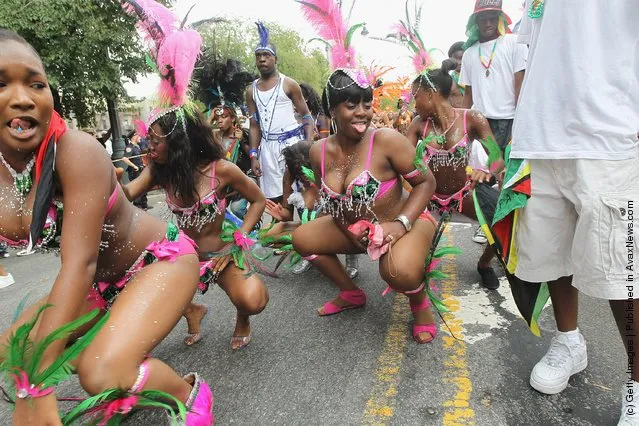
New Yorkers Celebrate At West Indian Day Parade

“The Labor Day Parade (or West Indian Carnival), is an annual celebration held on American Labor Day (the first Monday in September), in Crown Heights, Brooklyn, New York. Ms. Jessie Waddell and some of her West Indian friends started the Carnival in Harlem in the 1920s by staging costume parties in large enclosed places like the Savoy, Renaissance and Audubon Ballrooms due to the cold wintry weather of February. This is the usual time for the pre-Lenten celebrations held in most countries around the world. However, because of the very nature of Carnival, and the need to parade in costume to music, indoor confinement did not work well. The earliest known Carnival street parade was held on September 1, 1947. The Trinidad Carnival Pageant Committee was the founding force behind the parade, which was held in Harlem. The parade route was along Seventh Avenue, starting at 110th St.” – Wikipedia

Photo: A reveler looks on during the West Indian-American Day Parade September 5, 2011 in the Brooklyn borough of New York City. More than 2 million spectators were expected to attend the celebration of Caribbean culture. (Photo by Mario Tama/Getty Images)
Details
06 Sep 2011 11:18:00