Loading...
Done


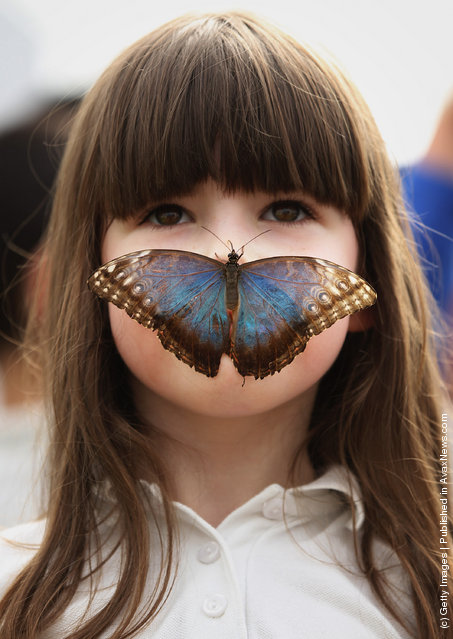
A girl allows a butterfly to be placed on her nose at the Sensational Butterflies exhibition at the Natural History Museum on April 6, 2011 in London, England. The exhibition is divided up into five sensory zones exploring how butterflies see, hear, taste, smell and touch. The display containing hundreds of butterflies runs from April 12 to September 11, 2011. (Photo by Peter Macdiarmid/Getty Images)
Details
07 Apr 2011 08:02:00


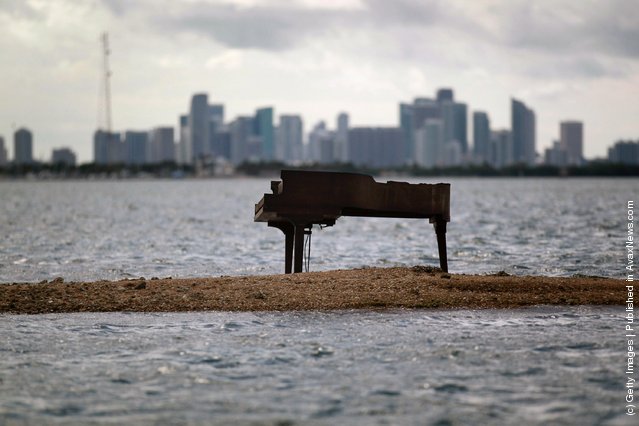
With the city of Miami skyline behind it a grand piano is seen on a sandbar in Biscayne Bay on January 26, 2011 in Miami, Florida. It's unknown how or why the heavy musical instrument was on the sandbar but some were speculating it was part of a music video production. The piano was charred from being burned. (Photo by Joe Raedle/Getty Images)
Details
27 Jul 2011 12:51:00
Leviathan By Anish Kapoor

A single object, a single shape, a single colour,' is how Anish Kapoor summed up Leviathan, his response to the Monumenta challenge this year. Radically departing from Christian Boltanski’s busy collage-like approach in Personnes for Monumenta 2010, Kapoor has filled the 13,500 square metre space with a single cavernous entity which surges through the Grand Palais roof.
Details
06 May 2014 13:11:00
Stunning images capture the tribes of Papua New Guinea during a gathering of clans. (Photo by Trevor Cole/Media Drum World)

These powerful images capture the spear-wielding tribes of Papua new Guinea who believe they are possessed with the spirit of the crocodile. They show how the Kangunaman clansmen scar their backs to resemble reptile scales while the Huli Wigmen wear elaborate headdresses to signal they are ready for battle. (Photo by Trevor Cole/Media Drum World)
Details
05 May 2018 00:05:00
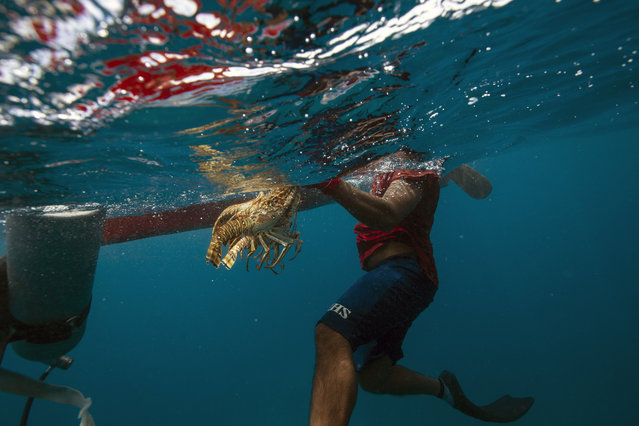
In this September 9, 2018 photo, a diver holds onto his catch of lobsters during a fishing journey in the Miskito coast near Cay Savannah, Honduras. A diver makes 75 lempiras ($3) per pound of lobster. An average 10-pound daily haul of lobster is a windfall for people in one of the most impoverished regions of the Americas, so many take the risk, and many suffer for it. (Photo by Rodrigo Abd/AP Photo)

In this September 9, 2018 photo, a diver holds onto his catch of lobsters during a fishing journey in the Miskito coast near Cay Savannah, Honduras. A diver makes 75 lempiras ($3) per pound of lobster. An average 10-pound daily haul of lobster is a windfall for people in one of the most impoverished regions of the Americas, so many take the risk, and many suffer for it. (Photo by Rodrigo Abd/AP Photo)
Details
23 Jan 2019 00:01:00
Aluminum Wire Sculptures By Seung Mo Park

Korean artist Seung Mo Park continues to amaze with his astonishingly crafted figurative sculptures made with tightly wrapped layers of aluminum wire based on fiberglass forms. The works shown here are part of the Brooklyn-based artist’s Human series where he recreates the delicate wrinkles and folds of clothing as well as the sinuous musculature of the human body in metallic layers remeniscent of tree rings. He’s also sculpted bicycles, musical insturments and other forms as part of his Object series.
Details
17 Jan 2014 12:02:00
Precious Metal By Yoav Kotik

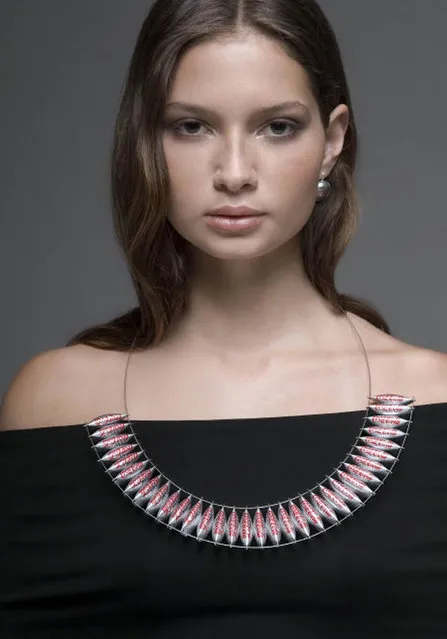
Jewelry from packaging: Yoav Kotik’s rings, bracelets, necklaces and pendents are made from metal bottle caps. Yoav Kotik, the designer of "Precious metal" jewellery line, is a graduate of the "Bezalel academy of art and design" in Jerusalem. Yoav is a member of the Zik group. He frequently leads Master classes in the field of sculpture and design in recycled materials in academic institutes such as the "Shenkar academy of design" the "Bezalel academy" and the "Wizo academy". His works were presented in galleries across Israel, the UK, the Netherland and Japan.
Details
07 Feb 2014 13:45:00


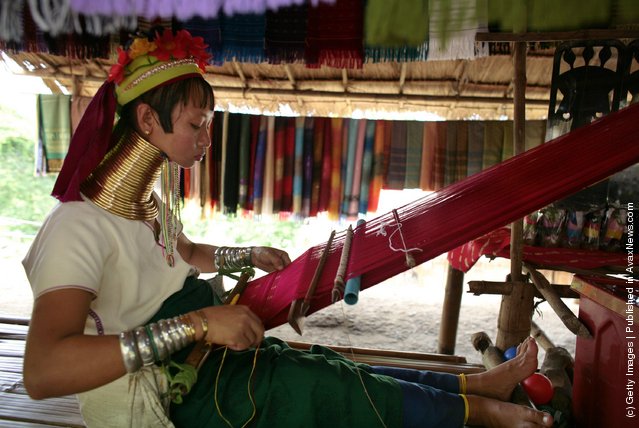
Mah Chan, a Long Neck Padaung hill tribe woman weaves a scraf for sale to tourists in a small village where 30 familes live July 13, 2006 in Chiang Dao, Thailand. All the Long Neck villages are set up for tourists and just over a year ago the hill tribe members were hand picked to move closer to Chiang Mai from more remote communities so that they could be more accessible. The Padaung women famously wear brass rings around their necks, beginning at five-years-old, to distort the growth of their collarbones and making them look like they have long necks. They are originally from eastern Burma near the Thailand border. (Photo by Paula Bronstein/Getty Images)
Details
19 Apr 2011 11:56:00