Loading...
Done
Dancers attend a dress rehearsal. (Photo by Hannibal Hanschke/Reuters)

Dancers attend a dress rehearsal for the new grand show “THE WYLD” at Friedrichstadt-Palast in Berlin October 2, 2014. Ten choreographers are working with 60 dancers from the world's largest show ballet company to create the flamboyant stage spectacle. The show's name, “THE WYLD”, represents human nature in its diversity and the wilderness of the big city – in this case, Berlin. The premiere of the 10.6 million euro ($13.5 million) show, the largest production budget in the 95-year history of Friedrichstadt-Palast, is on October 23, 2014. (Photo by Hannibal Hanschke/Reuters)
Details
24 Oct 2014 12:03:00
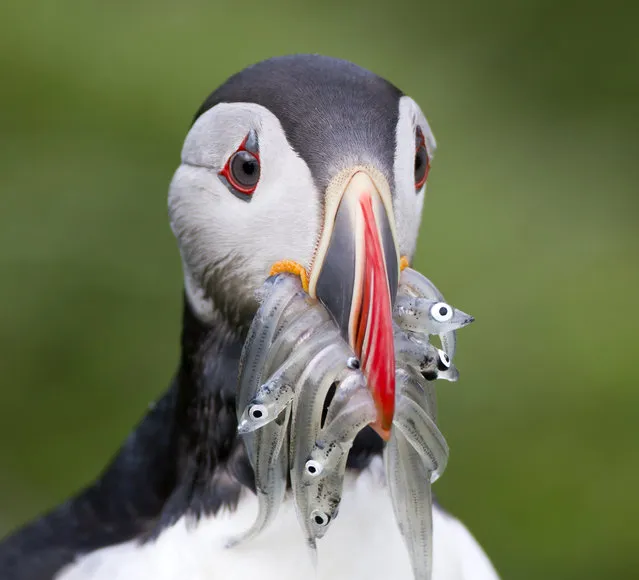
Atlantic Puffin Is AKA Puffins Or Puffin Birds

The Atlantic Puffin is definitely a curious-looking bird. The special coloring that this bird develops for the breeding season in the spring is very reminiscent of tropical birds. The bright colors of the beak and the markings around the eyes serve no particular advantage and have evolved as a result of sexual selection. However, Puffins don’t look that pretty all year round. They shed all these festive colors in partial moult after the breeding season is over. They lose the ornaments around their eyes, their face becomes darker, and their beak becomes very different. The natural habitat of these birds is the cold waters of the North Atlantic Ocean.
Details
12 Nov 2014 13:40:00
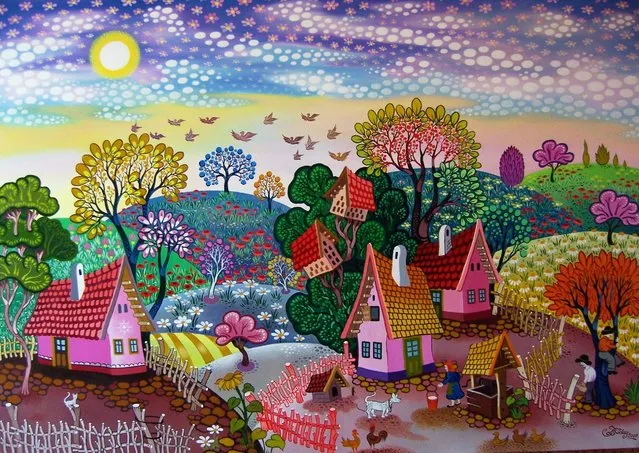
Painting By Koday Laszlo

Laszlo Koday was born in Hungary in 1945. In 1970 he began as a self-tought painter. The life and work of Henri Rousseau made a deep impression on him. His pictures are fairy tales expressed by pictorial means, human, animal and nature are equally important in them. There are bright, with unmixed pure colours, compositions wich spread calmness and gaiety. Kaday's works are know not only in Hungary but in many countries and are included in many private and public collections. His paintings can be found in galleries abroad, for example the GINA Gallery.
Details
23 Jul 2013 09:00:00
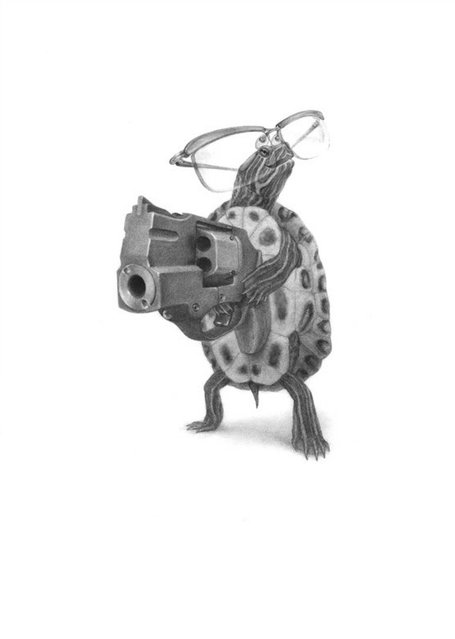
Gun-Toting Animals By Xiau Fong
Tempering the violence of modern weaponry with charmingly rendered creatures, artist Xiau-Fong Wee captures a dark humor in her quirky drawings. While some of the weapons appear terrifyingly realistic, others such as in the ray gun wielding bunny portrait, speaks more to the fantastical worlds of science fiction. The anthropomorphic dispositions of the spectacle-wearing creatures also range in merry reverie to stern seriousness, adding to the delightful nature of these well-executed portraits. View more of the drawings below.
Details
27 Jul 2013 08:08:00
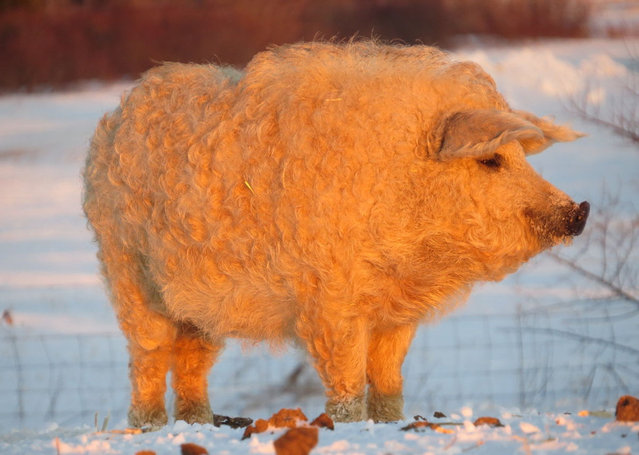
Mangalitsa The Hairy Pig

When you look at the picture of a furry pig that resembles a sheep from a distance, you may think that this may be the result of the work of some crazy scientist that tinkered with the pig’s genome. However, in this case, this is not true. Mangalica is a natural breed of pigs, which were bred in Europe for their lard. This breed of pigs is very unique, since the only other breed of pigs which had a long coat was Loncolnshire Curly Coat, which is now extinct. In the past, these pigs were quite popular, since they were able to produce a lot of lard. However, when the demand for pig lard dwindled, the population of these pigs rapidly decreased, making it a “rare breed”.
Details
01 Dec 2014 13:42:00
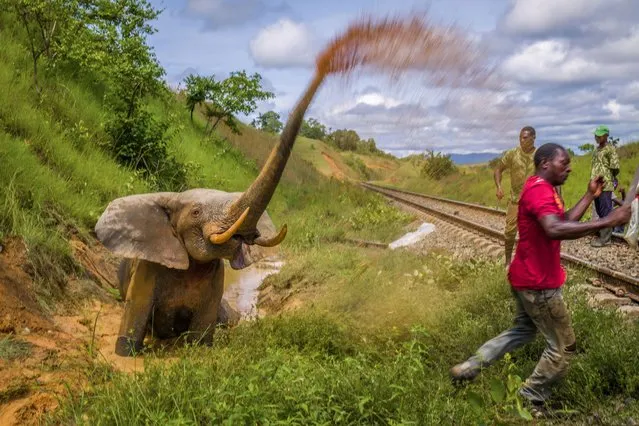
Grand prize winner: environmental photographer of the year 2023; also 1st place in the humanity v nature category; and winner of the 2023 public award. Lopé national park, Gabon, 2021. An angry elephant tries to defend itself after it was hit by a train that crosses paths the animals use within Lopé national park. Park officials decided the elephant was too severely injured to be saved. After it was killed, the park director distributed the meat to local people. As the forest loses its carrying capacity to sustain its megafauna, this kind of human-wildlife conflict is increasing. (Photo by Jasper Doest/Environmental Photography Award)

Grand prize winner: environmental photographer of the year 2023; also 1st place in the humanity v nature category; and winner of the 2023 public award. Lopé national park, Gabon, 2021. An angry elephant tries to defend itself after it was hit by a train that crosses paths the animals use within Lopé national park. Park officials decided the elephant was too severely injured to be saved. After it was killed, the park director distributed the meat to local people. As the forest loses its carrying capacity to sustain its megafauna, this kind of human-wildlife conflict is increasing. (Photo by Jasper Doest/Environmental Photography Award)
Details
09 Jul 2023 03:06:00
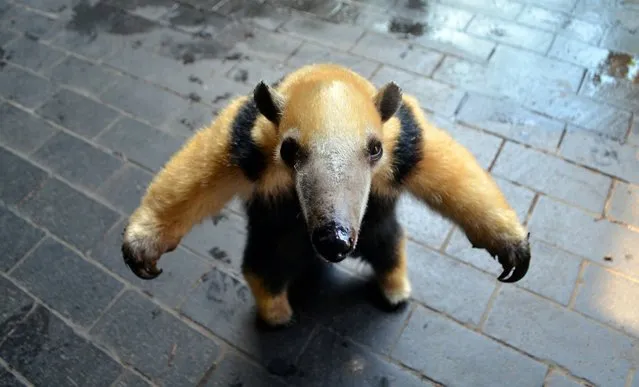
London Zoo photo of Tammy the tree-climbing anteater who is to be given her own minder during a series of late night events at ZSL London Zoo this summer. The twelve-year-old tree-climbing anteater is famed for her friendly disposition, but with naturally poor eyesight zookeepers will be giving Tammy help to steer her past any errant feet in the free-roaming exhibit. (Photo by ZSL London Zoo/PA Wire)

London Zoo photo of Tammy the tree-climbing anteater who is to be given her own minder during a series of late night events at ZSL London Zoo this summer. The twelve-year-old tree-climbing anteater is famed for her friendly disposition, but with naturally poor eyesight zookeepers will be giving Tammy help to steer her past any errant feet in the free-roaming exhibit. (Photo by ZSL London Zoo/PA Wire)

P.S. All pictures are presented in high resolution. To see Hi-Res images – just TWICE click on any picture. In other words, click small picture – opens the BIG picture. Click BIG picture – opens VERY BIG picture (if available; this principle works anywhere on the site AvaxNews)
Details
08 Jun 2013 11:16:00
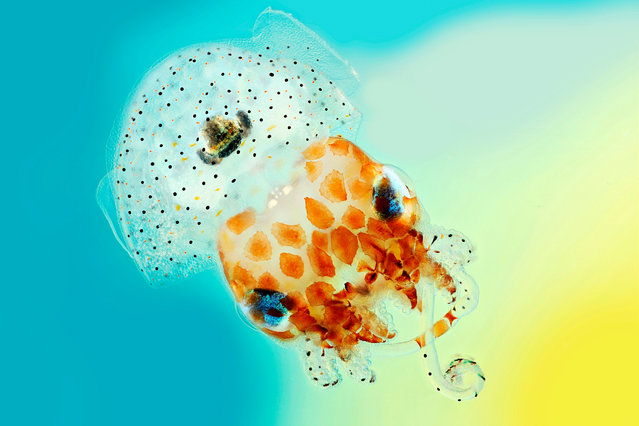
With its huge eyes, comical name and diminutive size, Mark R. Smith’s image of a baby Hawaiian bobtail squid can’t help but raise a smile. A curiously endearing creature, the cephalopod is just 1.5cm across, its mantle cavity bearing more than a passing resemblance to a rather natty shower cap. But it is also a beautiful example of symbiosis – nature’s version of “I’ll scratch your back if you scratch mine” – for on the underside of the squid is a light organ which houses bioluminescent bacteria. The squid offers the bacteria protection and food, while the bacteria emit a glow – a handy trait that the squid uses to offset its silhouette, helping it to evade predators in the depths below. Mark R. Smith’s entry combines several images of a Hawaiian bobtail squid with different focus lengths to create a final picture with greater depth of field than normal. (Photo by Mark R. Smith/Wellcome Images/Macroscopic Solutions)

With its huge eyes, comical name and diminutive size, Mark R. Smith’s image of a baby Hawaiian bobtail squid can’t help but raise a smile. A curiously endearing creature, the cephalopod is just 1.5cm across, its mantle cavity bearing more than a passing resemblance to a rather natty shower cap. But it is also a beautiful example of symbiosis – nature’s version of “I’ll scratch your back if you scratch mine” – for on the underside of the squid is a light organ which houses bioluminescent bacteria. The squid offers the bacteria protection and food, while the bacteria emit a glow – a handy trait that the squid uses to offset its silhouette, helping it to evade predators in the depths below. Mark R. Smith’s entry combines several images of a Hawaiian bobtail squid with different focus lengths to create a final picture with greater depth of field than normal. (Photo by Mark R. Smith/Wellcome Images/Macroscopic Solutions)
Details
08 Mar 2017 00:05:00