Loading...
Done
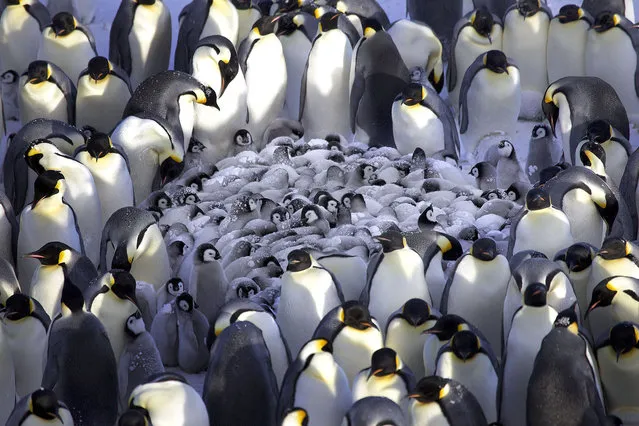
Emperor penguins gathered together to keep their chicks warm in these pictures. Marine scientist Frederique Oliver snapped the protective parents in Antarctica as they huddled against the huge winds.The adorable birds have to battle temperatures on -20 degrees Celsius as well as winds of up to 40 knots on the ice. (Photo by Frederique Oliver/Caters News)

Emperor penguins gathered together to keep their chicks warm in these pictures. Marine scientist Frederique Oliver snapped the protective parents in Antarctica as they huddled against the huge winds.The adorable birds have to battle temperatures on -20 degrees Celsius as well as winds of up to 40 knots on the ice. (Photo by Frederique Oliver/Caters News)
Details
18 Feb 2015 13:24:00
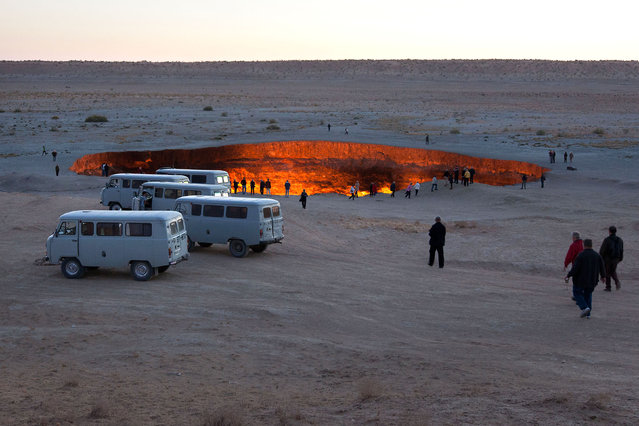
The door to hell. (Photo by William Keeping/Caters News)

“These are the astonishing images of the very aptly named door to hell, a fiery crater thats baffled scientist and has been flaming away for more than 40 years. The crater is 230-feet wide and situated near Derweze village in Turkmenistan”. – Caters News. (Photo by William Keeping/Caters News)
Details
07 Mar 2014 12:08:00
In this Thursday, February 19, 2015 photo, participants at a seminar on edible insects taste a Cricket Consomme at Le Cordon Bleu cooking school in Bangkok, Thailand. A group of chefs and food scientists at the esteemed French school's branch in Bangkok spent the week simmering, sautéing and grilling insects to extract innovative flavors they say could open a new frontier for the world of gastronomy. (Photo by Sakchai Lalit/AP Photo)

In this Thursday, February 19, 2015 photo, participants at a seminar on edible insects taste a Cricket Consomme at Le Cordon Bleu cooking school in Bangkok, Thailand. A group of chefs and food scientists at the esteemed French school's branch in Bangkok spent the week simmering, sautéing and grilling insects to extract innovative flavors they say could open a new frontier for the world of gastronomy. (Photo by Sakchai Lalit/AP Photo)
Details
22 Feb 2015 11:15:00
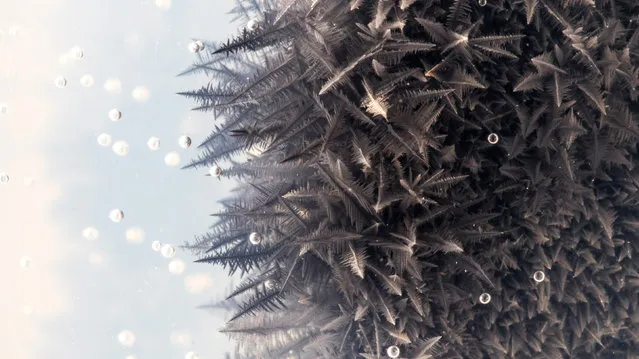
Zinc reacting with lead nitrate in a soft gel to form lead crystals. (Photo by Yan Liang/Caters News)

These beautiful shots may look like works of modern art – but they are actually close-ups of chemical reactions. The works were snapped with the help of a group of scientists from the University of Science and Technology of China (USTC) in Anhui, China. Here: Zinc reacting with lead nitrate in a soft gel to form lead crystals. (Photo by Yan Liang/Caters News)
Details
23 Oct 2014 11:33:00
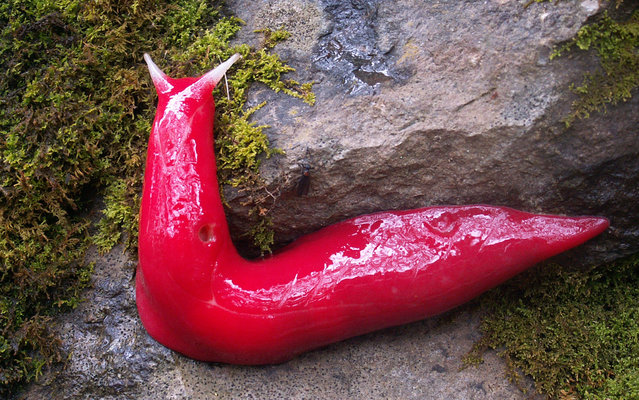
It would seem to be something you'd see only in a cartoon or at a Phish concert, but according to park rangers in New South Wales, Australia, dozens of giant, fluorescent pink slugs have been popping up on a mountaintop there. (Photo by Michael Murphy/AFP Photo/NSW Environment Office)

It would seem to be something you'd see only in a cartoon or at a Phish concert, but according to park rangers in New South Wales, Australia, dozens of giant, fluorescent pink slugs have been popping up on a mountaintop there. The eight-inch creatures have been spotted only on Mount Kaputar, a 5,000-foot peak in the Nandewar Range in northern New South Wales. Scientists believe the eye-catching organisms are survivors from an era when Australia was home to rainforests. A series of volcanoes, millions of years of erosion and other geological changes “have carved a dramatic landscape at Mount Kaputar”, the park service wrote on its Facebook page, and unique arid conditions spared the slugs from extinction. (Photo by Michael Murphy/AFP Photo/NSW Environment Office)
Details
01 Jun 2013 14:09:00
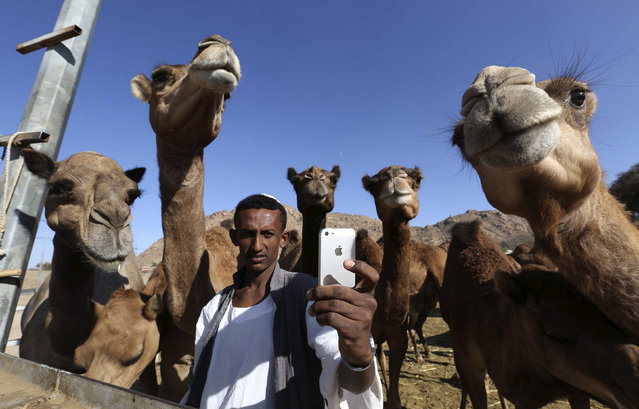
A man takes a “selfie” with camels at a farm in Taif November 1, 2014. Saudi Arabia said late on Wednesday it had detected six new cases of the deadly Middle East Respiratory Syndrome (MERS) in 24 hours, the biggest daily jump for months with officials blaming lax hospital procedures. (Photo by Mohamed Alhwaity/Reuters)

A man takes a “selfie” with camels at a farm in Taif November 1, 2014. Saudi Arabia said late on Wednesday it had detected six new cases of the deadly Middle East Respiratory Syndrome (MERS) in 24 hours, the biggest daily jump for months with officials blaming lax hospital procedures. Scientists are not sure of the origin of the virus, but several studies have linked it to camels and some experts think it is being passed to humans through close physical contact or through the consumption of camel meat or camel milk. (Photo by Mohamed Alhwaity/Reuters)
Details
08 Nov 2014 12:33:00
The possible surface of TRAPPIST-1f, one of seven newly discovered planets in the TRAPPIST-1 system that scientists using the Spitzer Space Telescope and ground based telescopes have discovered. (Photo by Reuters/NASA/JPL-Caltech)

The possible surface of TRAPPIST-1f, one of seven newly discovered planets in the TRAPPIST-1 system that scientists using the Spitzer Space Telescope and ground based telescopes have discovered. (Photo by Reuters/NASA/JPL-Caltech)
Details
07 Mar 2017 00:02:00
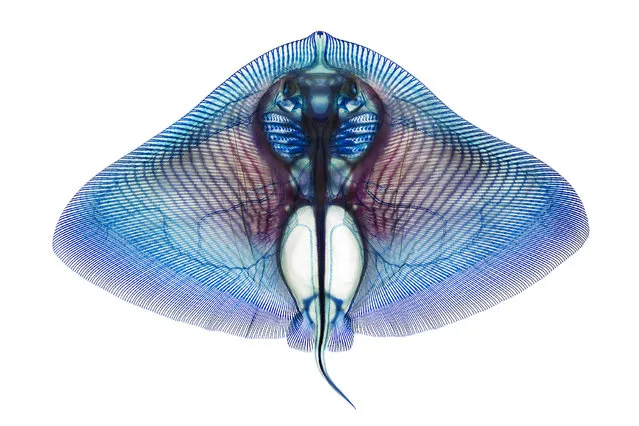
This image of the butterfly ray (Gymnura crebripunctata) helped scientists study the joints in its wings. (Photo by Adam Summers)

The photographs feature fish that have been specially treated to make the stained skeletal tissues visible through the skin and flesh. The technique, developed by Dr. Adam Summers, uses dyes, hydrogen peroxide, a digestive enzyme and glycerin to make the flesh seem to disappear. Photo: This image of the butterfly ray (Gymnura crebripunctata) helped scientists study the joints in its wings. (Photo by Adam Summers)
Details
23 Feb 2014 14:53:00