Loading...
Done
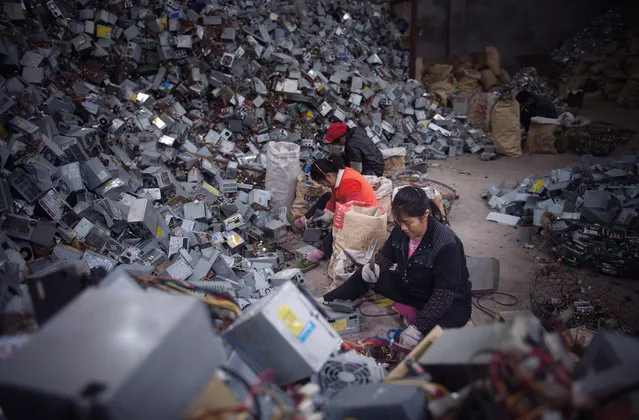
“The sustainable development goals cannot be met unless waste management is addressed as a priority”, says UK waste management charity Waste Aid. “E-waste is one of the fastest growing categories of the 7-10bn tonnes of waste produced globally every year”, adds director Mike Webster. “In our view, decent waste management is a basic right and we want governments around the world take this issue much more seriously – in 2012 only 0.2% of international aid went on improving solid waste management – it’s just not enough”. (Photo by Kai Loeffelbein/laif Agentur)

Sustainable development goal target 12.5 is to reduce waste. But with a planet increasingly dependent on technology, is that even possible? As of today, over 30m tonnes of electronic waste has been thrown out so far this year, according to the World Counts. Most e-waste is sent to landfills in Asia and Africa where it is recycled by hand, exposing the people who do it to environmental hazards. Kai Loeffelbein’s photographs of e-waste recycling in Guiyu, southern China show what happens to discarded computers. (Photo by Kai Loeffelbein/laif Agentur)
Details
19 Oct 2016 12:14:00
In the hours 41-year-old Ralph Savelsberg is not working as a physicist for the Dutch Ministry of Defence, he is recreating classic vehicles in everyones favourite bricks. The Lego mad film buff has lived in the UK for the last few years building every famous car in entertainment you can imagine – And the characters to match! From Del Boys Reliant Regal to Chitty Chitty Bang Bang and the Batmobile, has Ralph handmade the most complete set of popular vehicles ever? Ralph said: Building a LEGO set is fun, but Ive always preferred to build my own models. Here: “Ghostbusters”. (Photo by Ralph Savelsberg/Caters News)

In the hours 41-year-old Ralph Savelsberg is not working as a physicist for the Dutch Ministry of Defence, he is recreating classic vehicles in everyones favourite bricks. Ralph said: Building a LEGO set is fun, but I've always preferred to build my own models. Here: “Ghostbusters”. (Photo by Ralph Savelsberg/Caters News)
Details
29 Nov 2016 13:21:00
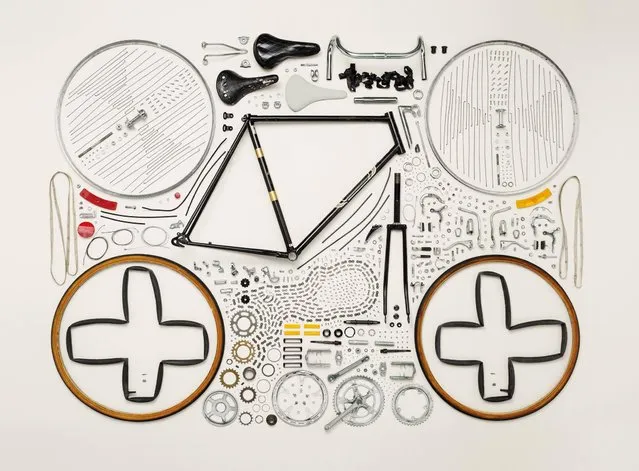
Deconstructed Objects By Todd McLellan

It is simply staggering how complicated some items really are. We never think about it, but some items that we use every day consist of hundreds of parts meticulously put together and working perfectly. Todd McLellan is a photographer who based his newest book “Things Come Apart” on the complexity of various old and new tech. By carefully taking apart various items and arranging all of the parts in perfect order, Todd has allowed us not only to look inside various appliances, but also to appreciate the astounding complexity of these items. Just like the human mind, we are so used to seeing and talking with people that we forget just how complicated their minds really are. It would be great if we could “take apart” the human mind in order to gain some insight into the person’s thoughts and desires. However, very few people are capable of doing it, while the rest will remain blind to the obvious. (Photo by Todd McLellan)
Details
15 Nov 2014 12:30:00
An employee of Paris city Hall removes padlocks clipped by lovers on the fence of the Pont des Arts over the River Seine in Paris, December 9, 2014. For years, visiting couples have hung brass padlocks on the iron grills lining the city's bridges to symbolise their undying love – they write their names on the locks, then toss the key into the Seine below. (Photo by Philippe Wojazer/Reuters)

An employee of Paris city Hall removes padlocks clipped by lovers on the fence of the Pont des Arts over the River Seine in Paris, December 9, 2014. For years, visiting couples have hung brass padlocks on the iron grills lining the city's bridges to symbolise their undying love – they write their names on the locks, then toss the key into the Seine below. About 700,000 love locks are added every few months and Paris officials say they are damaging the bridges and threatening safety because of the added weight. (Photo by Philippe Wojazer/Reuters)
Details
10 Dec 2014 12:24:00
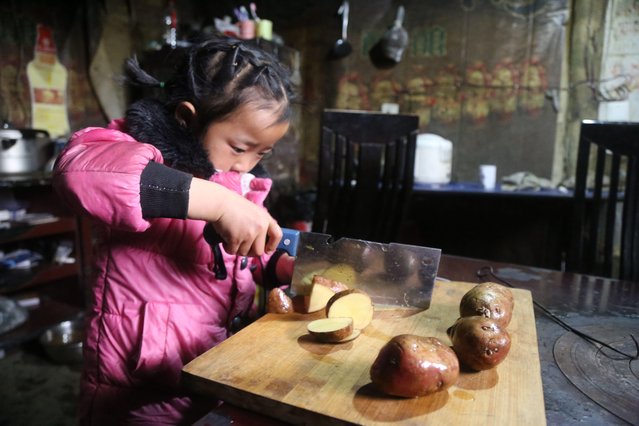
5-year-old Chinese girl Wang Anna prepares meals for her grandmother and great-grandmother at home in Zhuyuan village, Guizhou province, China on March 3, 2017. (Photo by Imaginechina/Rex Features/Shutterstock)

5-year-old Chinese girl Wang Anna prepares meals for her grandmother and great-grandmother at home in Zhuyuan village, Guizhou province, China on March 3, 2017. Chinese girl called Wang Anna, 5, takes care of her ill grandmother and 92-year-old great-grandmother on her own every day in a mountainous village in Zhima town, Zunyi city, southwest China's Guizhou province. Her father went to jail before she was born and her mother remarried after gave birth to her. Although she is just five years old, she started to shoulder the responsibility to look after ill grandmother and elderly great-grandmother. (Photo by Imaginechina/Rex Features/Shutterstock)
Details
09 Mar 2017 00:05:00
CGAP Photo Contest – South Asia Regional Winner: Bricks Worker, Bangladesh. A private enterprise worker is working at a brick field. These small businesses are creating new job opportunities for many poor people. (Photo by Moksumul Haque)

The shoemaker in Turkey, the potato seller in Vietnam, and the weaver in Bolivia are among the billions of low-income entrepreneurs who make the world go round. They are also the type of people who can benefit significantly from microfinance. Every year, the Consultative Group To Assist The Poor (or CGAP) hosts a photo contest asking entrants to submit photos based around the idea of microfinance.The purpose of the contest is to give amateur and professional photographers a chance to show the different ways that poor households manage their financial lives and make their lives better through financial inclusion. Photo: South Asia Regional Winner – “Bricks Worker”, Bangladesh. A private enterprise worker is working at a brick field. These small businesses are creating new job opportunities for many poor people. (Photo by Moksumul Haque)
Details
14 Aug 2014 10:58:00
A Belgian shrimp fisherman rides a carthorse to haul a net out in the sea to catch shrimps during low tide at the coastal town of Oostduinkerke, Belgium July 3, 2015. (Photo by Yves Herman/Reuters)

A Belgian shrimp fisherman rides a carthorse to haul a net out in the sea to catch shrimps during low tide at the coastal town of Oostduinkerke, Belgium July 3, 2015. At the end of each fishing session, the fishermen and their mounts leave the water to empty the net's contents into two wicker baskets fixed on each side of the horse. This traditional method of catching shrimps along the North Sea coast, which dates back to some 500 years, attracts tourists every summer. In 2013, Unesco recognized shrimp fishing on horseback as an intangible cultural heritage. (Photo by Yves Herman/Reuters)
Details
04 Jul 2015 11:29:00
Plants grow on houses in the abandoned fishing village of Houtouwan on the island of Shengshan July 26, 2015. (Photo by Damir Sagolj/Reuters)

Plants grow on houses in the abandoned fishing village of Houtouwan on the island of Shengshan July 26, 2015. Just a handful of people still live in a village on Shengshan Island east of Shanghai that was once home to more than 2,000 fishermen. Every day hundreds of tourists visit Houtouwan, making their way on narrow footpaths past tumbledown houses overtaken by vegetation. The remote village, on one of more than 400 islands in the Shengsi archipelago, was abandoned in the early 1990s as first wealthy residents then others moved away, aiming to leave problems with education and food delivery behind them. (Photo by Damir Sagolj/Reuters)
Details
30 Jul 2015 12:24:00