Loading...
Done
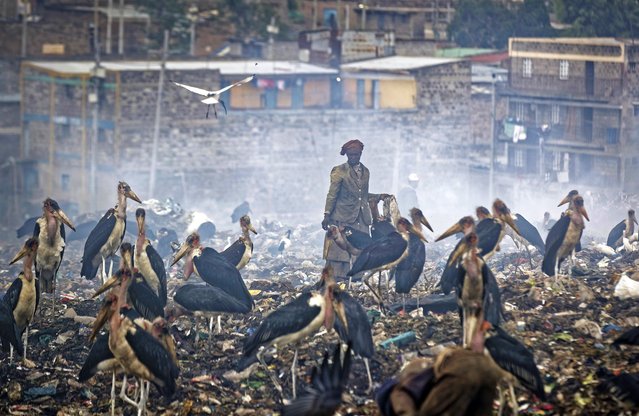
In this photo taken Wednesday, December 5, 2018, a woman who scavenges recyclable materials from garbage for a living is seen through a cloud of smoke from burning trash, surrounded by Marabou storks who feed on the garbage, at the dump in the Dandora slum of Nairobi, Kenya. As the world meets again to tackle the growing threat of climate change, how the continent tackles the growing solid waste produced by its more than 1.2 billion residents, many of them eager consumers in growing economies, is a major question in the fight against climate change. (Photo by Ben Curtis/AP Photo)

In this photo taken Wednesday, December 5, 2018, a woman who scavenges recyclable materials from garbage for a living is seen through a cloud of smoke from burning trash, surrounded by Marabou storks who feed on the garbage, at the dump in the Dandora slum of Nairobi, Kenya. As the world meets again to tackle the growing threat of climate change, how the continent tackles the growing solid waste produced by its more than 1.2 billion residents, many of them eager consumers in growing economies, is a major question in the fight against climate change. (Photo by Ben Curtis/AP Photo)
Details
14 Jan 2019 00:01:00
A man takes a photo of a radio antenna that's part of the Atacama Large Milimeter Array Observatory on March 12, 2013 at Llano de Chajnantor, about 43 miles (70 kilometers) from San Pedro de Atacama, Chile. The $1.5 billion ALMA facility, which had its official inauguration on March 13, is considered the world's most expensive ground-based observatory. (Photo by Felipe Trueba/EPA)

A man takes a photo of a radio antenna that's part of the Atacama Large Milimeter Array Observatory on March 12, 2013 at Llano de Chajnantor, about 43 miles (70 kilometers) from San Pedro de Atacama, Chile. The $1.5 billion ALMA facility, which had its official inauguration on March 13, is considered the world's most expensive ground-based observatory. (Photo by Felipe Trueba/EPA)
Details
03 Apr 2013 09:25:00
The British Breitling Wingwalkers, Danielle Hughes and Emily Guilding, soar above the Palm Jumeirah in Dubai at 1,500 feet (460 meters) in excess of 100mp/h, ahead of their Dubai debut performance at the 2014 UIM Skydive Dubai XCAT World Powerboating Series, on Saturday, 13th December 2014. (Photo by Katsuhiko Tokunaga/Breitling via AP Images)

The British Breitling Wingwalkers, Danielle Hughes and Emily Guilding, soar above the Palm Jumeirah in Dubai at 1,500 feet (460 meters) in excess of 100mp/h, ahead of their Dubai debut performance at the 2014 UIM Skydive Dubai XCAT World Powerboating Series, on Saturday, 13th December 2014. The British team is the only aerobatic formation display team who employ full time wingwalkers and fly their two Breitling-liveried 1930's Boeing Stearman bi-planes at Air Shows and major sporting events around the world. (Photo by Katsuhiko Tokunaga/Breitling via AP Images)
Details
13 Dec 2014 13:11:00
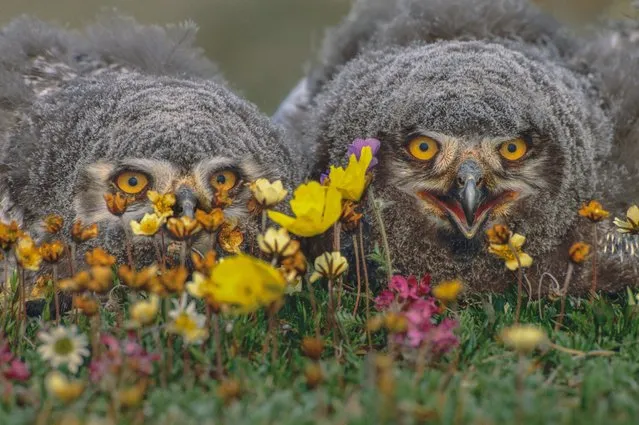
Snowy owlets (Bubo scandiacus), Arctic National Wildlife Refuge, Alaska, USA. “A pair of gray-feathered snowy owlets hunker down in the abundant flowers that flourish in the dropping-enriched soil of their nest mound”. (Photo by Art Wolfe/Art Wolfe Stock)

The photography of Art Wolfe covers the globe, capturing landscapes, wildlife, and cultures from every continent; here he talks through a selection of his favourite images. Art Wolfe is an American photographer and conservationist. His photographs have been noted by environmental advocacy groups for their “stunning” visual impact. Here: Snowy owlets (Bubo scandiacus), Arctic National Wildlife Refuge, Alaska, USA. (Photo by Art Wolfe/Art Wolfe Stock)
Details
19 Mar 2018 00:05:00
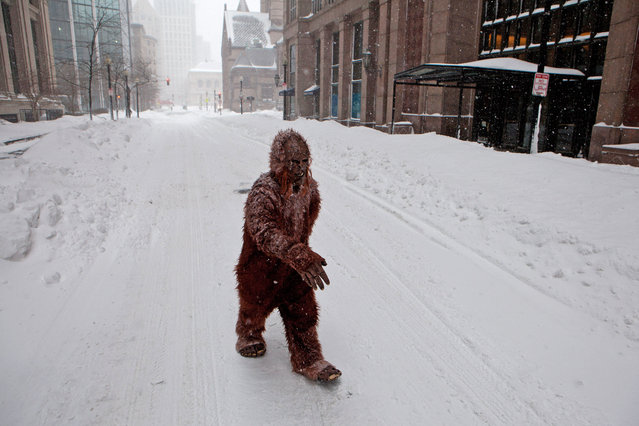
A person dressed as “bigfoot” makes their way through the strong wind and snow in the Back Bay neighborhood during a blizzard on January 27, 2015 in Boston, Massachusetts. (Photo by Kayana Szymczak/Getty Images)

A person dressed as “bigfoot” makes their way through the strong wind and snow in the Back Bay neighborhood during a blizzard on January 27, 2015 in Boston, Massachusetts. (Photo by Kayana Szymczak/Getty Images)
Details
31 Jan 2015 12:27:00
A resident looks into a newly-built giant trash can, partially buried underground, next to a street in Taiyuan, Shanxi province November 6, 2014. The trash can, which has a diameter of 1.9 meters and a depth of 2.8 meters, could contain approximately 10 cubic metres of garbage. It was built to replace an open-air garbage dump site, local media reported. (Photo by Reuters/Stringer)

A resident looks into a newly-built giant trash can, partially buried underground, next to a street in Taiyuan, Shanxi province November 6, 2014. The trash can, which has a diameter of 1.9 meters and a depth of 2.8 meters, could contain approximately 10 cubic metres of garbage. It was built to replace an open-air garbage dump site, local media reported. (Photo by Reuters/Stringer)
Details
08 Nov 2014 12:40:00
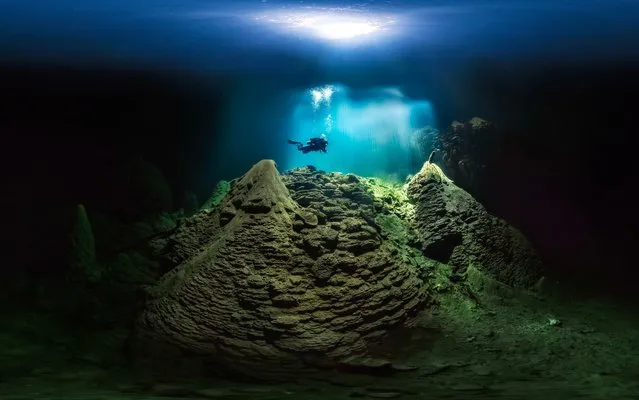
Cave Diver, Anhumas Abyss, Bonito, Brazil: The Anhumas Abyss is an underground cavern with a crystal-clear lake below, more than 260 feet (79 m) deep. A visitor must enter through a narrow opening at the top of the chamber and rappel into the cave. Snorkeling and scuba diving in the lake reveal amazing scenery. Distinctive, conical limestone stalagmites and stalactites occupy the lake and the surrounding area, some reaching 65 feet (20 m) high. “One must rappel about 235 feet (72 m) to get down into this deep lake. The photo was taken at a depth of 50 feet (15 m). It was a challenge to create the image because of the high contrast, plus the diver could not see into the darkness, making communication impossible”. (Photo by Marcio Cabral/Nature’s Best Photography Awards 2017)

Cave Diver, Anhumas Abyss, Bonito, Brazil: The Anhumas Abyss is an underground cavern with a crystal-clear lake below, more than 260 feet (79 m) deep. A visitor must enter through a narrow opening at the top of the chamber and rappel into the cave. Snorkeling and scuba diving in the lake reveal amazing scenery. Distinctive, conical limestone stalagmites and stalactites occupy the lake and the surrounding area, some reaching 65 feet (20 m) high. (Photo by Marcio Cabral/Nature’s Best Photography Awards 2017)
Details
26 Oct 2017 08:10:00
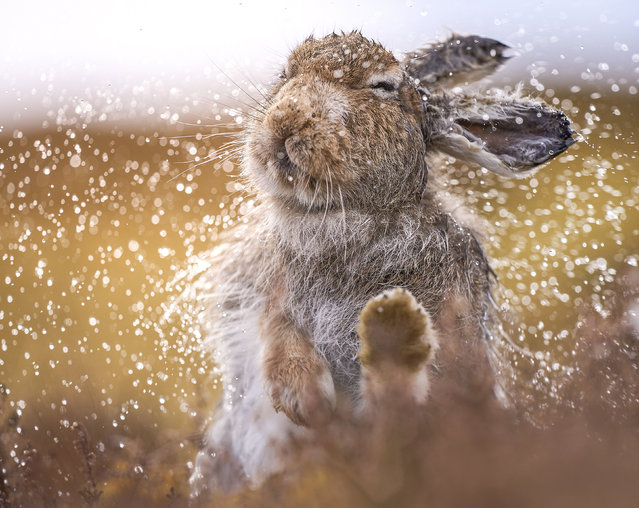
A mountain hare shakes off rain from its fur, in Findhorn Valley, Moray, Scotland in the second decade of August 2024. In summer, the hare’s coat is a grey-brown colour with a tinge of blue, making them hard to spot against the heather moorland. In winter, it changes to almost completely white for camouflage in the snow. (Photo by Will Hall/Solent News)

A mountain hare shakes off rain from its fur, in Findhorn Valley, Moray, Scotland in the second decade of August 2024. In summer, the hare’s coat is a grey-brown colour with a tinge of blue, making them hard to spot against the heather moorland. In winter, it changes to almost completely white for camouflage in the snow. (Photo by Will Hall/Solent News)
Details
25 Aug 2024 03:50:00